
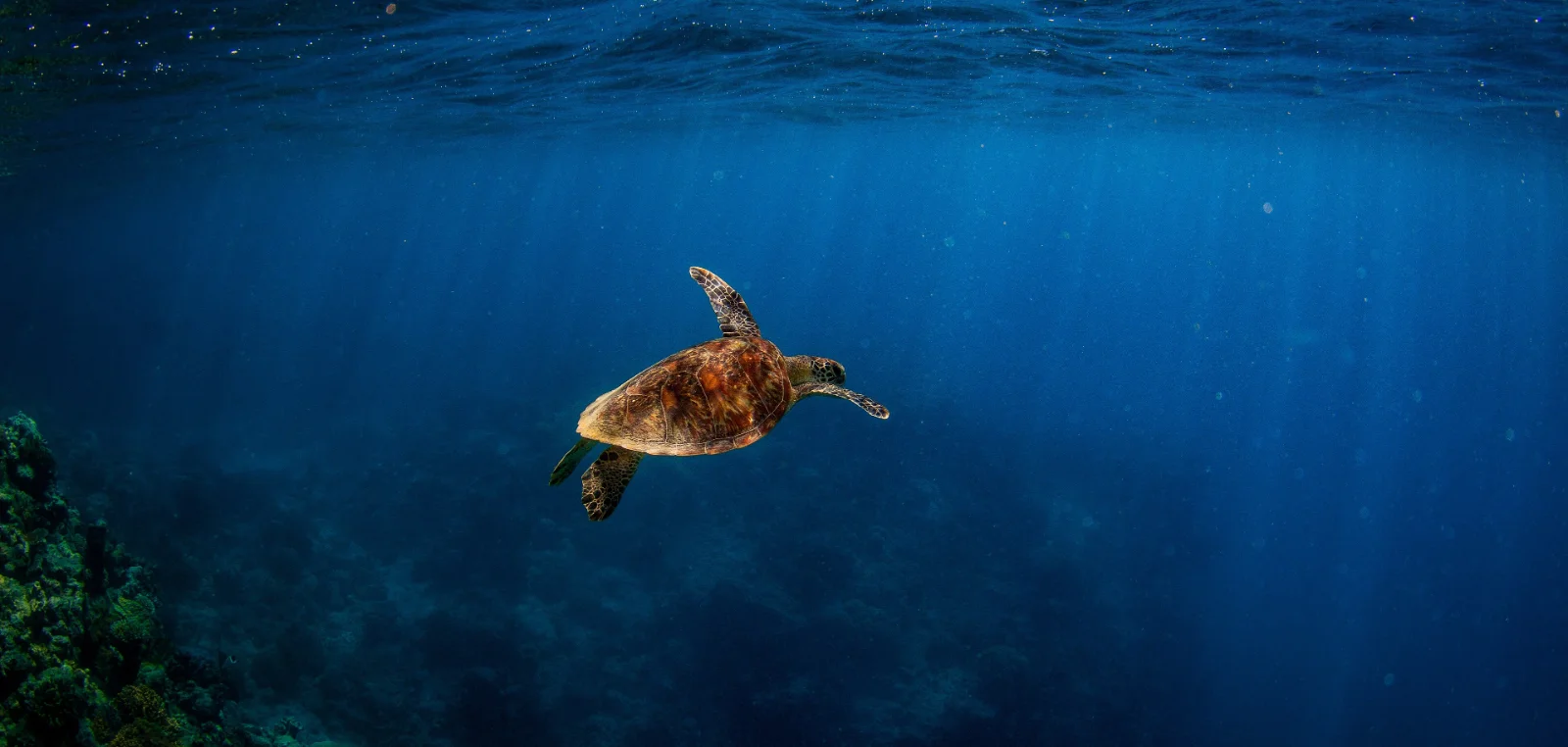
Five of the world’s seven sea turtle species use Sri Lankan water, and all five have been recorded coming ashore on a single stretch of the south coast at Rekawa. Very few beaches anywhere can say that. It is a consequence of position: the island sits at the top of the Indian Ocean with deep water close in, seagrass on the shallow shelves, and warm sand on both coasts, which covers the feeding requirements of species that otherwise have very little in common.
The five are not interchangeable and this page is organised around that. A green turtle grazing seagrass in a metre of water at Hikkaduwa and a leatherback hauling out at Rekawa in April are different animals doing different things in different places, and the only thing a single line about turtles in Sri Lanka achieves is to blur them. Every entry below is a record in the Wildseer database with its own place and season.
The five species, and where each one is
One card per species, with every place it is recorded stacked inside it. Note how differently they are distributed: the green turtle is on nine coasts and Common at one of them, the leatherback is on three and Rare or Very rare at all of them.
31 places
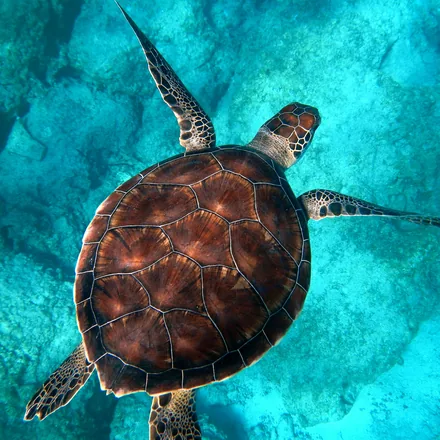
Green Sea Turtle Common
Chelonia mydas
The great grazing turtle of the tropics, the only sea turtle that turns vegetarian as an adult.
Hikkaduwa: The shallow reef and the beach shallows, where turtles come in to be fed by hotels. Best: November to April. Turtles here are habituated and hand fed, which is why they are so easy to see. That is a fed animal, not a wild encounter, and it is worth knowing the difference.
Trincomalee: Shallow reef and seagrass at Pigeon Island and Nilaveli. Best: May to September.
Kalpitiya: Bar Reef and the surrounding shallows. Best: November to April.
Rekawa: The nesting beach, on the guided night watch from the visitor centre. Best: February to July, from 20:00. A genuine wild nesting beach with in situ nest protection, not a hatchery. Expect to wait, and expect no torches.
Tangalle: The beaches between Tangalle and Rekawa at night. Best: February to July. The same nesting coast as Rekawa, with less structure around it. Do not use white light on a nesting beach.
Arugam Bay: Shallow water off the bay and the beaches north towards Pottuvil. Best: May to September.
Mannar: Seagrass beds in the gulf. Best: December to April. The seagrass that feeds the dugongs feeds the green turtles too.
Great Basses: Resting on ledges and feeding on the reef. Best: March to April.
Jaffna: Shallow water and seagrass off the islands and the northern shore. Best: Year round.
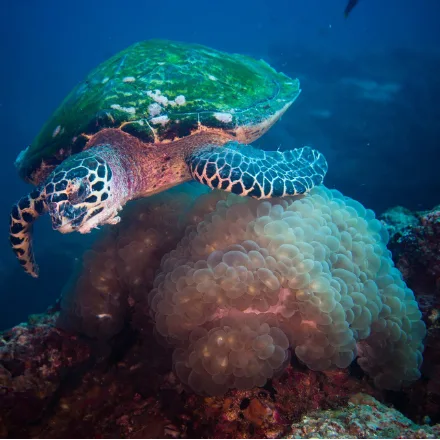
Hawksbill Turtle Regular Critically Endangered
Eretmochelys imbricata
The reef's sponge specialist, its beautiful shell also the reason it was hunted to the edge.
Trincomalee: Reef at Pigeon Island and off Nilaveli. Best: May to September. The single best place in Sri Lanka to see one.
Kalpitiya: Bar Reef Marine Sanctuary. Best: November to April.
Hikkaduwa: Coral on the fringing reef. Best: November to April.
Great Basses: The reef structure and its overhangs. Best: March to April.
Mannar: Reef and rubble in the Gulf, and around the Adam's Bridge shallows. Best: Year round.
Tangalle: Offshore reef and rubble rather than the nesting beaches. Best: Year round.
Rekawa: The nesting beach, on the night watch. Best: February to July. Historically nested heavily on the south coast and was hunted out for tortoiseshell.
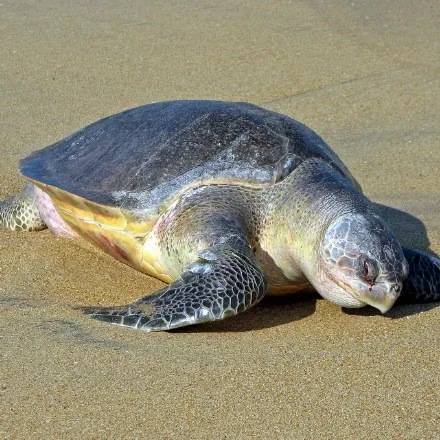
Olive Ridley Turtle Occasional Vulnerable
Lepidochelys olivacea
The smallest and most numerous sea turtle, famous elsewhere for mass nestings of thousands at once.
Rekawa: The nesting beach on the night watch. Best: December to January.
Kalpitiya: Nesting beaches around Kandakuliya, and offshore. Best: November to March. Sri Lankan waters feed animals that nest at the Odisha arribadas in India.
Tangalle: The nesting beaches. Best: December to January.
Kumana: The park beaches between Okanda and Kumana, coming ashore at night. Best: October to March. The east coast nesting beaches are quieter and far less watched than the south coast ones.
Arugam Bay: The beaches north and south of the bay, coming ashore at night. Best: October to March.
Mirissa: Offshore water on the whale watching route. Best: November to March. Often seen at the surface between whale sightings.
Bundala: The park's beach frontage. Best: November to March.
Hikkaduwa: Offshore water and occasionally over the reef. Best: Year round.
Mannar: Shallow coastal water on both sides of the island. Best: Year round.
Jaffna: Coastal water off the peninsula and the islands. Best: Year round.
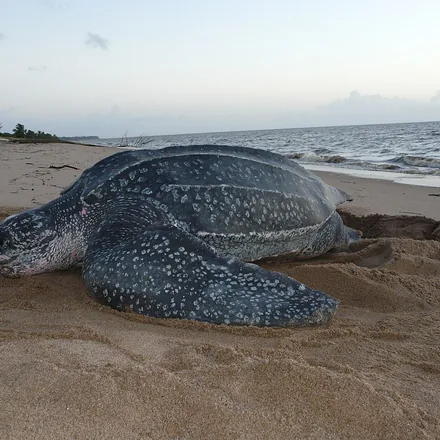
Leatherback Turtle Rare Vulnerable
Dermochelys coriacea
The largest turtle on Earth, a jellyfish hunter that dives deeper than most whales and crosses whole oceans.
Rekawa: The nesting beach on the night watch. Best: January to June. The second commonest nester here, ahead of the olive ridley, and anyone who sees one has had an exceptional night.
Tangalle: The beaches between Tangalle and Rekawa, coming ashore at night. Best: April to July. The largest turtle in the world and the least often seen. A nesting leatherback is a genuinely rare thing to witness.
Bundala: The park's beach frontage and the Kalametiya stretch. Best: January to June.
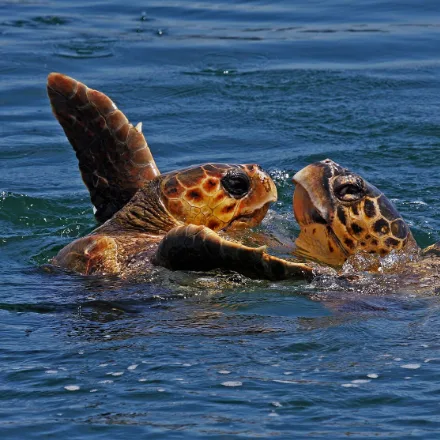
Loggerhead Turtle Ultra rare Vulnerable
Caretta caretta
Jaws powerful enough to crush a queen conch, and it navigates ocean basins by reading the earth's magnetic field.
Rekawa: The nesting beach on the night watch. Best: November to April. If an operator claims routine loggerhead nesting, treat everything else they tell you sceptically.
Trincomalee: Coastal water and reef edges, usually juveniles. Best: May to September.
Telling them apart, which is easier than it looks
Count the scales between the eyes. A green turtle has one pair of prefrontal scales, and every other species here has two. That single character separates the commonest turtle on the coast from all the others and it works on an animal underwater, on a nesting female and on a photograph.
After that, work on the head and the shell edge. A hawksbill has a narrow, tapering beak and overlapping shell scutes with a serrated back edge, like roof tiles. A loggerhead has a head out of proportion to its body, blunt and heavy, built for crushing shellfish. An olive ridley is the small one, olive grey, with a nearly circular shell and more than five costal scutes down each side, where the others have four.
The leatherback needs none of this. It has no scutes and no hard shell at all, just a leathery skin over seven long ridges running front to back, and it is enormous: a nesting female is well over a metre and a half of carapace and can exceed half a tonne. If you are unsure whether you are looking at a leatherback, you are not looking at one.
Rekawa, and why one beach takes all five
Rekawa is a two kilometre strip of dark sand on the south coast between Tangalle and the Kirinda road, and it is one of very few beaches in the world with records of all five species coming ashore. Green turtles are Regular there from February to July, olive ridleys peak in December and January, leatherbacks are Rare from January to June, hawksbills are Very rare and loggerheads are close to a once-in-a-career sighting.
The reason is unglamorous. The sand is coarse and dark, it holds heat, the slope is steep enough that a female does not have to cross a long flat to reach dry sand, and there is no river mouth cutting it. Turtles are conservative about beaches, returning to the region they hatched in, and a beach that works keeps working for generations of animals.
Nesting is a slow business. A female hauls out, digs a body pit, then a narrower egg chamber with her back flippers alone, lays, covers, disguises the site and returns to the sea, and the whole sequence takes a couple of hours. Almost all of it happens after dark.
What happens to the nests, which most pages leave out
A clutch is around a hundred eggs and it incubates for roughly two months in the sand. The temperature of that sand decides the sex of the hatchlings: warmer nests produce females, cooler ones males, with the switch inside a narrow band of about two degrees. It is one of the clearest reasons sea turtles are exposed to a warming climate, because a beach that shifts a degree does not produce fewer turtles, it produces turtles of one sex.
Ghost crabs work the sand in numbers and take eggs and emerging hatchlings, and monitor lizards dig out nests. Of the hatchlings that reach the water, the widely repeated figure is that about one in a thousand reaches maturity, and while that number is an estimate rather than a measurement, the shape of it is right: the strategy is volume.
Hatchlings find the sea by heading for the brightest, lowest horizon, which for the whole history of the species has been the sky over open water. Artificial light inland reverses that cue, and a lit beach draws hatchlings the wrong way. It is the single largest man-made pressure on a nesting coast that is otherwise intact.
Find coastal stays and marine trips in Sri Lanka
Some links on this page are affiliate links. If you book through them, Wildseer may earn a small commission at no extra cost to you. No venue pays to appear here and none ever will.
Frequently asked questions
How many sea turtle species are there in Sri Lanka?
Five: the green turtle, the hawksbill, the olive ridley, the leatherback and the loggerhead. That is five of the world’s seven, and all five have been recorded coming ashore at Rekawa on the south coast, which very few beaches anywhere can claim.
Which sea turtle is easiest to see in Sri Lanka?
The green turtle, by a distance. It is recorded on nine coasts and is Common at Hikkaduwa, where it feeds in shallow water a few strokes from the sand. It is also the one most people see first, and the prefrontal scales between the eyes are the way to confirm it: one pair on a green turtle, two on everything else.
When do turtles nest in Sri Lanka?
It depends on the species. Green turtles nest at Rekawa and Tangalle from February to July, olive ridleys peak in December and January, and leatherbacks come ashore from January to June. Some nesting happens in most months somewhere on the coast, which is unusual and is why the island has records year round.
Where is the best place to see turtles in Sri Lanka?
For nesting, Rekawa on the south coast, after dark, where all five species are recorded. For turtles in the water, Hikkaduwa in the shallows from November to April, or Pigeon Island off Trincomalee from May to September, where green and hawksbill turtles feed on the reef.
Are sea turtles endangered in Sri Lanka?
All five species are of conservation concern globally, and the hawksbill and the leatherback are the most threatened of the group. On this coast the nesting beaches themselves are in reasonable condition; the pressures are artificial light, which disorients hatchlings, and the loss of eggs to predators and to collection.
More on Sri Lanka wildlife
- Rekawa marine life
- Hikkaduwa marine life
- Trincomalee marine life
- Reptiles and amphibians of Sri Lanka
- Wildlife in Sri Lanka
Part of the Wildlife in Sri Lanka guide.
Image credits
Square thumbnails are cropped from the original. Wide banner images are cropped to a band. Other images are resized only. No other changes have been made.
- sea-turtles-sri-lanka: Ppmh21 | CC BY-SA 4.0, cropped
- Green Sea Turtle: Randall Ruiz | Unsplash License, cropped
- Hawksbill Turtle (cropped to square): Daniel Sasse | CC BY-SA 4.0, cropped
- Olive Ridley Turtle (cropped to square): Bernard Gagnon | CC BY-SA 3.0, cropped
- Leatherback Turtle (cropped to square): Julien Renoult | CC BY 4.0, cropped
- Loggerhead Turtle (cropped to square): Eco cruising | CC BY-SA 4.0, cropped
Square thumbnails are cropped from the original. Wide banner images are cropped to a band. Other images are resized only. No other changes have been made.
- sea-turtles-sri-lanka: Ppmh21 | CC BY-SA 4.0, cropped
- Green Sea Turtle: Randall Ruiz | Unsplash License, cropped
- Hawksbill Turtle (cropped to square): Daniel Sasse | CC BY-SA 4.0, cropped
- Olive Ridley Turtle (cropped to square): Bernard Gagnon | CC BY-SA 3.0, cropped
- Leatherback Turtle (cropped to square): Julien Renoult | CC BY 4.0, cropped
- Loggerhead Turtle (cropped to square): Eco cruising | CC BY-SA 4.0, cropped