
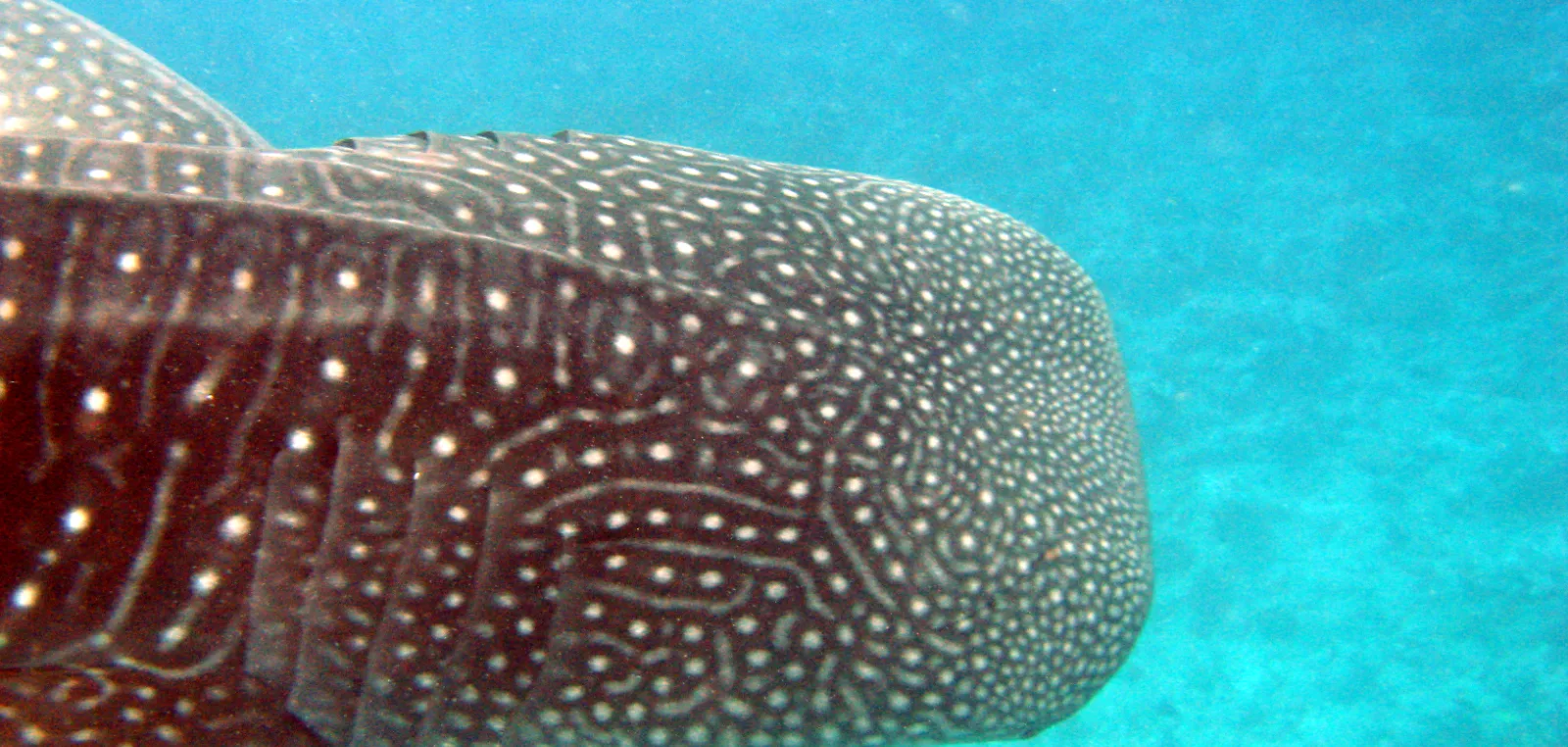
A whale shark is the largest fish in the sea and Thailand has five places where you have a real chance of one. It is still a rare sighting, and it cannot be promised. A whale shark is a wide ranging filter feeder following food, so no percentage anyone quotes you can be more than a guess.
What this page gives you is the honest version: the five sites that actually produce, the months that matter on each coast, why the Andaman and the Gulf run on opposite calendars, and what to do in the water if it happens. It also explains why Thailand is a better place to see one than several better known destinations, which is a point almost nobody makes.
The five sites that produce
Richelieu Rock, north of the Similans, is the single best chance in Thai water and one of the better ones in Southeast Asia. It is a horseshoe of submerged limestone in open sea with nothing else around it, which is exactly the sort of feature that concentrates plankton and everything that eats it. Koh Bon and Koh Tachai on the same liveaboard route are the other two Andaman contenders.
Hin Daeng and Hin Muang are the deep, cold, open water pinnacles further south, and they produce sightings for the same reason: isolated structure in blue water. In the Gulf, Sail Rock between Samui and Koh Tao is the one, and it runs on a completely different calendar.
These are the guide’s own records for each site, with the odds attached. Note that every one of them says rare. That is not pessimism, it is the actual figure.
5 places
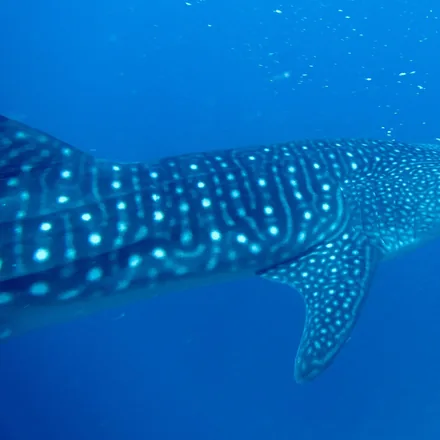
Whale Shark Rare Endangered
Rhincodon typus
The biggest fish in the ocean, a spotted, bus sized filter feeder and the undisputed holy grail of tropical diving.
Where: Koh Bon, Koh Tachai and the outer pinnacles on liveaboard itineraries. Best: Feb-Apr. The single most sought sighting on any Similan trip, and worth the liveaboard over a day boat.
Where: The Hin Daeng pinnacle top and the blue off Hin Muang. Best: Nov-Apr, peak Feb-Apr. Hin Daeng has one of the better whale shark records in Thai waters. Stay shallow and wait.
Where: Sail Rock and the pinnacles between Samui and Koh Tao. Best: Mar-May peak, possible Feb-Sep. Sail Rock is the Gulf's whale shark site. Day boats run from Samui, Phangan and Koh Tao.
Where: Bida Nok and Bida Nai, and the outer walls. Best: Feb-Apr.
Where: Richelieu Rock, Koh Tachai, Hin Daeng, Phi Phi. Best: Feb-Apr, Andaman dive sites. Richelieu Rock and Koh Tachai are the classic seasonal hotspots.
The season, and why the two coasts disagree
The Andaman season runs roughly February to May, with March and April the peak, and it is tied to plankton blooms as the water warms before the southwest monsoon. The Similan and Surin national parks close from about mid-May to mid-October, so the liveaboard window and the whale shark window overlap almost exactly.
The Gulf works on the opposite monsoon. Sail Rock produces from around March to May and again from September into October, and the Gulf stays diveable through the months when the Andaman is shut. If your dates are fixed in August, the Gulf is your only option, and it is a legitimate one.
Practically, that means the best single move you can make is to book a liveaboard in March or April rather than a day trip in any month. It is not a small difference: four days on the outer Andaman sites is many more hours at Richelieu Rock and Koh Tachai than a day boat can give you, and hours in the water are the only variable you actually control.
What your actual chances are
Plenty of divers do a full season on the Andaman coast and see none. Others get one on a first open water dive. There is no useful average, because a whale shark is a wide ranging filter feeder following food, not a resident animal on a reef.
What genuinely improves the odds: go in March or April, dive the outer sites rather than the inshore ones, spend multiple days rather than one, and get as many hours in the water at those sites as your dates allow. What does not improve the odds: paying more, and being told you will definitely see one.
Set your expectations around the trip rather than the animal. The Similan liveaboard route is worth doing for the mantas, the leopard sharks, the schooling fish and the soft coral at Richelieu whether or not the big one turns up. Treat a whale shark as the thing that would make it extraordinary rather than the thing that makes it worthwhile, and you will not be disappointed.
Find Similan liveaboards and Richelieu Rock dive trips
Some links on this page are affiliate links. If you book through them, Wildseer may earn a small commission at no extra cost to you. No venue pays to appear here and none ever will.
Frequently asked questions
Where is the best place to see whale sharks in Thailand?
Richelieu Rock, north of the Similan Islands, is the single best chance in Thai water, with Koh Bon and Koh Tachai on the same liveaboard route close behind. Hin Daeng and Hin Muang produce them further south, and Sail Rock is the Gulf site.
When is whale shark season in Thailand?
On the Andaman coast, roughly February to May with March and April the peak. The Similan and Surin parks close from about mid-May to mid-October. In the Gulf, Sail Rock produces around March to May and again from September into October, so it covers the months the Andaman is shut.
What are the chances of seeing a whale shark in Thailand?
Genuinely low on any single dive, and no number anyone quotes you can be more than a guess. Multiple days on the outer Andaman sites in March or April is the best thing you can do. Plenty of divers complete a full season without one.
Can you snorkel with whale sharks in Thailand?
Occasionally, if one is feeding near the surface, but the recorded sightings are almost all at dive sites in open water rather than in shallow bays. Thai whale sharks are not concentrated at any one shallow site, which is why there is no snorkelling spot that reliably produces them.
Why can nobody guarantee a whale shark sighting in Thailand?
Because a whale shark is not resident anywhere in Thai water. It is a wide ranging filter feeder that follows plankton, present at a site when the food is there and absent when it is not. That is what makes a Thai sighting rare, and worth having.
More on Thailand wildlife
- Sharks and Rays of Thailand
- Thailand liveaboard wildlife
- Diving in Thailand
- Similan Islands in February
- Koh Samui marine life
Part of the Wildlife in Thailand guide.
Image credits
Square thumbnails are cropped from the original. Wide banner images are cropped to a band. Other images are resized only. No other changes have been made.
- Whale shark cruising in open blue water (cropped to a banner): Dapaan | CC BY-SA 3.0, cropped
- Whale Shark (cropped to square): Jerome Paillet (IFREMER) | CC BY 4.0, cropped
Square thumbnails are cropped from the original. Wide banner images are cropped to a band. Other images are resized only. No other changes have been made.
- Whale shark cruising in open blue water (cropped to a banner): Dapaan | CC BY-SA 3.0, cropped
- Whale Shark (cropped to square): Jerome Paillet (IFREMER) | CC BY 4.0, cropped