
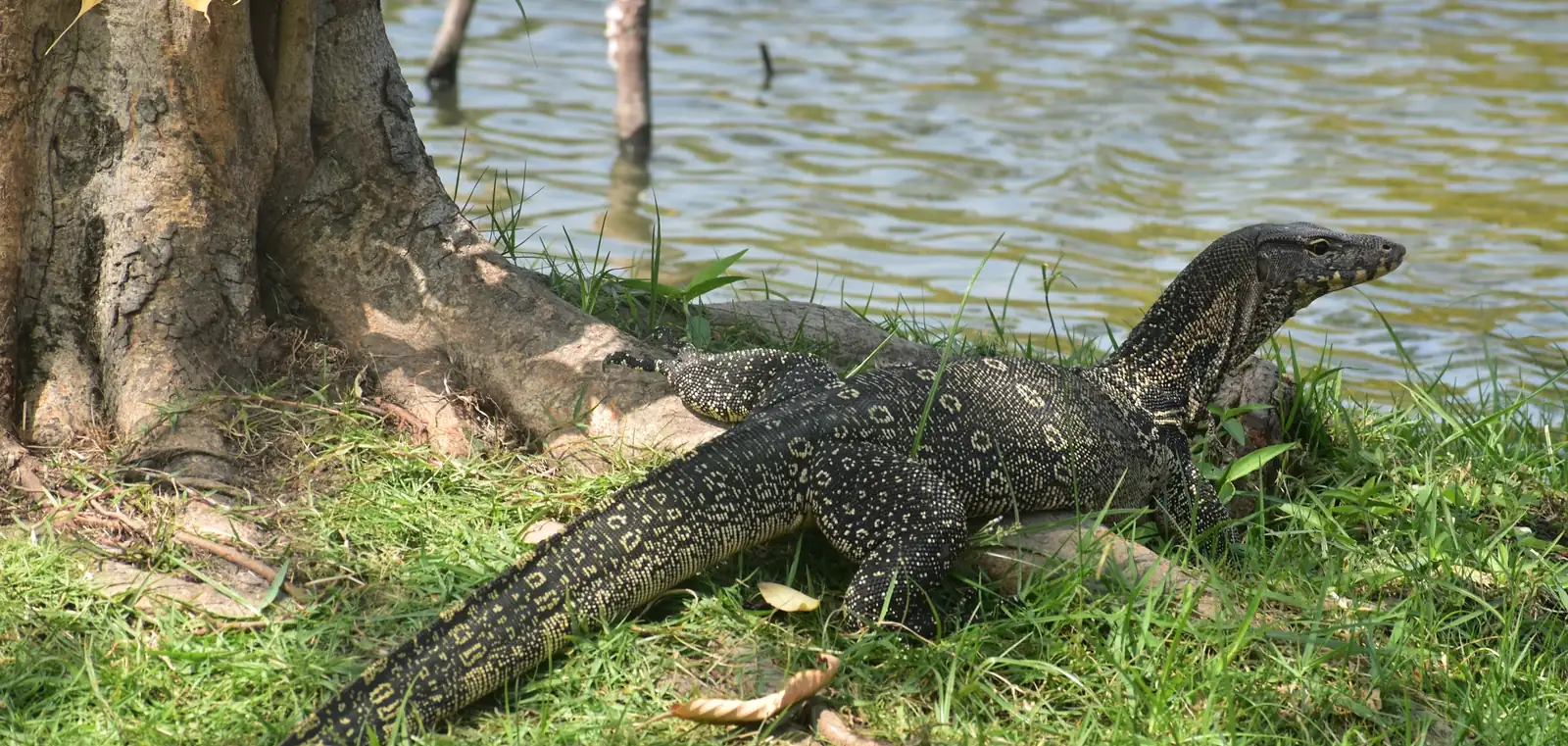
The reptiles and amphibians of Thailand are as approachable as they are rich, and one of the easiest places in Asia to start. Water monitors patrol city canals, tokay geckos shout from guesthouse walls, and a night walk in any decent patch of rainforest turns up frogs, vipers and geckos within an hour. This guide covers 79 species, grouped by where you will actually find them.
The marquee animals are here too: king cobras and reticulated pythons, four species of sea turtle, the last Siamese crocodiles in a handful of protected wetlands, and gliding oddities like the flying dragon and Wallace’s flying frog. We flag the dangerous ones plainly and the rare ones honestly.
Highlights
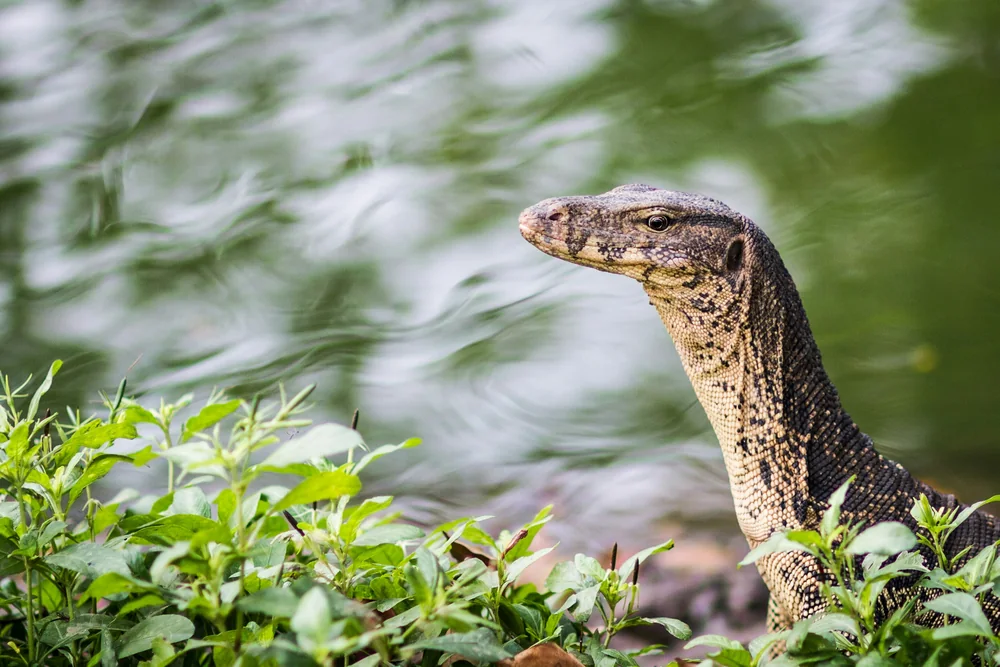
Asian Water Monitor
A dragon sized lizard that swims canals and city parks, second only to the Komodo dragon in length. Where: Rivers, canals and parks countrywide, including Bangkok. Best: Year round, day.
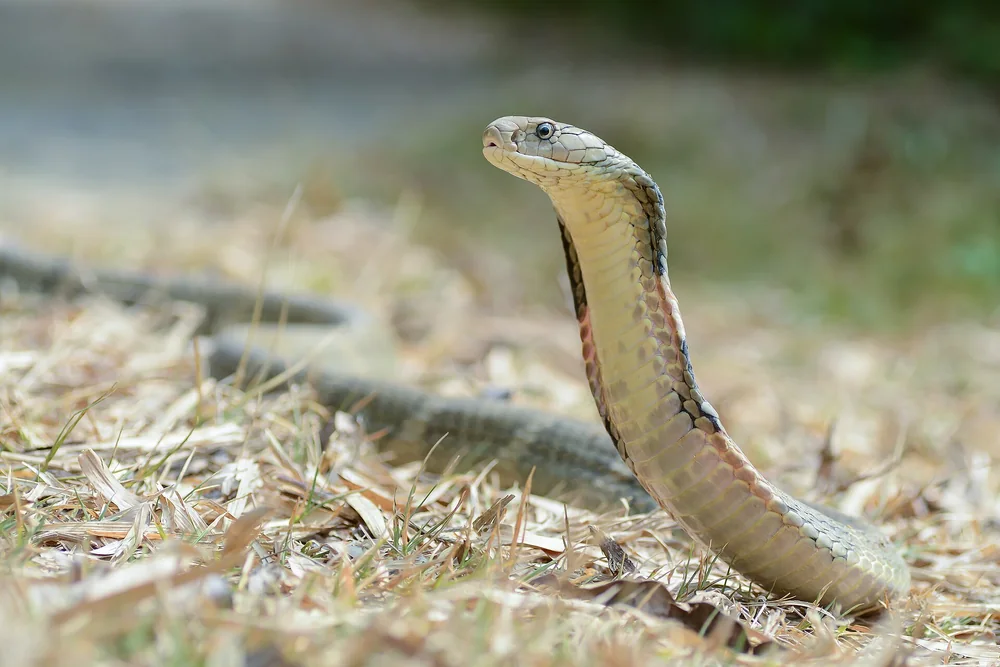
King Cobra
The world's longest venomous snake, and one of the shyest, so a sighting is a genuine holy grail. Where: Khao Sok, Kaeng Krachan. Best: Warm season, daytime near forest streams.
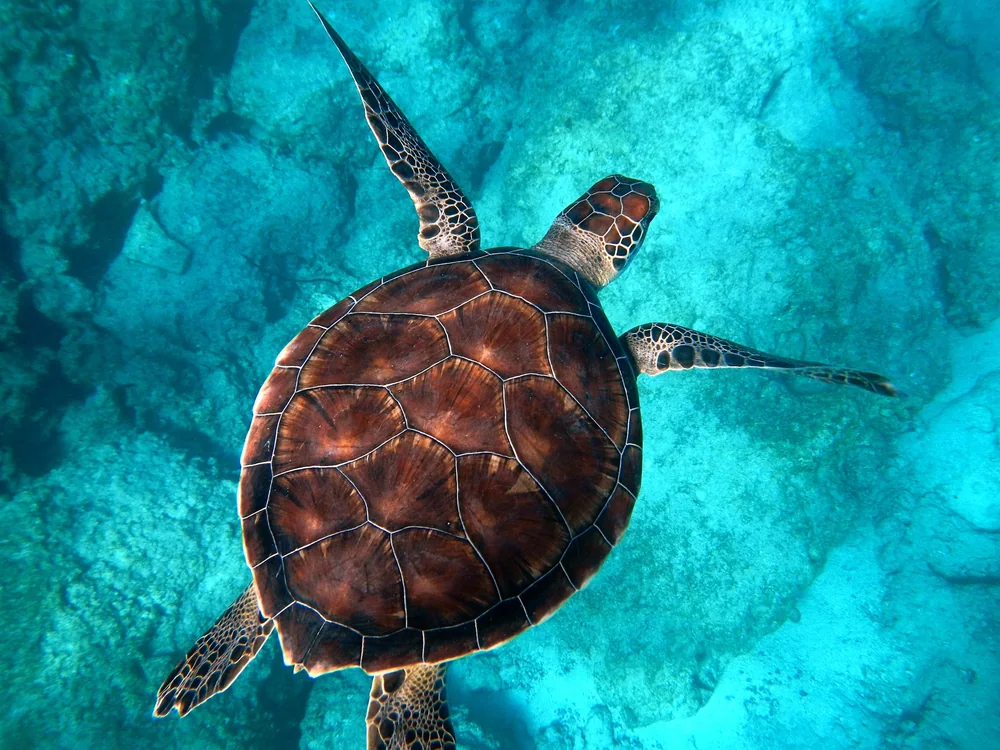
Green Sea Turtle
The great grazing turtle of the tropics, the only sea turtle that turns vegetarian as an adult. Where: Similan, Trang and Koh Libong, southern reefs and seagrass. Best: Dive season, Nov-Apr.
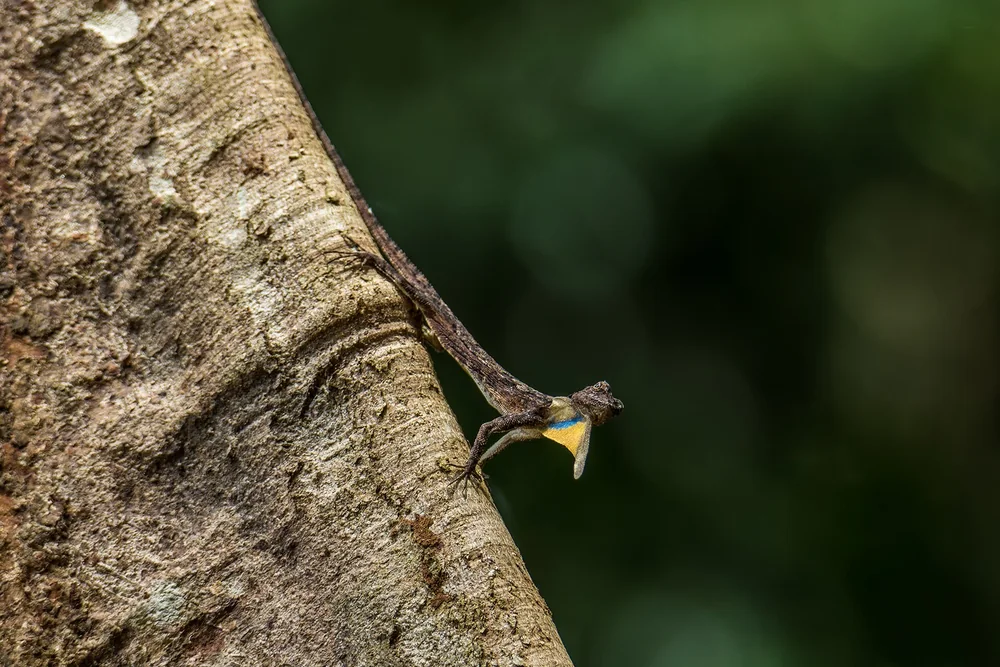
Common Flying Dragon
A tiny lizard that unfurls bright wings from its ribs and glides between tree trunks like a paper dart. Where: Khao Yai, Kaeng Krachan, Khao Sok, forest with tall trees. Best: Warm season, day.
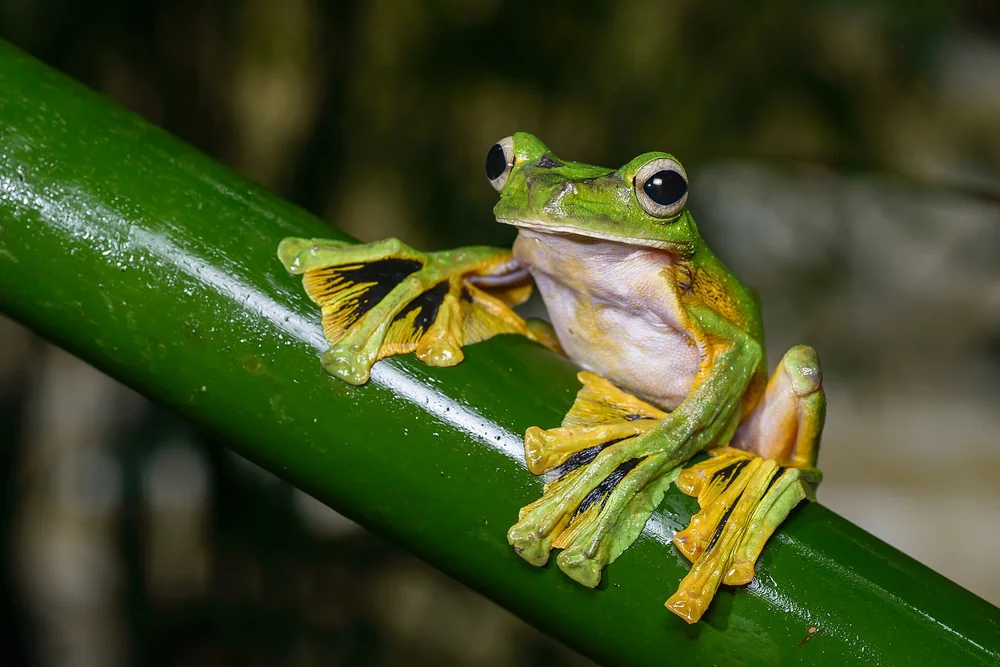
Wallace's Flying Frog
A big green tree frog that parachutes between trees on huge webbed feet spread like four little sails. Where: Far southern rainforest and the peninsula. Best: Rainy season, night.
Rainforest reptiles
25 species
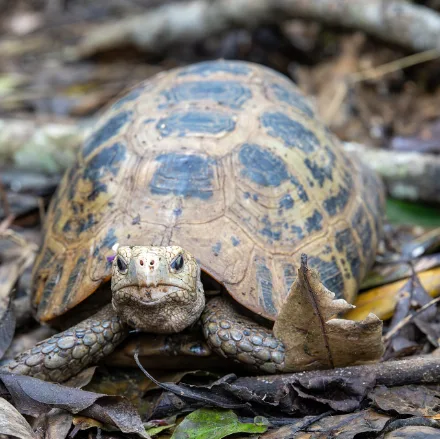
Elongated Tortoise Rare Critically Endangered
Indotestudo elongata
A forest tortoise whose pale head flushes pink around the eyes and nose in the breeding season.
Where: Deciduous and evergreen forest, Huai Kha Khaeng, Khao Yai. Best: Rainy season.
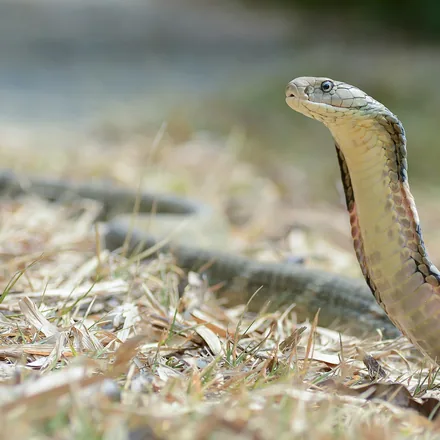
King Cobra Rare Vulnerable
Ophiophagus hannah
The world's longest venomous snake, and one of the shyest, so a sighting is a genuine holy grail.
Where: Khao Sok, Kaeng Krachan. Best: Warm season, daytime near forest streams.
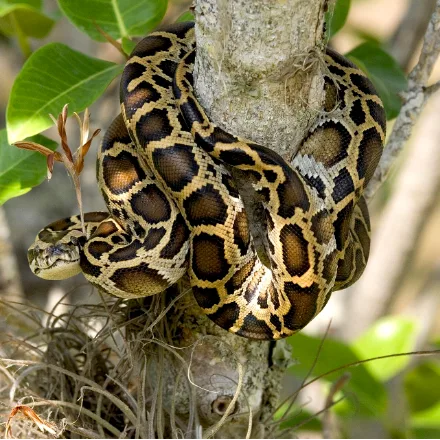
Burmese Python Occasional Vulnerable
Python bivittatus
One of the largest snakes on Earth, a giant constrictor that can swallow prey the size of a deer.
Where: Huai Kha Khaeng, Khao Yai, wetlands and grassland. Best: Cooler months, basking.
Blue Coral Snake Rare
Calliophis bivirgatus
A jaw dropping snake in electric blue and neon red, armed with venom glands that run a third of the length of its body.
Where: Lowland rainforest of the south, Khao Sok and peninsula. Best: Rainy season, night.
Giant Angle-headed Lizard Rare
Gonocephalus grandis
Males are electric blue and green with a sail of a crest, and they drop straight into the stream below when disturbed.
Where: Trunks over forest streams in the southern peninsula; Khao Sok and Hala-Bala. Best: Year round.
Kuhl's Flying Gecko Rare
Gekko kuhli
A gecko fringed with skin flaps that let it parachute between trees and vanish against bark.
Where: Southern rainforest, Khao Sok and peninsula. Best: Year round, night.
Malayan Krait (Blue Krait) Rare
Bungarus candidus
A quiet killer in crisp black and white bands, with venom many times stronger than a cobra's.
Where: Lowland forest and farmland countrywide. Best: Warm rainy nights.
Paradise Flying Snake Rare
Chrysopelea paradisi
A snake that launches from the treetops and glides between trees by flattening its body into a living ribbon.
Where: Southern forests and the peninsula. Best: Warm season, day.
Banded Krait Occasional
Bungarus fasciatus
Unmistakable in bold black and yellow bands, a powerfully venomous snake that is oddly timid after dark.
Where: Khao Yai, Kaeng Krachan, lowland forest and farmland. Best: Rainy season, after dark.
Clouded Monitor Occasional
Varanus nebulosus
A more terrestrial, forest loving cousin of the water monitor, often seen digging for beetles and crabs.
Where: Khao Yai, Huai Kha Khaeng, dry forest. Best: Warm season, day.
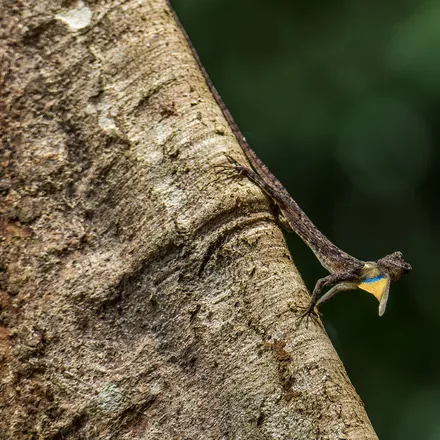
Common Flying Dragon Occasional
Draco maculatus
A tiny lizard that unfurls bright wings from its ribs and glides between tree trunks like a paper dart.
Where: Khao Yai, Kaeng Krachan, Khao Sok, forest with tall trees. Best: Warm season, day.
Equatorial Spitting Cobra Occasional
Naja sumatrana
A cobra of the southern forests that defends itself by spraying venom straight at an intruder's eyes.
Where: Peninsular Thailand and the far south. Best: Warm season, day.
Green Cat Snake Occasional
Boiga cyanea
Hatches out brick red, turns olive as a juvenile and ends up emerald green, three colours in one lifetime.
Where: Low branches along forest streams; Khao Yai, Khao Sok and Kaeng Krachan. Best: Year round, at night.
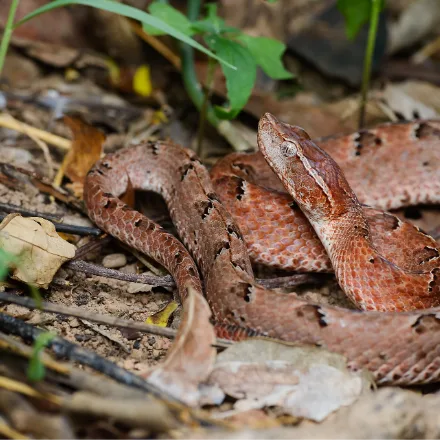
Malayan Pit Viper Occasional
Calloselasma rhodostoma
A short, bad tempered viper that lies still on the forest floor and bites more people in the region than almost any other snake.
Where: Kaeng Krachan, Khao Yai, plantations and forest edges. Best: Warm months, night and early morning.
Mountain Horned Dragon Occasional
Acanthosaura crucigera
Sits so still on a mossy trunk that people walk within a foot of it, spines, crest and all.
Where: Trunks and saplings in hill and montane forest; Doi Inthanon, Doi Suthep and Kaeng Krachan. Best: Year round.
Red-tailed Green Racer Occasional
Gonyosoma oxycephalum
A big, muscular emerald snake with a rust red tail, a powerful climber of the rainforest canopy.
Where: Southern rainforest, Khao Sok and peninsula. Best: Year round, day.
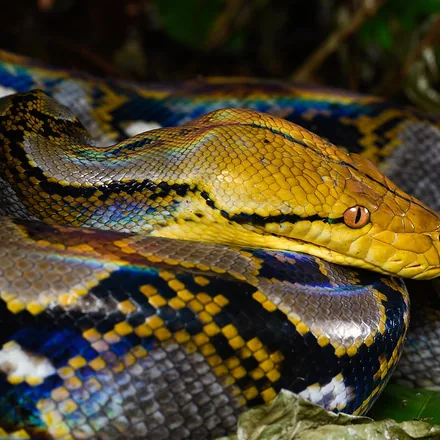
Reticulated Python Occasional
Malayopython reticulatus
The longest snake in the world, a jewelled, net patterned constrictor that turns up from rainforest to city canals.
Where: Khao Yai, Khao Sok, wetlands and even cities. Best: Night, near water.
Wagler's Pit Viper (Temple Viper) Occasional
Tropidolaemus wagleri
The famously placid temple viper, revered at the Snake Temple and so sluggish by day it can be gently handled, though nobody should.
Where: Southern forests, Khao Sok and the peninsula. Best: Year round, on branches.
Golden Tree Snake Regular
Chrysopelea ornata
A fast, elegant climber that can also glide, and one of the most common snakes seen in Thai gardens and temples.
Where: Gardens, parks and forest edges countrywide. Best: Warm season, day.
Green Crested Lizard Regular
Bronchocela cristatella
A slim emerald lizard with a whip tail that can flush from green to brown in moments.
Where: Southern gardens, forest edges and Khao Sok. Best: Year round, day.
Large-eyed Pit Viper Regular
Trimeresurus macrops
Vivid green with enormous copper eyes, and it hunts entirely by heat, so darkness makes no difference to it.
Where: Low vegetation near water in lowland forest; Khao Yai, Kaeng Krachan and Bangkok parks. Best: Year round, at night.
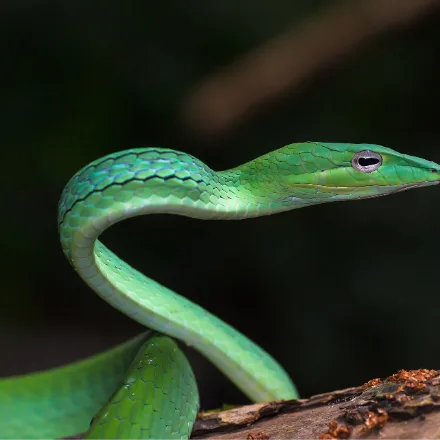
Oriental Whip Snake (Asian Vine Snake) Regular
Ahaetulla prasina
A snake so slender and green it looks like a hanging vine, with strange keyhole shaped pupils.
Where: Khao Yai, Kaeng Krachan, Khao Sok, forest and gardens. Best: Year round, day.
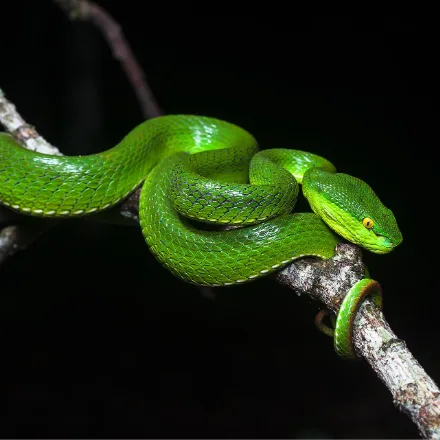
White-lipped Pit Viper Regular
Trimeresurus albolabris
A vivid green viper that drapes over branches at night, one of the most encountered venomous snakes in the tropics.
Where: Khao Yai, Kaeng Krachan, Khao Sok, near streams. Best: Rainy season nights.
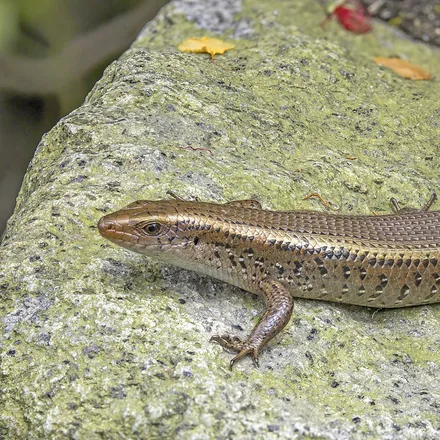
Common Sun Skink Common
Eutropis multifasciata
A glossy bronze skink that basks on logs and forest paths and gives birth to live young.
Where: Forest floor and clearings countrywide. Best: Year round, day.
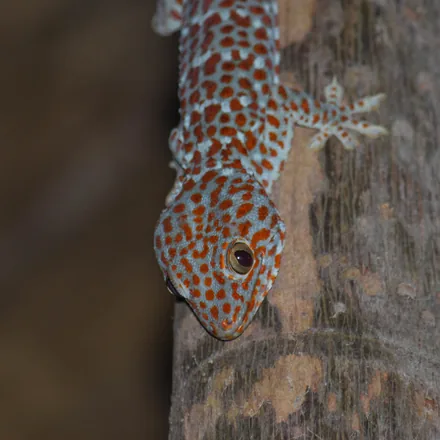
Tokay Gecko Common
Gekko gecko
A big, boldly spotted gecko whose loud TOH-kay call echoes through Thai nights and, by legend, brings luck if it calls seven times.
Where: Buildings, temples and forest countrywide. Best: Year round, night.
Dry forest and grassland reptiles
9 species
Indochinese Spitting Cobra Occasional Vulnerable
Naja siamensis
Sprays venom at the eyes from up to three metres, aiming with enough accuracy to hit a moving face.
Where: Farmland, plantations and village edges countrywide. Best: Year round, active at dusk and night.
Bengal Monitor Occasional
Varanus bengalensis
A dry-country monitor that climbs well, digs constantly and eats essentially anything smaller than itself.
Where: Dry forest and scrub in the north and northeast; Huai Kha Khaeng and the Isan uplands. Best: Year round, by day.
Common Butterfly Lizard Occasional
Leiolepis belliana
A ground lizard that flares brilliant orange and black bars on its flanks like opening butterfly wings.
Where: Coastal dunes and sandy scrub, Khao Sam Roi Yot area. Best: Warm sunny days.
Eastern Russell's Viper Occasional
Daboia siamensis
Responsible for more serious snakebite in Asia than almost any other species, and it hisses louder than any snake in the region.
Where: Farmland, scrub and dry grassland countrywide; commonest in the central plains and northeast. Best: Year round, most active at dusk in the wet season.
Copperhead Racer Regular
Coelognathus radiatus
Rears into a vertical S and inflates its neck into a striped shield when cornered, all bluff and no venom.
Where: Farmland, forest edge and paddy countrywide. Best: Year round, by day.
Monocled Cobra Regular
Naja kaouthia
The classic hooded cobra of the rice fields, marked with a single O shaped eyespot on its spread hood.
Where: Rice fields, wetlands and forest edges countrywide. Best: Warm season, day and dusk.
Oriental Rat Snake Regular
Ptyas mucosa
A long, fast, wide eyed snake that races across open ground and is one of the region's great rodent controllers.
Where: Farmland, wetlands and forest edges countrywide. Best: Warm season, day.
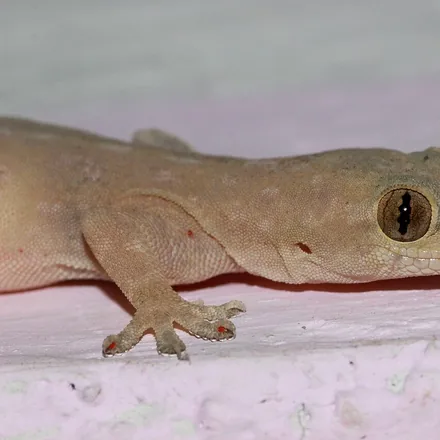
Common House Gecko Common
Hemidactylus frenatus
Sticks to glass using van der Waals forces across billions of microscopic hairs, not glue and not suction.
Where: Walls, lights and buildings countrywide. Best: Year round, at night.
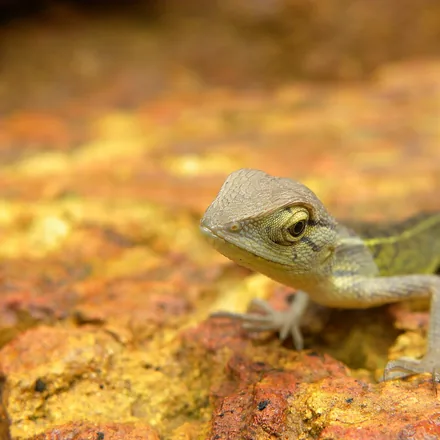
Oriental Garden Lizard Common
Calotes versicolor
The everyday garden lizard whose breeding males flush blood red about the head, earning the name bloodsucker.
Where: Gardens, scrub and towns countrywide. Best: Year round, day.
Wetland, river and lake reptiles
14 species
Giant Asian Pond Turtle Ultra rare Critically Endangered
Heosemys grandis
The largest hard-shelled freshwater turtle in mainland Southeast Asia, and it is being eaten out of existence.
Where: Protected swamps and slow streams; Bueng Boraphet, Thale Noi and western sanctuaries. Best: Year round.
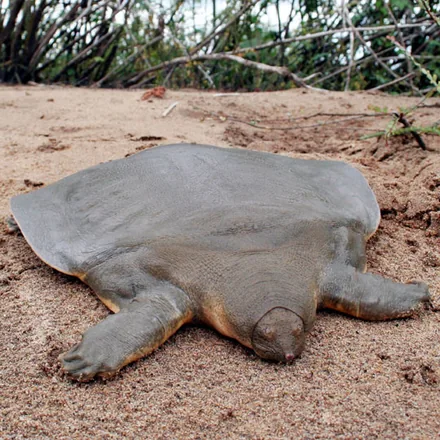
Asian Giant Softshell Turtle Very rare Critically Endangered
Pelochelys cantorii
A huge, frog faced softshell that buries itself in river mud and surfaces to breathe only twice a day.
Where: A few remote lowland rivers and protected wetlands. Best: Rare, any time.
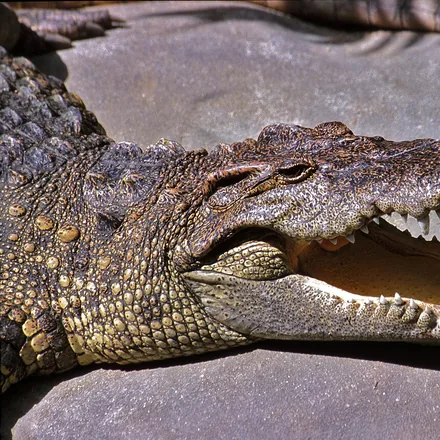
Siamese Crocodile Very rare Critically Endangered
Crocodylus siamensis
A freshwater crocodile once thought nearly extinct in the wild, now clinging on in a few remote Thai wetlands.
Where: A few remote protected wetlands, Kaeng Krachan area rivers. Best: Rare, any time.
Big-headed Turtle Very rare Endangered
Platysternon megacephalum
A bizarre stream turtle with a head too big to pull in and a tail nearly as long as its shell, which climbs trees.
Where: Cool fast hill streams of the north and west. Best: Night, cooler months.
Black Marsh Turtle Rare Endangered
Siebenrockiella crassicollis
Two pale patches above the eyes give it a permanently startled expression, which is why Thais call it the smiling terrapin.
Where: Muddy ponds, canals and marshes of the central plain. Best: Year round, at dusk.
Malayan Box Turtle Occasional Endangered
Cuora amboinensis
A domed marsh turtle that seals itself completely inside a hinged shell like a living box.
Where: Marshes, ponds and rice paddies countrywide. Best: Rainy season, dusk and night.
Asian Water Dragon Rare Vulnerable
Physignathus cocincinus
A handsome green dragon of forest streams that dives into the water and can run briefly on its hind legs.
Where: Forest streams of the north and east. Best: Warm season, day, near water.
Asiatic Softshell Turtle Rare Vulnerable
Amyda cartilaginea
Buries itself in riverbed mud with only a snorkel-like nose showing, and strikes at anything that passes.
Where: Rivers and reservoirs countrywide; Mekong, Chao Phraya and protected rivers. Best: Year round.
Malayan Snail-eating Turtle Occasional
Malayemys macrocephala
Eats almost nothing but snails, crushing them with broad flat jaw surfaces, and wears white racing stripes on its face.
Where: Paddies, canals and marshes of the central plain; Bueng Boraphet and Thale Noi. Best: Year round.
Blood Python Rare
Python brongersmai
Short, immensely thick and blotched deep blood red, it can strike faster than almost any other python.
Where: Swamp forest and plantation drains in the southern peninsula. Best: Year round, at night.
Red-tailed Pipe Snake Occasional
Cylindrophis ruffus
When threatened it hides its head and raises its blunt tail instead, flashing bright red underneath as a decoy.
Where: Damp lowland soil, paddies and gardens countrywide. Best: May-Oct, after rain.
Sunbeam Snake Occasional
Xenopeltis unicolor
Looks plain brown until light hits it, when the scales split the light into a full oil-slick rainbow.
Where: Paddies, gardens and damp lowland ground countrywide. Best: May-Oct, on wet roads after dark.
Puff-faced Water Snake Regular
Homalopsis buccata
Harvested from Tonle Sap and Thai wetlands by the million each year, which may make it the most heavily exploited snake on earth.
Where: Canals, paddies and swamps of the central plain; Bueng Boraphet and the Chao Phraya basin. Best: Year round, at night.
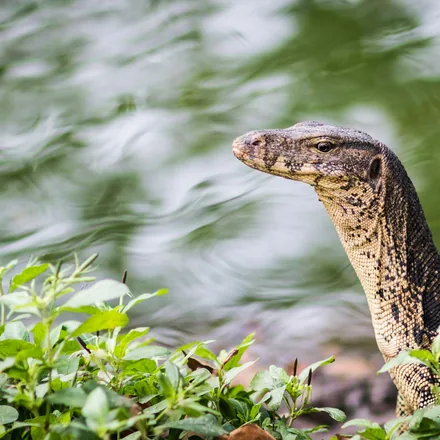
Asian Water Monitor Common
Varanus salvator
A dragon sized lizard that swims canals and city parks, second only to the Komodo dragon in length.
Where: Rivers, canals and parks countrywide, including Bangkok. Best: Year round, day.
Mangrove and estuary reptiles
7 species
Saltwater Crocodile Very rare
Crocodylus porosus
The largest living reptile and the ocean going giant of crocodiles, now virtually gone from Thai waters.
Where: Historically coastal estuaries and mangroves. Best: Rare, any time.
Beaked Sea Snake Rare
Hydrophis schistosus
Drop for drop, one of the most venomous snakes in the sea, and it is responsible for most sea snake bites in Asia.
Where: Turbid coastal water and estuaries on both coasts. Best: Year round.
Dumeril's Monitor Rare
Varanus dumerilii
Hatches out with a brilliant orange head, and specialises almost entirely in eating crabs.
Where: Mangrove and swamp forest of the southern peninsula; Ranong and Krabi. Best: Year round.
Little File Snake Rare
Acrochordus granulatus
Loose baggy skin covered in rasping granular scales, used to grip slippery fish that no smooth snake could hold.
Where: Mangrove creeks, estuaries and shallow coastal water on both coasts. Best: Year round, at night.
Dog-faced Water Snake Occasional
Cerberus schneiderii
Sidewinds across bare mudflats at low tide, one of very few snakes anywhere that moves that way.
Where: Mangrove mudflats and creeks on both coasts; Krabi, Ranong and Bang Pu. Best: Year round, at low tide.
Mangrove Pit Viper Occasional
Trimeresurus purpureomaculatus
Hangs at head height in mangrove branches and is one of the few Thai snakes that will strike without much provocation.
Where: Mangrove branches on both coasts; Krabi, Ranong and Ao Phang Nga. Best: Year round, at night.
Mangrove Snake (Gold-ringed Cat Snake) Occasional
Boiga dendrophila
A glossy black tree snake laced with gold rings, prowling the mangroves after dark.
Where: Southern mangroves and riverine forest, Khao Sok. Best: Rainy season, night.
Reef and open ocean reptiles
6 species
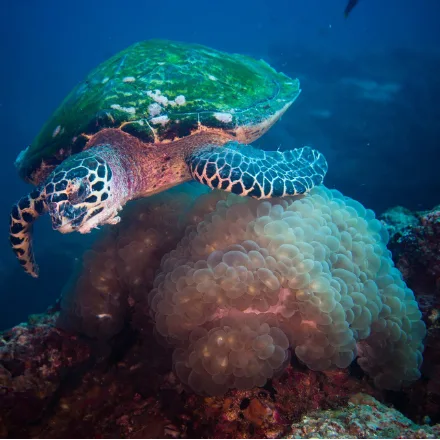
Hawksbill Turtle Occasional Critically Endangered
Eretmochelys imbricata
The reef's sponge specialist, its beautiful shell also the reason it was hunted to the edge.
Where: Similan, Hin Daeng and Hin Muang, coral reefs. Best: Dive season, Nov-Apr.
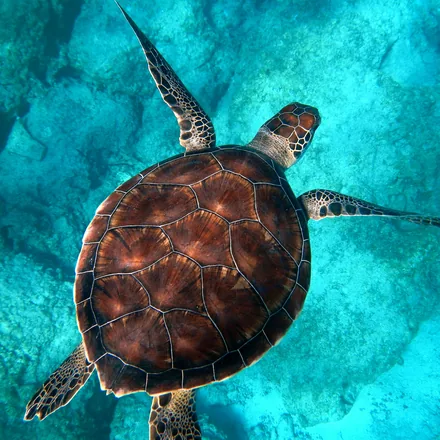
Green Sea Turtle Regular Endangered
Chelonia mydas
The great grazing turtle of the tropics, the only sea turtle that turns vegetarian as an adult.
Where: Similan, Trang and Koh Libong, southern reefs and seagrass. Best: Dive season, Nov-Apr.
Loggerhead Turtle Ultra rare Vulnerable
Caretta caretta
Jaws powerful enough to crush a queen conch, and it navigates ocean basins by reading the earth's magnetic field.
Where: Offshore Andaman and Gulf waters; no confirmed regular nesting. Best: Year round.
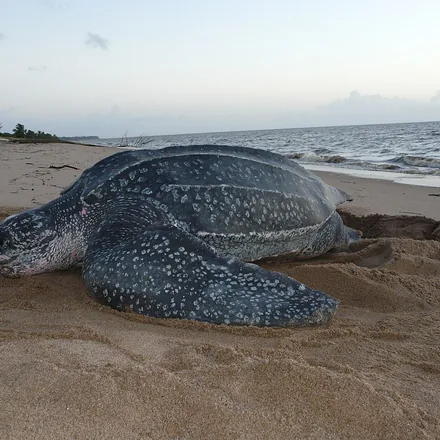
Leatherback Turtle Very rare Vulnerable
Dermochelys coriacea
The largest turtle on Earth, a jellyfish hunter that dives deeper than most whales and crosses whole oceans.
Where: Andaman waters and rare nesting beaches. Best: Nesting Nov-Feb.
Olive Ridley Turtle Rare Vulnerable
Lepidochelys olivacea
The smallest and most numerous sea turtle, famous elsewhere for mass nestings of thousands at once.
Where: Andaman coast and offshore waters. Best: Nesting season, cool months.
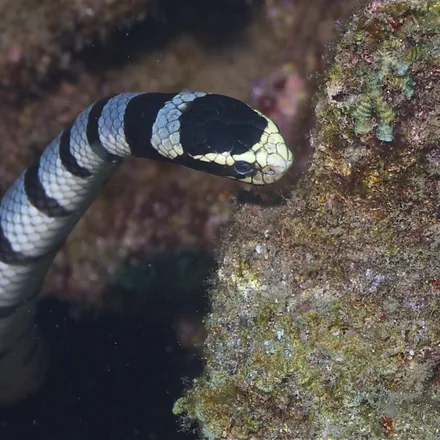
Banded Sea Krait Regular
Laticauda colubrina
A sea snake that hunts eels underwater but must come ashore to rest, drink fresh water and lay its eggs.
Where: Similan, Hin Daeng and Hin Muang, southern reefs. Best: Dive season, Nov-Apr.
Frogs, toads and other amphibians
18 species
Asian Tree Toad Rare
Rentapia hosii
A toad that lives in the canopy, and the females are bright yellow and purple while the males stay plain brown.
Where: Streamside trees in southern lowland rainforest; Khao Sok and Hala-Bala. Best: May-Oct, at night.
Malayan Horned Frog Rare
Pelobatrachus nasutus
A frog that looks exactly like a dead leaf, complete with horned eyelids and a pointed snout for a leaf tip.
Where: Southern rainforest near streams, Khao Sok. Best: Rainy season, night.
Thai Crocodile Newt Rare
Tylototriton uyenoi
Thailand's only newt, restricted to a handful of cool mountain pools in the north, and it looks like a small armoured dragon.
Where: Cool montane pools and ditches in the north; Doi Inthanon, Doi Suthep and Chiang Dao above 1,000 m. Best: May-Aug, during the rains.
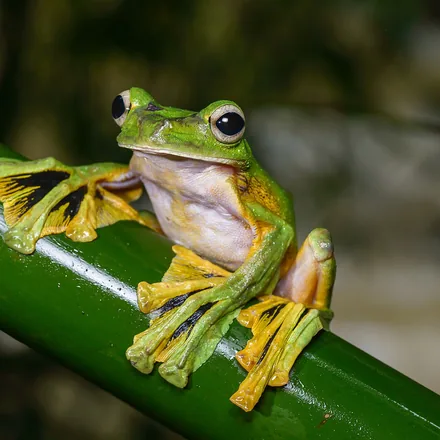
Wallace's Flying Frog Rare
Rhacophorus nigropalmatus
A big green tree frog that parachutes between trees on huge webbed feet spread like four little sails.
Where: Far southern rainforest and the peninsula. Best: Rainy season, night.
Yellow-striped Caecilian Rare
Ichthyophis kohtaoensis
A limbless, burrowing amphibian that looks like a giant earthworm and belongs to a group most travellers never know exists.
Where: Moist forest and paddy soils, north and northeast. Best: Rainy season, after rain.
Green Cascade Frog Occasional
Odorrana chloronota
Lives in the spray of waterfalls and calls in ultrasound, above the range of human hearing, to beat the noise of the water.
Where: Waterfall splash zones in northern hill forest; Doi Inthanon, Doi Suthep and Doi Chiang Dao. Best: May-Sep, at night.
Kuhl's Creek Frog Occasional
Limnonectes kuhlii
Males grow tusk-like projections from the lower jaw and use them to wrestle rivals in the stream.
Where: Gravel edges of shaded hill streams in the north and west; Doi Inthanon and Kaeng Krachan. Best: May-Sep, at night.
Malayan Giant Frog (Blyth's River Frog) Occasional
Limnonectes blythii
A hefty stream frog the size of a dinner plate, with a mouth big enough to take crabs and other frogs.
Where: Clear forest streams of the south, Khao Sok. Best: Rainy season, night.
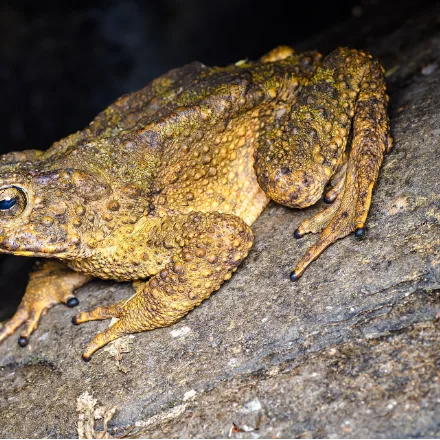
Malayan Giant Toad Occasional
Phrynoidis asper
The biggest toad in Southeast Asia, and it sits in the spray zone of waterfalls where nothing can hear it call.
Where: Splash zones of waterfalls and fast streams; Khao Sok, Kaeng Krachan and the peninsula. Best: May-Oct, at night.
White-lipped Frog Regular
Chalcorana labialis
A clean white stripe along the upper lip, and a call like two stones being tapped together.
Where: Rocks and vegetation beside clear forest streams in the south; Khao Sok and Hala-Bala. Best: May-Oct, at night.
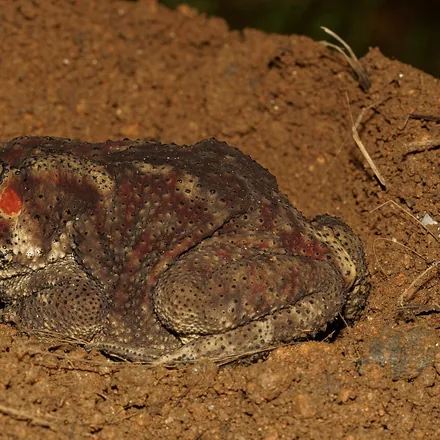
Asian Common Toad Common
Duttaphrynus melanostictus
The ubiquitous warty toad of doorsteps and gardens, hoovering up insects under every night light.
Where: Gardens, towns and forest countrywide. Best: Rainy season, night.
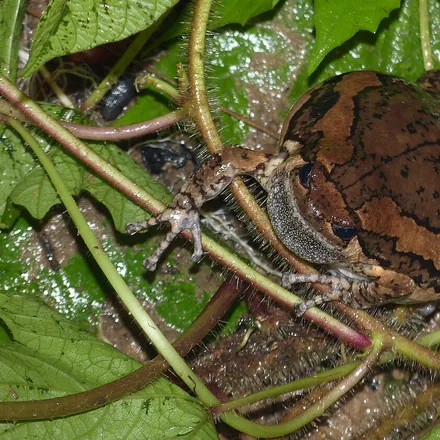
Banded Bullfrog (Chubby Frog) Common
Kaloula pulchra
A round, rubbery frog that inflates like a balloon when threatened and bellows like a cow after rain.
Where: Gardens, farmland and forest edges countrywide. Best: Rainy season nights.
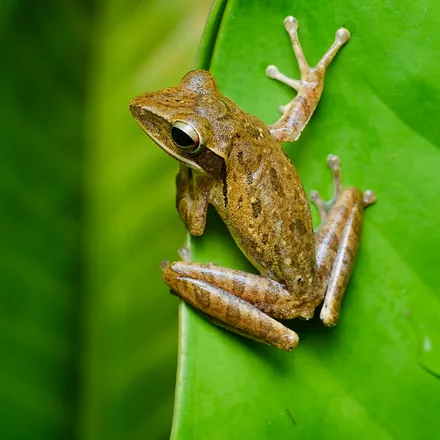
Common Tree Frog (Four-lined Tree Frog) Common
Polypedates leucomystax
The tan tree frog of porch lights and bathrooms, which whips up foam nests that hang above the water.
Where: Gardens, buildings and forest countrywide. Best: Rainy season nights.
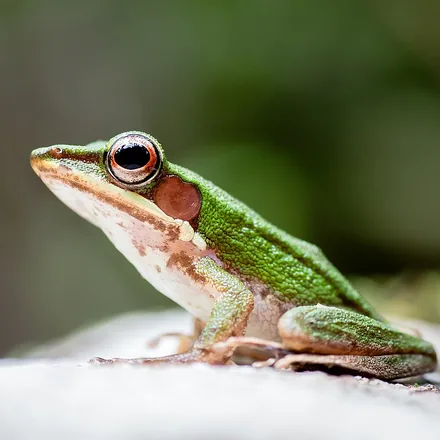
Copper-cheeked Frog Common
Chalcorana eschatia
Its eyes throw back a brilliant copper shine in torchlight, which is usually how you find it before you see the frog.
Where: Streamside vegetation in southern lowland forest; Khao Sok and Hala-Bala. Best: May-Oct, at night.
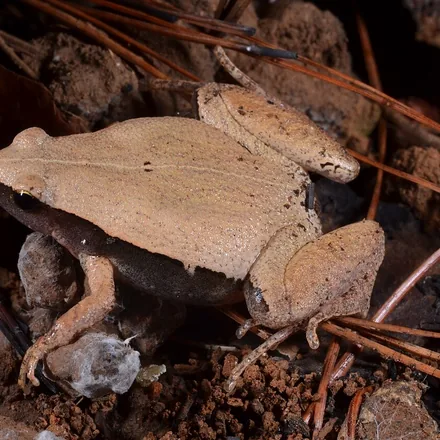
Dark-sided Chorus Frog Common
Microhyla heymonsi
A pale hairline stripe runs the full length of its back, and a pair of dark spots on it mimic eyes at the wrong end.
Where: Shallow standing water in paddies and forest puddles countrywide. Best: May-Oct, at night.
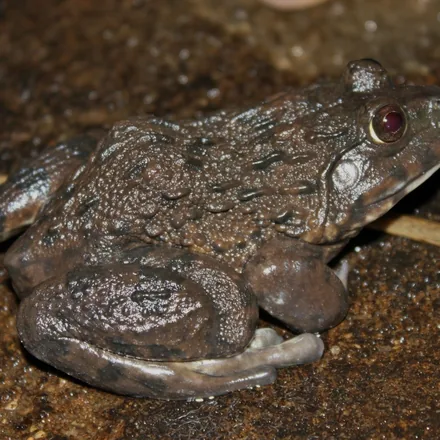
East Asian Bullfrog Common
Hoplobatrachus rugulosus
The big ridge backed frog of the rice paddies, whose deep quacking chorus is the sound of a Thai wet season.
Where: Rice paddies, ponds and canals countrywide. Best: Rainy season, night.
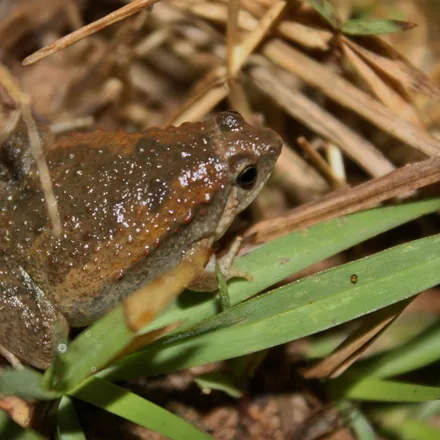
Ornate Narrow-mouthed Frog Common
Microhyla fissipes
Smaller than a thumbnail, and after rain a paddy full of them produces a rasping chorus you can hear a kilometre away.
Where: Paddies, ditches and gardens countrywide. Best: May-Oct, after rain.
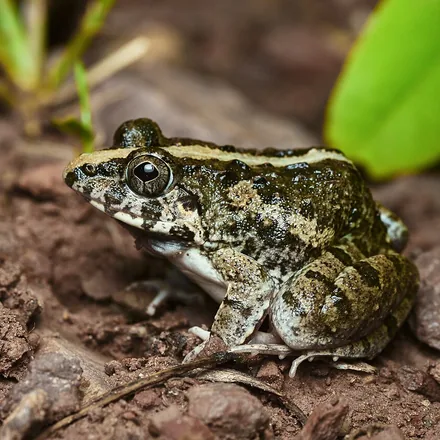
Rice Paddy Frog Common
Fejervarya limnocharis
The single most abundant frog in Thailand, and its numbers are now used as a live monitor for pesticide contamination.
Where: Paddies, ditches and puddles countrywide. Best: Year round, peaking May-Oct.
Planning and responsible watching
Reptiles are most active in the warm hours and amphibians after dark in the rains, so a head torch and a slow night walk will out-perform any daytime drive. Never handle a snake, venomous or not, and do not let a guide do it for a photograph. On the coast, keep well clear of nesting turtles and use no-touch operators. Every conservation status on this page is the current assessment from the IUCN Red List.
Find guided night walks and nature trips in Thailand
Some links on this page are affiliate links. If you book through them, Wildseer may earn a small commission at no extra cost to you.
Frequently asked questions
Where can you see king cobras in Thailand?
Khao Sok and Kaeng Krachan hold them, usually near forest streams in the warm season. Sightings are rare and almost always brief; the species is shy and avoids people.
Are there dangerous snakes in Thailand?
Yes. Cobras, kraits, Russell’s viper and several pit vipers are medically significant. Bites are uncommon and almost always the result of handling or stepping on a snake in the dark. Wear closed shoes at night and carry a torch.
When is the best time to see frogs in Thailand?
The green season from June to October, at night, near streams and pools. This is when breeding choruses are at their loudest and the tree frogs and horned frogs are easiest to find.
Explore more Thailand wildlife
 Mammals of Thailand
 Birds of Thailand
 Fish of Thailand
 Sharks and Rays of Thailand
 Reef Invertebrates of Thailand
 Insects and Spiders of Thailand
Part of the Wildlife in Thailand guide.