
The reef invertebrates of Thailand build and populate the reef itself, and they are what a good snorkeller notices second, once the fish stop being the whole show. This guide covers 90 species: the corals and anemones that make the structure, the molluscs, crustaceans and echinoderms that live in it, and the oddities that most guides never mention.
They are also the easiest group to see badly. Most are small, many are cryptic, and a few are genuinely worth not touching. Each entry gives the habitat, the sites and the season, so you know whether to look on a sand patch, under an overhang or in the shallows at night.
Highlights
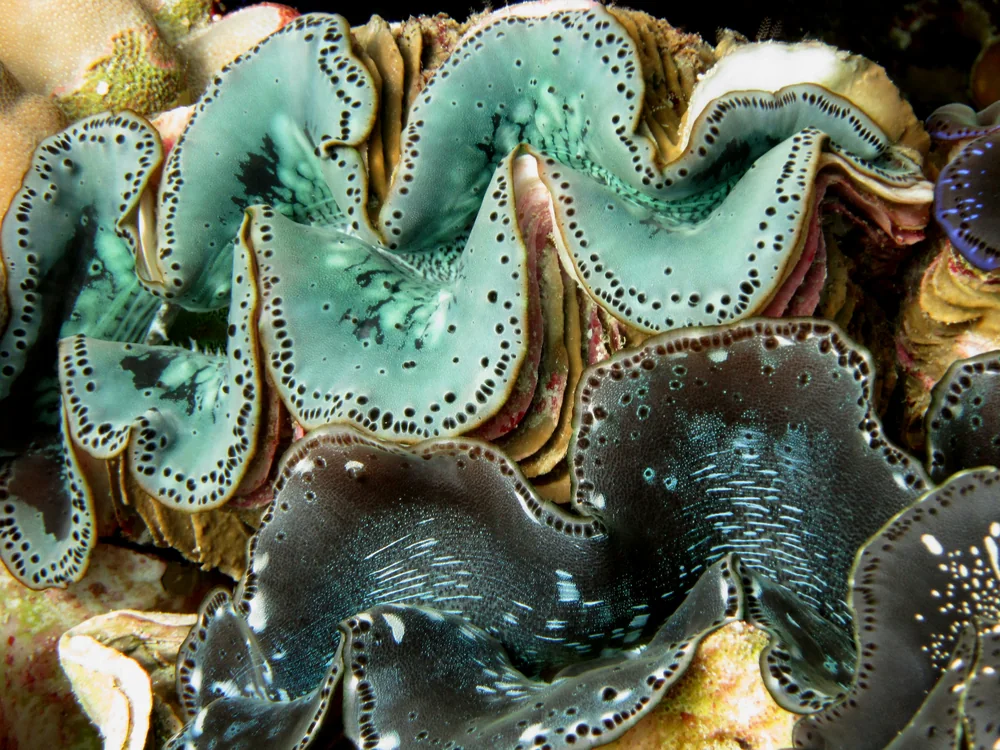
Giant Clam
The largest shellfish on Earth, a metre-wide clam that farms algae in its own rippling, jewel-coloured flesh. Where: Similan, Hin Daeng and Hin Muang, shallow reefs. Best: Dive and snorkel season, Nov-Apr.
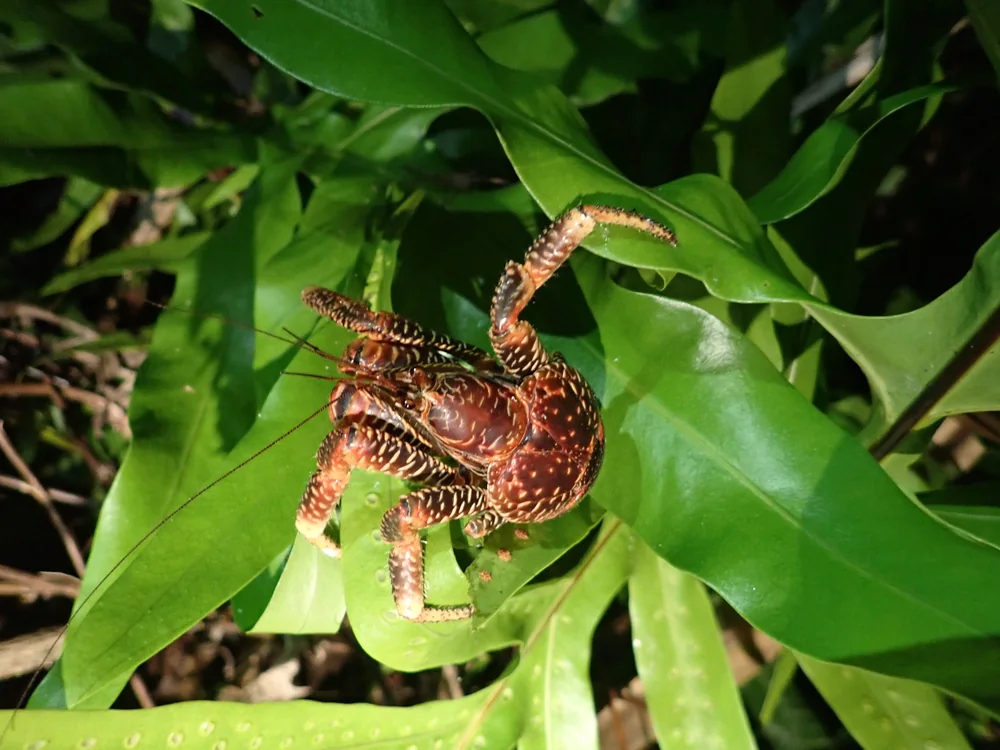
Coconut Crab
The largest land invertebrate on earth, with a grip strong enough to crack a coconut and hold ninety times its own body weight. Where: Remote uninhabited islands; parts of the Surin and Similan groups and outer Andaman islets. Best: Year round, at night.
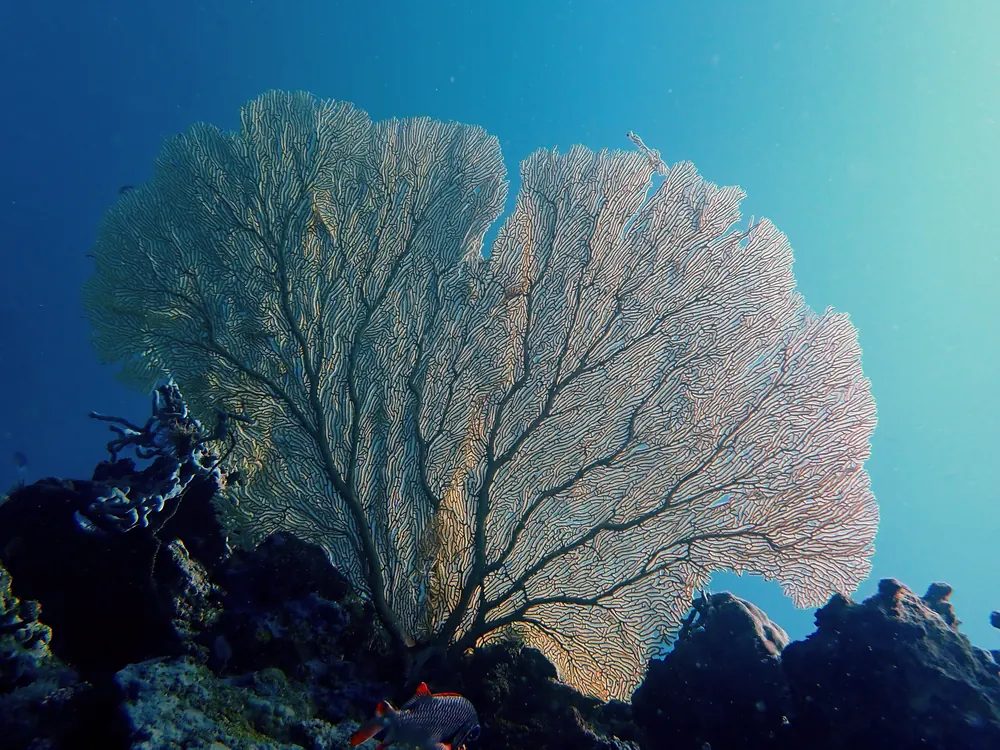
Giant Sea Fan (Gorgonian)
A great lattice fan spread across the current, a soft coral that farms the flow for plankton and shelters seahorses and hawkfish. Where: Hin Daeng and Hin Muang, Similan current-swept walls. Best: Dive season, Nov-Apr.
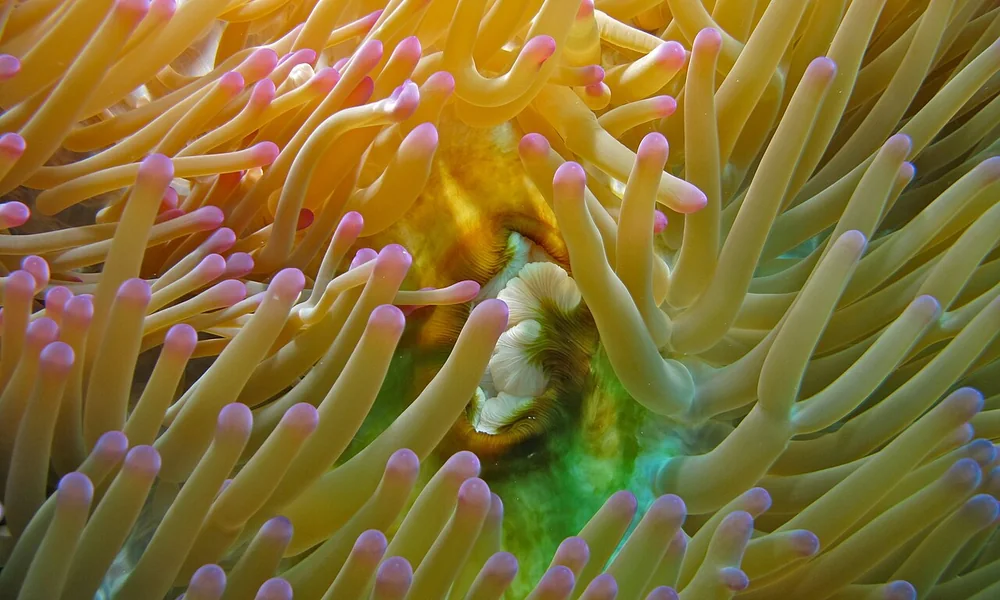
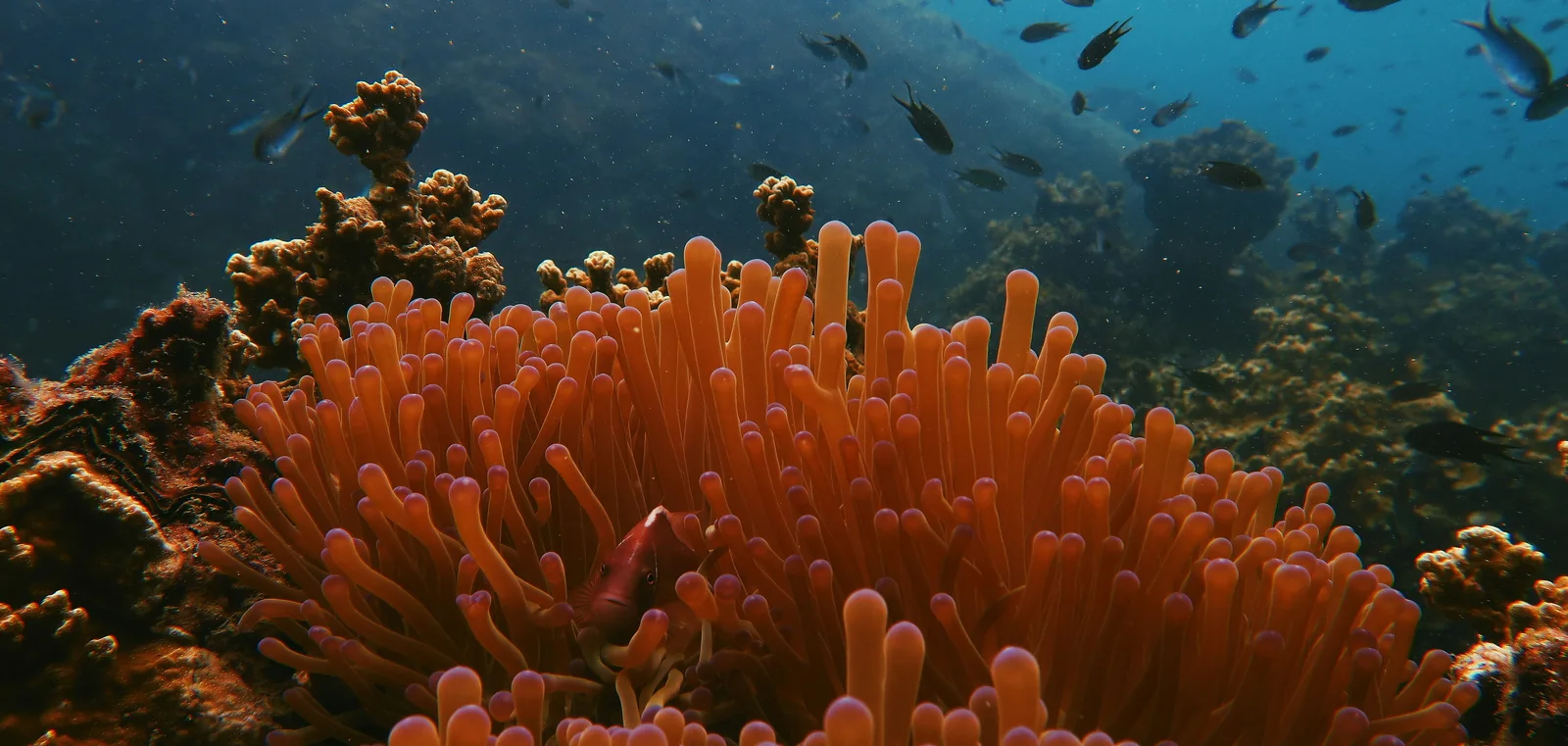
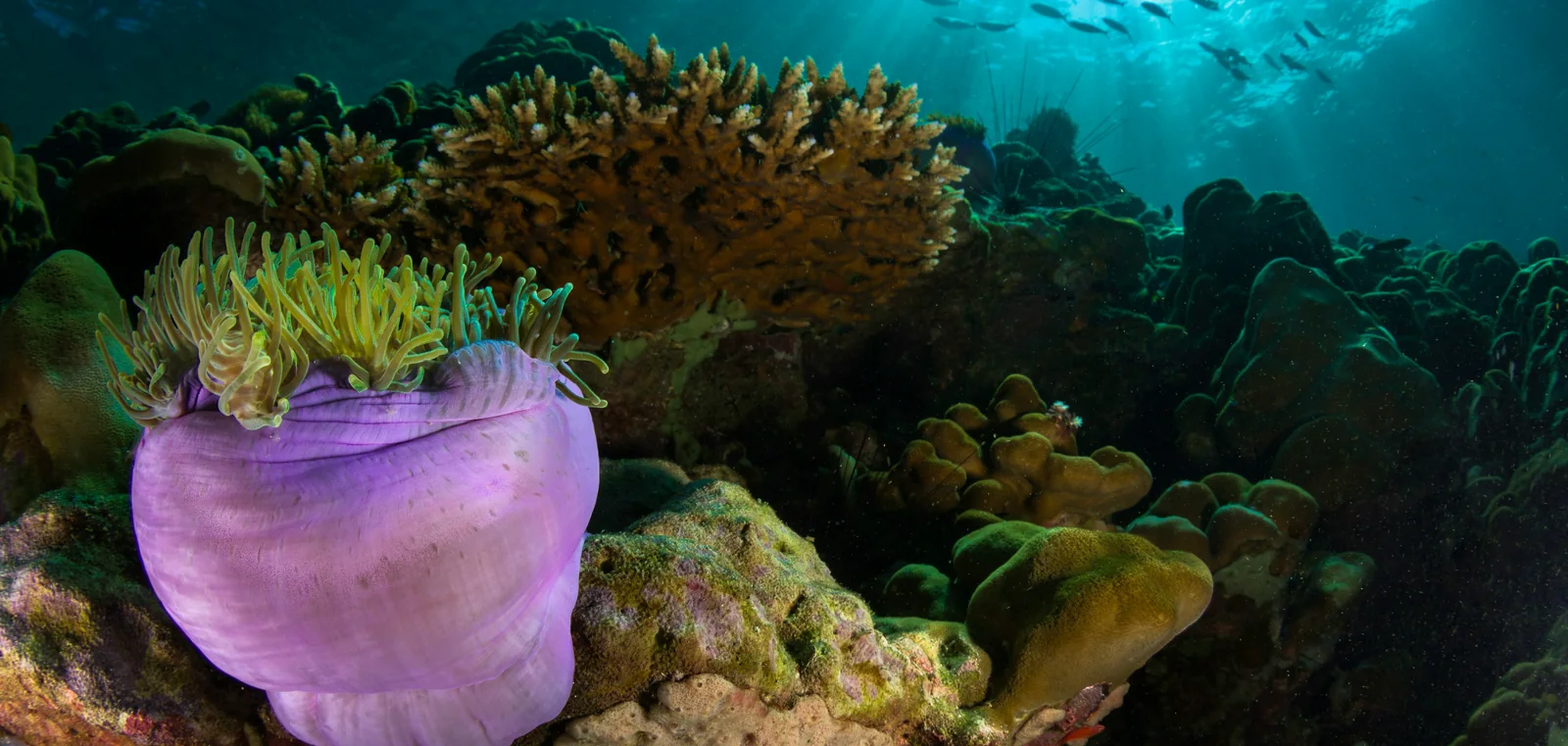
Magnificent Sea Anemone
A great carpet of stinging tentacles that is home and fortress to the anemonefish, a partnership at the heart of the reef. Where: Similan, Trang and Koh Libong, shallow reefs. Best: Dive and snorkel season, Nov-Apr.
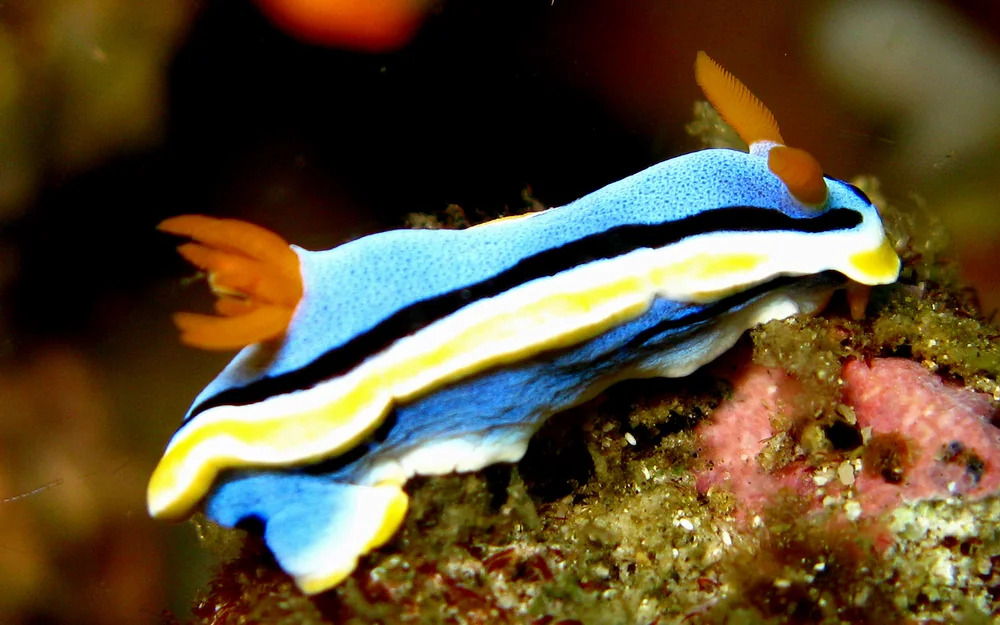
Chromodoris Nudibranch
A tiny sea slug in outrageous colours that borrows toxins from the sponges it eats and flaunts them as a warning. Where: Similan and Andaman reefs, on sponges. Best: Dive season, Nov-Apr.
Corals and anemones
22 species
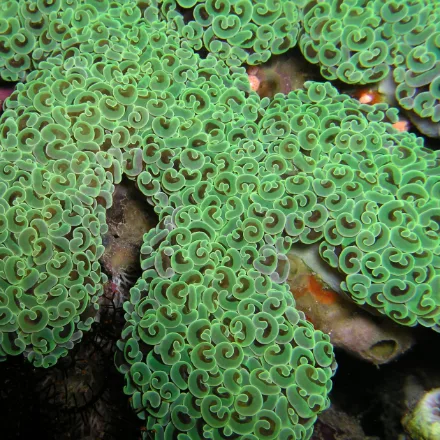
Anchor Coral Occasional Vulnerable
Euphyllia ancora
Every tentacle ends in a fat hammer-shaped tip, so the whole colony looks like a field of tiny anchors.
Where: Sheltered reef slopes and lagoons; Koh Tao, Phi Phi and Koh Chang. Best: Year round.
Blue Coral Occasional Vulnerable
Heliopora coerulea
The only coral on earth with a blue skeleton, hidden under brown tissue until the animal dies.
Where: Shallow high-energy reef; Surin, Similans and parts of the Gulf. Best: Nov-Apr.
Bubble Coral Regular
Plerogyra sinuosa
Inflates itself into a cluster of grape-sized bubbles by day and deflates at night to put out stinging tentacles.
Where: Sheltered reef slopes and overhangs on both coasts. Best: Year round.
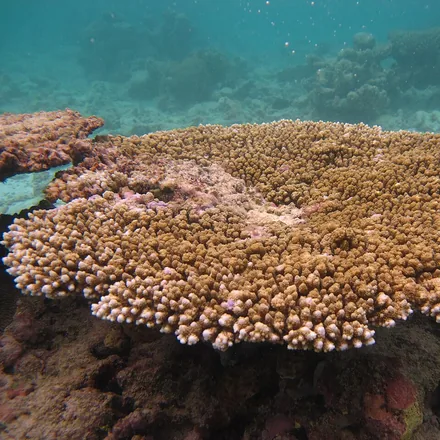
Table Coral Common
Acropora hyacinthus
Grows outward faster than it grows up, spreading a flat platform that shades out every competitor beneath it.
Where: Shallow reef slopes on both coasts; Similans, Surin and Koh Tao. Best: Nov-Apr Andaman, year round Gulf.
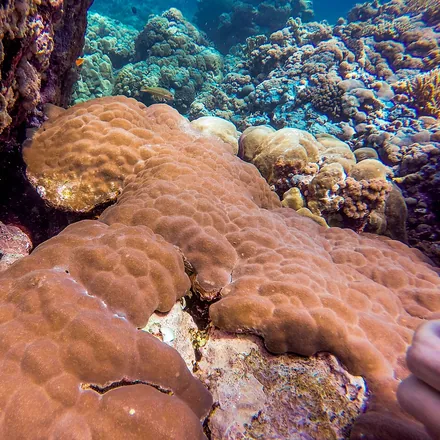
Boulder Porites Common
Porites lutea
Grows about a centimetre a year and lays down annual bands, so a large head is a climate record centuries long.
Where: Reef slopes and flats on both coasts. Best: Year round.
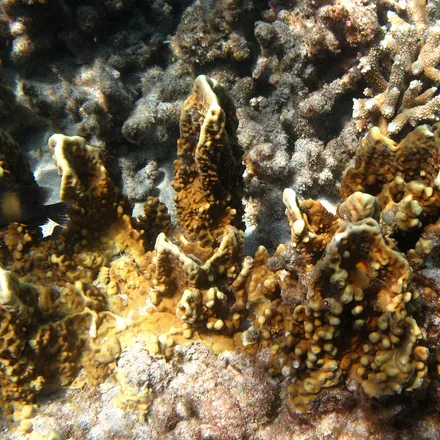
Fire Coral Common
Millepora platyphylla
Not a coral at all but a colonial jellyfish relative, and the sting feels exactly like the name suggests.
Where: Shallow reef, wreckage and rope on both coasts. Best: Year round.
Black Coral Rare
Antipathes dichotoma
Colonies have been aged at over four thousand years, making them among the oldest living animals on the planet.
Where: Deep walls, caves and shaded overhangs; Hin Daeng, Hin Muang and Richelieu Rock. Best: Nov-Apr.
Haddon's Carpet Anemone Occasional
Stichodactyla haddoni
A metre-wide sticky carpet on open sand that will genuinely hold onto a bare hand, and can pull a small fish under.
Where: Silty sand and seagrass; inner Gulf, Ao Phang Nga and Trang. Best: Year round.
Sea Pen Occasional
Pteroeides sp.
Plants itself in the sand like a quill pen, glows blue-green when touched, and can pull itself completely underground.
Where: Sandy slopes beside reef; Koh Tao, Ao Phang Nga and Koh Lipe. Best: Year round, at night.
Carnation Soft Coral Regular
Dendronephthya species
An explosion of pink, red and orange bloom that inflates with water to feed, turning shaded walls into hanging gardens.
Where: Hin Daeng and Hin Muang, Similan shaded walls and overhangs. Best: Dive season, Nov-Apr.
Carnation Tree Coral Regular
Dendronephthya klunzingeri
Has no algae and no skeleton, and pumps itself up with seawater until it stands rigid in the current.
Where: Current-swept pinnacles and walls; Richelieu Rock, Hin Daeng and Chumphon Pinnacle. Best: Nov-Apr Andaman, year round Gulf.
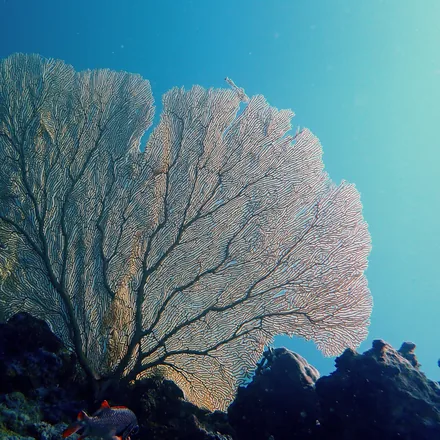
Giant Sea Fan (Gorgonian) Regular
Annella species
A great lattice fan spread across the current, a soft coral that farms the flow for plankton and shelters seahorses and hawkfish.
Where: Hin Daeng and Hin Muang, Similan current-swept walls. Best: Dive season, Nov-Apr.
Mushroom Coral Regular
Fungia species
A rare solitary coral that is a single giant polyp, unattached and able to right itself and even creep across the sand.
Where: Similan and Andaman reefs and sand. Best: Dive and snorkel season, Nov-Apr.
Orange Sun Coral Regular
Tubastraea coccinea
One of the few corals with no algae inside it, so it can live in complete darkness and feeds entirely by hunting.
Where: Caves, overhangs and wrecks on both coasts; HTMS Chang and Similan swim-throughs. Best: Year round, at night.
Sea Whip Coral Regular
Junceella fragilis
A single unbranched rod up to two metres tall, and it reproduces by simply dropping pieces of itself.
Where: Current-swept slopes on both coasts; Similans, Hin Daeng and Sail Rock. Best: Nov-Apr Andaman, year round Gulf.
Tube Anemone Regular
Cerianthus filiformis
Not an anemone at all: it builds a felt tube out of its own discharged stinging cells and can vanish into it instantly.
Where: Soft sediment beside reef on both coasts. Best: Year round, at night.
Brain Coral Common
Platygyra species
A boulder of living stone grooved in winding ridges and valleys, so like a brain that the name writes itself.
Where: Similan and Andaman reefs. Best: Dive and snorkel season, Nov-Apr.
Bulb-tentacle Anemone Common
Entacmaea quadricolor
The tentacles only swell into bulbs when an anemonefish is living in it, and nobody is quite sure why.
Where: Reef crevices on both coasts; Koh Tao, Similans and Phi Phi. Best: Year round.
Encrusting Zoanthid Common
Palythoa tuberculosa
Contains palytoxin, one of the most poisonous non-protein substances known, and it is growing on reef flats you can walk across.
Where: Shallow wave-washed reef flats and rock on both coasts. Best: Year round.
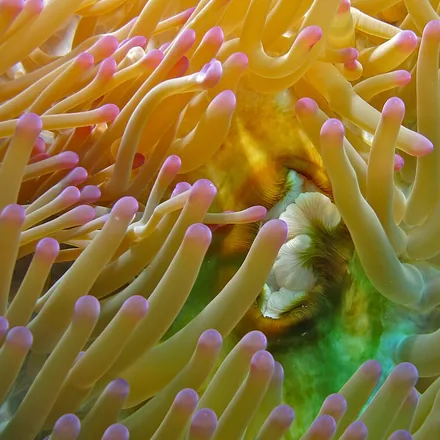
Magnificent Sea Anemone Common
Heteractis magnifica
A great carpet of stinging tentacles that is home and fortress to the anemonefish, a partnership at the heart of the reef.
Where: Similan, Trang and Koh Libong, shallow reefs. Best: Dive and snorkel season, Nov-Apr.
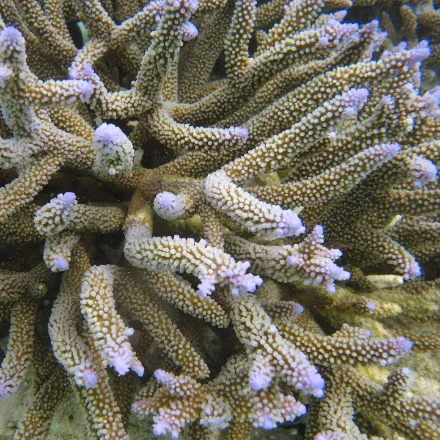
Staghorn Coral Common
Acropora species
The fast-growing branching coral that builds the living thickets of the reef, nursery and shelter for a whole community.
Where: Similan, Trang and Koh Libong, shallow reefs. Best: Dive and snorkel season, Nov-Apr.
Toadstool Leather Coral Common
Sarcophyton trocheliophorum
Shuts down and sheds its entire surface layer every few weeks, waxy skin and all, to clean off algae.
Where: Reef flats and slopes on both coasts. Best: Year round.
Molluscs
24 species
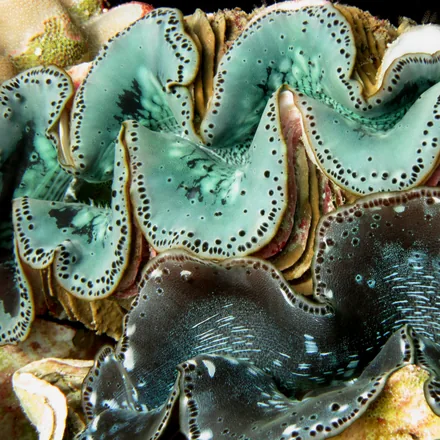
Giant Clam Occasional Critically Endangered
Tridacna gigas
The largest shellfish on Earth, a metre-wide clam that farms algae in its own rippling, jewel-coloured flesh.
Where: Similan, Hin Daeng and Hin Muang, shallow reefs. Best: Dive and snorkel season, Nov-Apr.
Chambered Nautilus Ultra rare Endangered
Nautilus pompilius
A living fossil that has kept the same shell design for 500 million years and steers by pumping gas between chambers.
Where: Deep Andaman drop-offs beyond recreational depth; occasionally on very deep night dives. Best: Nov-Apr.
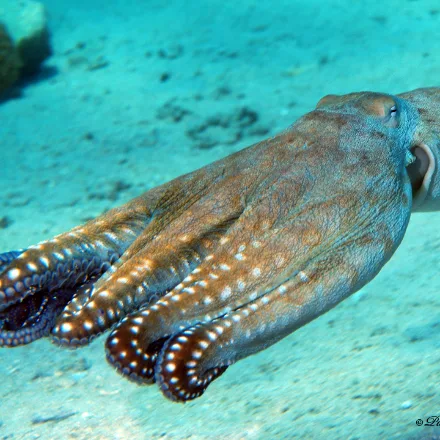
Day Octopus Occasional
Octopus cyanea
A shape-shifting reef genius that can change colour and texture in a blink and pour its boneless body through a coin-sized gap.
Where: Similan, Hin Daeng and Hin Muang, coral reefs. Best: Dive season, day.
Geographic Cone Snail Occasional
Conus geographus
The most venomous snail on earth: it releases a cloud of insulin to stun whole fish, then swallows them whole.
Where: Shallow sand and rubble on both coasts, mostly nocturnal. Best: Year round.
Textile Cone Snail Occasional
Conus textile
Its shell pattern is a natural cellular automaton, the same mathematics that generates computer-drawn fractals.
Where: Reef flats, rubble and sand on both coasts. Best: Year round, active at night.
Tiger Cowrie Occasional
Cypraea tigris
The mirror gloss comes from the animal itself, which wraps a fleshy mantle right over the shell and polishes it constantly.
Where: Crevices and overhangs on reefs both coasts. Best: Year round, out feeding at night.
Mimic Octopus Ultra rare
Thaumoctopus mimicus
Impersonates lionfish, flatfish and sea snakes, choosing the right disguise for whichever predator is bothering it.
Where: Open silt and sand near river mouths; Ao Phang Nga and inner Gulf muck sites. Best: Year round.
Berry's Bobtail Squid Rare
Euprymna berryi
Farms glowing bacteria in a light organ and uses them to erase its own shadow from the moonlit sand below.
Where: Sandy patches on night dives; Koh Tao, Koh Lipe and Ao Phang Nga. Best: Year round, at night.
Blue-ringed Octopus Rare
Hapalochlaena
A thumb-sized octopus whose glowing blue rings warn of venom with no antidote.
Where: Rubble and shallow reef, Andaman and Gulf. Best: Year round.
Coconut Octopus Rare
Amphioctopus marginatus
Carries a coconut shell around under its body and reassembles it into a shelter, one of the few clear cases of tool use in an invertebrate.
Where: Sandy and silty bottoms beside reef; Koh Tao, Ao Phang Nga and Koh Lipe. Best: Year round, best at dusk and night.
Flamboyant Cuttlefish Rare
Metasepia pfefferi
The only cuttlefish known to be poisonous to eat, and it advertises the fact in pulsing purple, yellow and red.
Where: Silty sand and muck sites; Ao Phang Nga, Koh Tao and Trang. Best: Year round.
Triton's Trumpet Rare
Charonia tritonis
A giant sea snail with a beautiful spiral shell that is one of the very few animals to hunt and eat the coral-killing crown-of-thorns.
Where: Similan and Andaman reefs. Best: Dive season, Nov-Apr.
Blue Dragon Nudibranch Occasional
Pteraeolidia semperi
Steals stinging cells from the hydroids it eats and redeploys them, live and functional, in its own tentacles.
Where: Hydroid clumps on reef and wreck structure both coasts. Best: Year round.
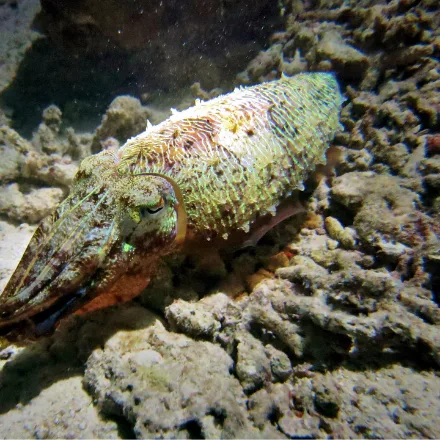
Broadclub Cuttlefish Occasional
Sepia latimanus
A big reef cuttlefish that hypnotises prey with bands of colour pulsing down its arms.
Where: Reefs and seagrass, Similan, Koh Tao, Phi Phi. Best: Year round.
Giant Spider Conch Occasional
Lambis truncata
It does not crawl, it pole-vaults, hooking a claw-shaped foot into the sand and flipping itself forward.
Where: Seagrass and sand flats in the Andaman; Trang, Koh Lipe and Ao Phang Nga. Best: Year round.
Painted Tree Snail Occasional
Amphidromus atricallosus
A tree snail that comes in both left and right handed shells, sometimes within a single population, which is almost unheard of.
Where: Lowland and hill forest trunks and low branches; Khao Yai, Khao Sok and Kaeng Krachan. Best: May-Oct, after rain.
Pharaoh Cuttlefish Occasional
Sepia pharaonis
A hovering cuttlefish that hypnotises prey by rippling bands of colour down its body like a living screen.
Where: Andaman reefs and reef margins. Best: Dive season, Nov-Apr.
Spanish Dancer Occasional
Hexabranchus sanguineus
A giant crimson sea slug that unfurls its frilled body and swims through open water like a flamenco dancer's skirt.
Where: Similan, Hin Daeng and Hin Muang, night dives. Best: Dive season, night.
Variable Neon Slug Occasional
Nembrotha kubaryana
Eats toxic sea squirts, keeps their poison for itself, and then advertises it in green and orange.
Where: Tunicate-covered reef and wreck on both coasts; Koh Tao and the Similans. Best: Year round.
Wedge Sea Hare Occasional
Dolabella auricularia
Ejects a cloud of purple ink that does not hide it but jams the chemical senses of whatever is attacking.
Where: Shallow seagrass and sand; Trang, Ao Phang Nga and the inner Gulf. Best: Year round.
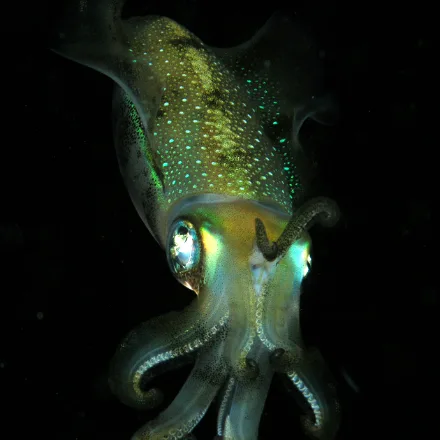
Bigfin Reef Squid Regular
Sepioteuthis lessoniana
Talks in colour: it can run one message down its left side and a different one down its right at the same time.
Where: Reef edges on both coasts; Koh Tao, Similans and Phi Phi. Best: Year round, best at night.
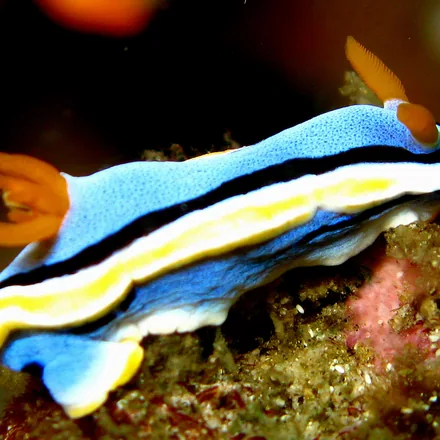
Chromodoris Nudibranch Regular
Chromodoris species
A tiny sea slug in outrageous colours that borrows toxins from the sponges it eats and flaunts them as a warning.
Where: Similan and Andaman reefs, on sponges. Best: Dive season, Nov-Apr.
Thorny Oyster Regular
Spondylus varius
Cements itself permanently to the reef and grows a fringe of dozens of tiny bright eyes along the mantle edge.
Where: Fixed to reef and wreck structure on both coasts. Best: Year round.
Varicose Phyllidia Regular
Phyllidia varicosa
Squeezes out a toxin strong enough to kill every fish in a bucket with it, which is why nothing on the reef will touch it.
Where: Sponge-covered rock on reefs both coasts. Best: Year round.
Crustaceans
19 species
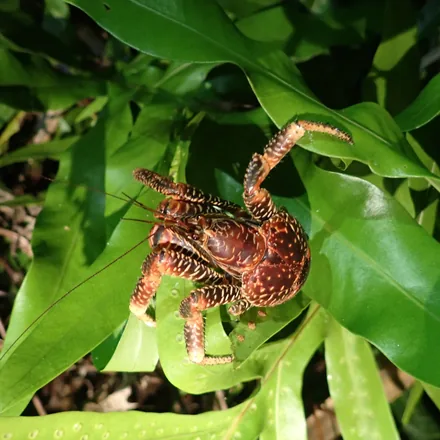
Coconut Crab Ultra rare Vulnerable
Birgus latro
The largest land invertebrate on earth, with a grip strong enough to crack a coconut and hold ninety times its own body weight.
Where: Remote uninhabited islands; parts of the Surin and Similan groups and outer Andaman islets. Best: Year round, at night.
Ornate Spiny Lobster Occasional
Panulirus ornatus
Migrates in single file across open seabed, hundreds of lobsters nose to tail, sometimes for hundreds of kilometres.
Where: Reef, rubble and silty inshore bottoms on both coasts. Best: Year round, at night.
Painted Spiny Lobster Occasional
Panulirus versicolor
Has no crushing claws at all, and defends itself instead by rasping out a screech you can hear underwater.
Where: Under coral heads and ledges on both coasts; Similans, Koh Tao and Phi Phi. Best: Year round, best at night.
Boxer Crab Rare
Lybia tessellata
Carries a live sea anemone in each claw and waves them at threats, and if it loses one it tears the other in half to clone a replacement.
Where: Rubble and under coral on both coasts; Koh Tao, Koh Lipe and the Similans. Best: Year round, at night.
Harlequin Shrimp Rare
Hymenocera picta
A shrimp painted like fine porcelain that hunts as a devoted pair and eats nothing but living starfish.
Where: Similan and Andaman reefs, in crevices. Best: Dive season, Nov-Apr.
Regal Crab Rare
Thaiphusa sirikit
Purple, white and scarlet, found in a handful of Thai streams and nowhere else on earth.
Where: Forest streams and waterfalls in the west; Kanchanaburi and Tak provinces. Best: May-Jul, at the start of the rains.
Slipper Lobster Rare
Scyllarides squammosus
Its antennae have been flattened into two broad shovels, which it uses to bulldoze into sand and disappear.
Where: Under ledges and buried in sand beside reef both coasts. Best: Year round, at night.
Zebra Mantis Shrimp Rare
Lysiosquillina maculata
The largest mantis shrimp in the world, and it pairs for life in a burrow it may hold for twenty years.
Where: Sand and rubble beside reef; Koh Tao, Ao Phang Nga and Koh Lipe. Best: Year round, at dusk.
Emperor Shrimp Occasional
Zenopontonia rex
Rides on the back of sea cucumbers and nudibranchs, hitching a lift and eating whatever its host stirs up.
Where: On sea cucumbers and nudibranchs on both coasts. Best: Year round.
Giant Mud Crab Occasional
Scylla serrata
The claws can generate enough force to crush a large clam, and will take a finger off without much trouble.
Where: Mangrove creeks and root systems on both coasts. Best: Year round, on a moving tide.
Hairy Squat Lobster Occasional
Lauriea siagiani
Lives only on giant barrel sponges, and is so small and so pink that most divers swim past a dozen without noticing.
Where: On giant barrel sponges; Similans, Richelieu Rock and Koh Tao. Best: Nov-Apr Andaman, year round Gulf.
Peacock Mantis Shrimp Occasional
Odontodactylus scyllarus
A jewel-coloured reef brawler that punches with the speed of a bullet and sees the world in colours we cannot imagine.
Where: Andaman reef rubble and sand, Similan. Best: Dive season, Nov-Apr.
Porcelain Anemone Crab Occasional
Neopetrolisthes maculatus
A tiny spotted crab that shelters in an anemone alongside the clownfish, fishing the current with feathery fans.
Where: Similan, Trang and Koh Libong, in sea anemones. Best: Dive and snorkel season, Nov-Apr.
White-spotted Hermit Crab Occasional
Dardanus megistos
Bright red and dotted with white, and it will kill a living snail to take the shell it wants.
Where: Reef and rubble on both coasts. Best: Year round, at night.
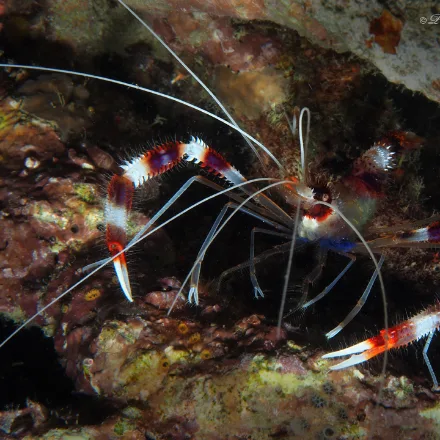
Banded Coral Shrimp Regular
Stenopus hispidus
A candy-striped shrimp with impossibly long white antennae that it waves to advertise its parasite-cleaning service.
Where: Similan, Hin Daeng and Hin Muang, reef crevices. Best: Dive season, Nov-Apr.
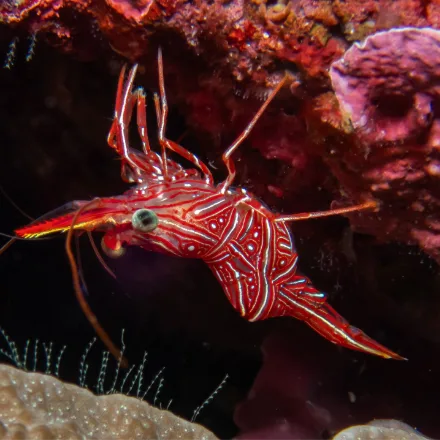
Durban Dancing Shrimp Regular
Rhynchocinetes durbanensis
Packs into caves in the hundreds, and the whole mass sways together when a torch beam crosses them.
Where: Caves and dark overhangs on both coasts; Koh Tao and Phi Phi. Best: Year round.
Fiddler Crab Common
Austruca annulipes
The male's oversized claw is useless for feeding, so he has to do everything with the small one while waving the big one at females.
Where: Mangrove mudflats on both coasts; Krabi, Ranong, Ao Phang Nga and Bang Pu. Best: Year round, strictly low tide.
Horn-eyed Ghost Crab Common
Ocypode ceratophthalmus
The fastest crab on earth, clocked at over two metres a second, and it growls at intruders from inside its burrow.
Where: Sandy beaches countrywide. Best: Year round, at dusk and after dark.
Tiger Pistol Shrimp Common
Alpheus bellulus
Snaps its claw hard enough to create a bubble that briefly reaches the temperature of the surface of the sun.
Where: Sandy margins beside reef on both coasts. Best: Year round.
Sea stars, urchins and sea cucumbers
15 species
Pineapple Sea Cucumber Rare Endangered
Thelenota ananas
A metre-long sea cucumber covered in star-shaped spikes, and one of the most valuable animals per kilo in Asian seafood.
Where: Reef slopes in the Andaman; Similans, Surin and Koh Lipe. Best: Nov-Apr.
Sea Apple Rare
Pseudocolochirus violaceus
A sea cucumber that stands upright and feeds with a crown of branching tentacles, and poisons the whole water column if it dies.
Where: Current-swept slopes and pinnacles; Hin Daeng, Richelieu Rock and Chumphon Pinnacle. Best: Nov-Apr Andaman, year round Gulf.
Basket Star Occasional
Astroboa nuda
A tangled ball by day that unfurls after dark into a two-foot net of branching arms to strain the current.
Where: On sea fans and whips at current-swept sites; Richelieu Rock, Hin Daeng and Sail Rock. Best: Nov-Apr Andaman, year round Gulf.
Crown-of-thorns Starfish Occasional
Acanthaster planci
A many-armed, venom-spined starfish that eats living coral and, in plague numbers, can strip a reef bare.
Where: Andaman coral reefs. Best: Dive season, Nov-Apr.
Fire Urchin Occasional
Asthenosoma varium
Its spines glow orange-red at the tips and deliver a burning sting, and a pair of tiny shrimp live on it in perfect safety.
Where: Sand and rubble slopes on both coasts; Koh Tao and Ao Phang Nga. Best: Year round, most active at dusk.
Flower Urchin Occasional
Toxopneustes pileolus
Looks like a bouquet of pink and white flowers and is listed as the most dangerous sea urchin in the world.
Where: Seagrass and shallow reef flats on both coasts. Best: Year round.
Slate Pencil Urchin Occasional
Heterocentrotus mamillatus
Its spines are thick blunt cylinders, and they were once used as writing implements on slate, hence the name.
Where: Crevices on shallow reef; Similans, Surin and Koh Tao. Best: Year round.
Blue Brittle Star Regular
Ophiothrix purpurea
Sheds an arm the instant something grabs it, then walks away and regrows the lost limb over weeks.
Where: Inside barrel sponges and among sea fan bases on both coasts. Best: Year round.
Cushion Star Regular
Culcita novaeguineae
So swollen with age that the arms disappear entirely and it ends up looking like a pentagonal beanbag.
Where: Reef flats and slopes on both coasts, shallow enough for snorkellers. Best: Year round.
Granulated Sea Star Regular
Choriaster granulatus
Fat, pink and smooth as putty, it looks less like a starfish than a set of five bread rolls.
Where: Shallow reef flats and slopes on both coasts. Best: Year round.
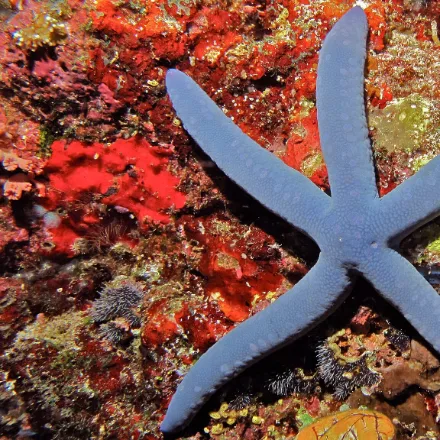
Blue Sea Star Common
Linckia laevigata
An almost unreal cobalt blue starfish scattered across the shallows, able to regrow a whole body from a single lost arm.
Where: Similan, Trang and Koh Libong, shallow reef flats. Best: Dive and snorkel season, Nov-Apr.
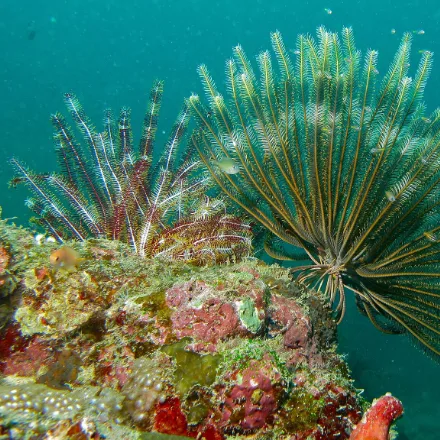
Feather Star (Crinoid) Common
Comatulida species
A living bouquet of feathery arms that clings to high points on the reef by day and can crawl, or even swim, to a better spot.
Where: Hin Daeng and Hin Muang, Similan, reef high points. Best: Dive season, Nov-Apr.
Long-spined Sea Urchin Common
Diadema setosum
A pincushion of needle-sharp black spines with a glowing orange ring, grazing algae and quietly shaping the reef.
Where: Similan and Andaman reefs, crevices. Best: Dive and snorkel season, Nov-Apr.
Pincushion Urchin Common
Tripneustes gratilla
Decorates itself with shell, weed and rubbish held on with its tube feet, apparently as a sunshade.
Where: Seagrass meadows and shallow sand; Trang, Koh Lipe and the inner Gulf. Best: Year round.
Sea Cucumber Common
Holothuria species
The reef's humble recycler, a sausage-shaped animal that eats its way through sand and returns it clean.
Where: Similan and Andaman reef floor and sand. Best: Dive and snorkel season, Nov-Apr.
Other invertebrates
10 species
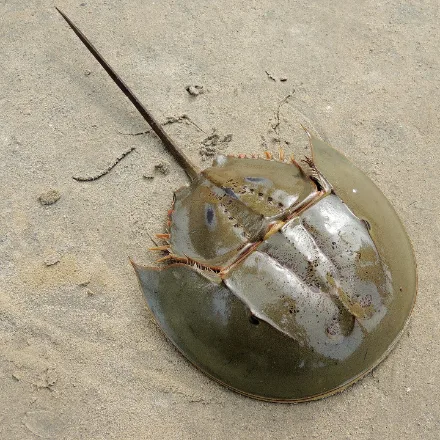
Indo-Pacific Horseshoe Crab Rare Endangered
Tachypleus gigas
Not a crab at all, closer to a spider, and its blue blood is used worldwide to test every injectable drug for contamination.
Where: Quiet sandy and muddy shores; the inner Gulf, Ranong and Trang. Best: Spawning on spring tides around the full and new moon.
Bobbit Worm Rare
Eunice aphroditois
A three metre worm buried in the sand that strikes so fast it can cut a fish in half.
Where: Sand and rubble beside reef on both coasts; Ao Phang Nga and Koh Tao. Best: Year round, at night.
Box Jellyfish Occasional
Chironex indrasaksajiae
Has twenty four eyes, including four that form proper images, and it is the only animal in Thai waters that has killed swimmers.
Where: Gulf coast shallows; Koh Samui, Koh Pha Ngan, Koh Lanta and Hua Hin. Best: Jul-Oct is the peak, but stings occur year round.
Persian Carpet Flatworm Occasional
Pseudobiceros bedfordi
Two hermaphrodites fight by fencing with their reproductive organs, and the loser has to carry the eggs.
Where: Reef and rubble on both coasts. Best: Year round.
Portuguese Man o' War Occasional
Physalia physalis
Not one animal but a colony of four kinds of specialised individual that cannot survive apart.
Where: Open water and windward beaches on both coasts. Best: Nov-Mar, after sustained onshore winds.
Giant Forest Millipede Regular
Thyropygus
A slow, glossy black millipede as long as a pencil that curls into a tight coil when touched.
Where: Damp forest floor nationwide. Best: Rainy season, after rain.
Upside-down Jellyfish Regular
Cassiopea andromeda
Lies on the seabed with its tentacles pointing at the sky, farming algae inside its own tissue like a coral.
Where: Sheltered mangrove lagoons and shallow bays; Ao Phang Nga, Krabi and the inner Gulf. Best: Year round.
Christmas Tree Worm Common
Spirobranchus giganteus
Pairs of tiny spiral trees in every colour, studding the coral and vanishing in a flash when a shadow passes.
Where: Similan and Andaman coral heads. Best: Dive and snorkel season, Nov-Apr.
Giant Barrel Sponge Common
Xestospongia testudinaria
Filters tens of thousands of litres a day and can live for well over a century, which is why divers call them the redwoods of the reef.
Where: Reef slopes on both coasts; Similans, Richelieu Rock and Koh Tao. Best: Year round.
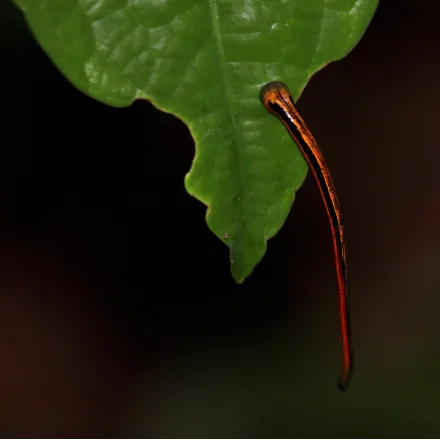
Tiger Leech Common
Haemadipsa picta
Waits on leaf tips with one end waving, detecting your breath and body heat from a metre away.
Where: Wet lowland and hill rainforest; Khao Sok, Kaeng Krachan, Khao Yai and Hala-Bala. Best: May-Oct wet season.
Planning and responsible watching
Nothing on this page should be touched, stood on or collected, and several species will make that point for you. Reef invertebrates are also the first casualties of careless fins and anchors, so pick operators with mooring buoys and a proper briefing. Night dives and shallow rockpools at low tide are where this group comes alive. If you are getting in the water, the Green Fins code of conduct, run by the Reef-World Foundation with UNEP and first trialled in Thailand, is the fifteen-point standard for snorkelling and diving without damaging the reef.
Find reef trips and night dives in Thailand
Some links on this page are affiliate links. If you book through them, Wildseer may earn a small commission at no extra cost to you.
Frequently asked questions
What should you not touch on a Thai reef?
Anything, as a rule. Fire coral, sea urchins, cone snails, the blue-ringed octopus and stonefish are all present and all capable of a serious injury. Corals are also killed by handling.
Where can you see nudibranchs in Thailand?
On sponge-covered walls and overhangs across the Andaman, especially Richelieu Rock, the Similans and Hin Daeng. They are small and easy to miss, so dive slowly and look at the surfaces rather than the water column.
When is the best time for reef life in Thailand?
November to April on the Andaman side, when visibility peaks and the sites are diveable. The Gulf, including Koh Tao, is workable for much of the year.
Explore more Thailand wildlife
 Mammals of Thailand
 Birds of Thailand
 Reptiles and Amphibians of Thailand
 Fish of Thailand
 Sharks and Rays of Thailand
 Insects and Spiders of Thailand
Part of the Wildlife in Thailand guide.