
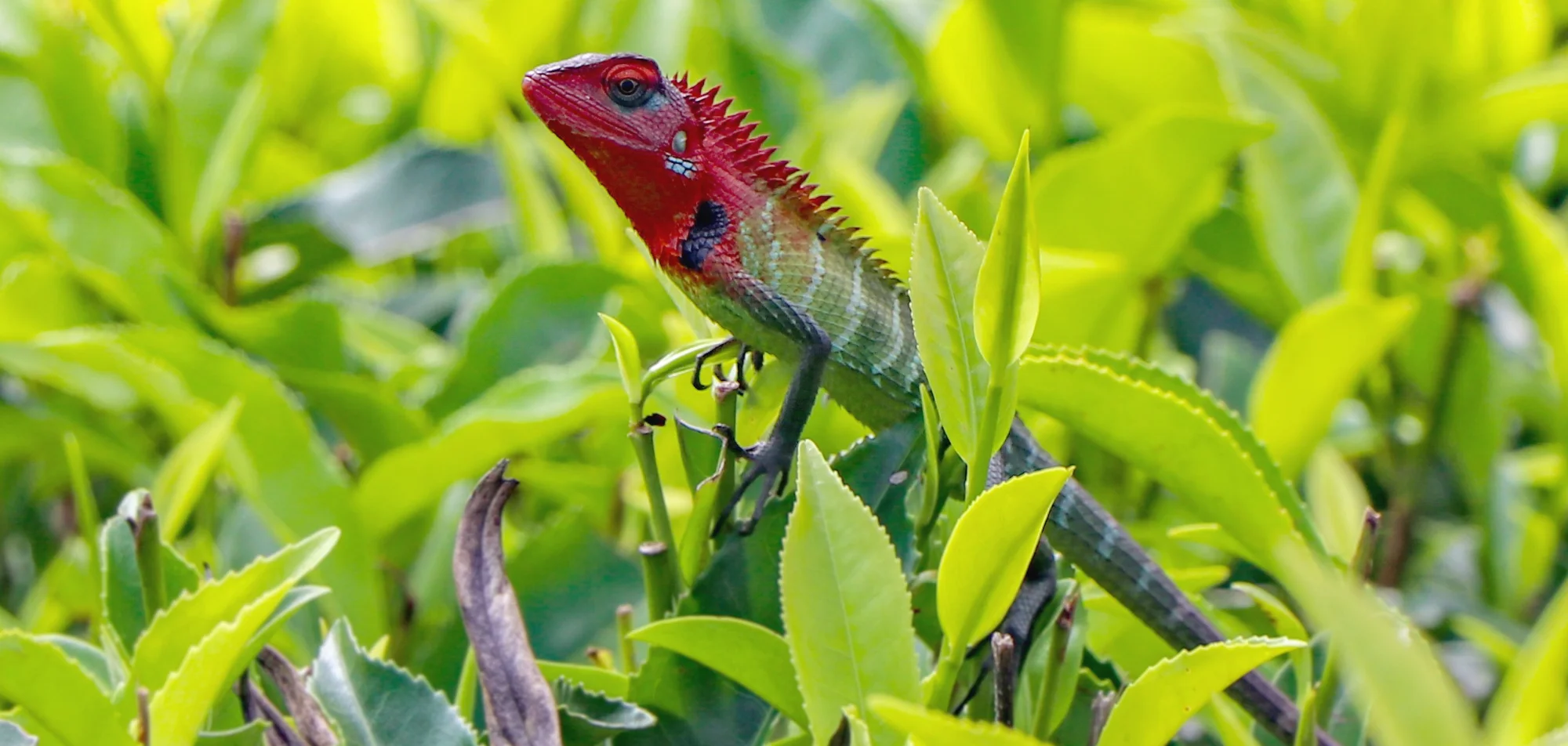
The reptiles and amphibians of Sri Lanka are the island’s real claim on the natural world. The wet zone holds an endemic radiation of shrub frogs found on no other landmass, many of them skipping the tadpole stage entirely and hatching as miniature adults out of an egg laid in leaf litter. The lizards match them: horned, rough-scaled and leaf-nosed agamids that look assembled rather than evolved, most of them confined to a single forest block.
This page lists every reptile and amphibian the Wildseer database records for Sri Lanka. It also records what the island has lost. Sri Lanka declared 21 amphibian species extinct in 2004, more than any country on earth; three have since been found alive, and eighteen are still listed as gone. That is part of the honest picture of this group and we do not leave it out.
This page lists all 82 reptiles and amphibians recorded for Sri Lanka in the Wildseer database. Use the contents to jump to a group.
Highlights
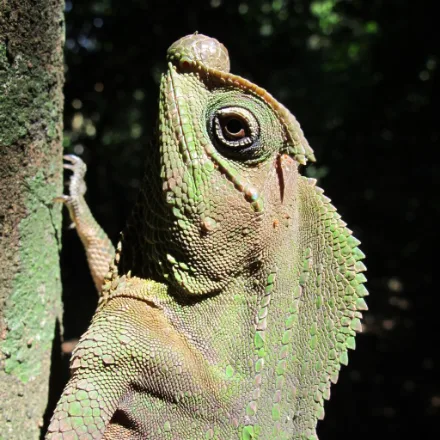
Hump-nosed Lizard
The only member of its genus anywhere on earth, with a bulbous knob on its nose and a bony lyre across its skull, and it is slow enough to photograph properly. Where: Wet zone forest with dense understorey, from near sea level to 1,650 m. Best: Year round, best January to March and July to August.
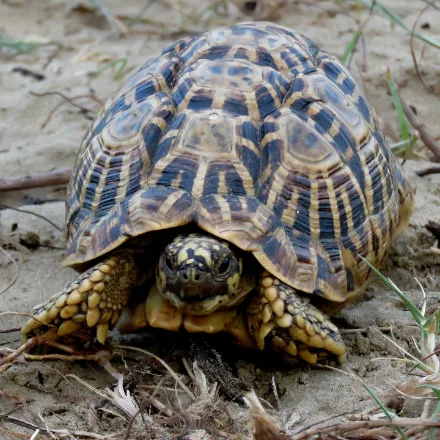
Indian Star Tortoise
The most trafficked tortoise on earth, and the Sri Lankan animals are the biggest and the most boldly starred of the lot. Where: Dry and arid zone thorn scrub, dune country and grassy clearings below about 270 m. Best: Best after rain, October to December and March to April.
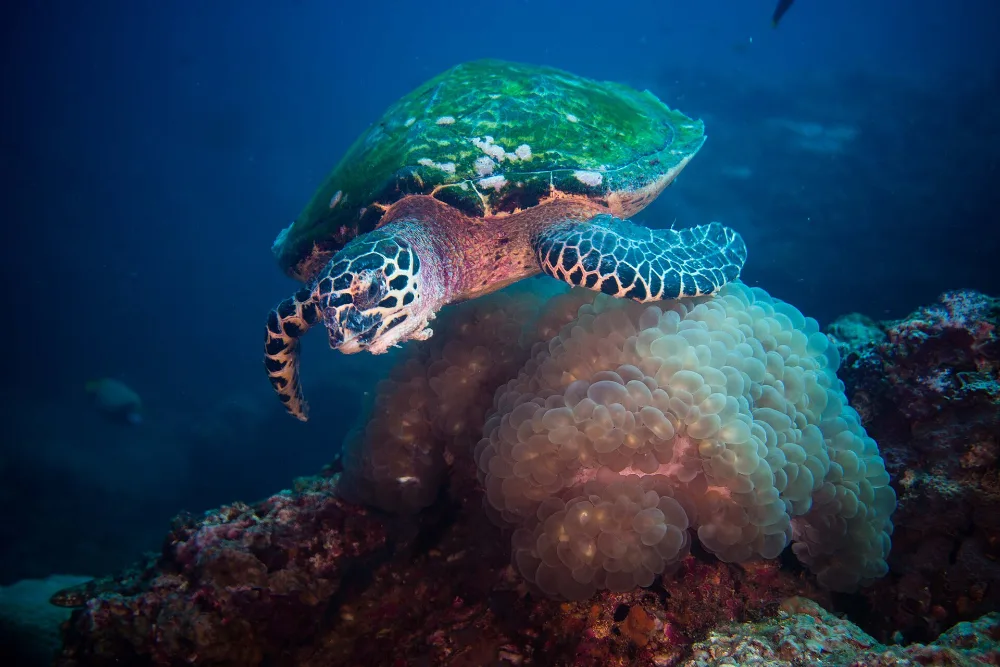
Hawksbill Turtle
The reef's sponge specialist, its beautiful shell also the reason it was hunted to the edge. Where: Coral reef, feeding on sponges; nesting on coarse sand pocket beaches and now very rare. Best: Reef season by coast; nesting almost nonexistent.
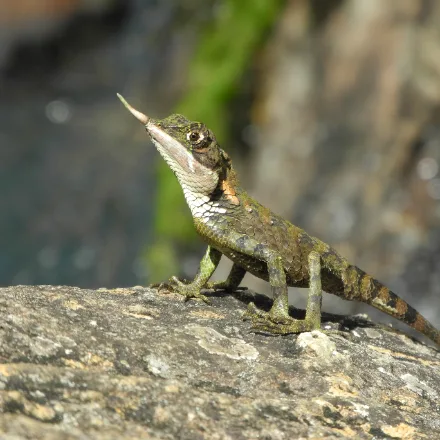
Rhino-horned Lizard
A cloud forest lizard with a curved horn on its nose, and when it is cornered it opens a bright orange mouth at you. Where: Mossy montane cloud forest between about 1,200 m and 2,300 m. Best: January to March, early morning.
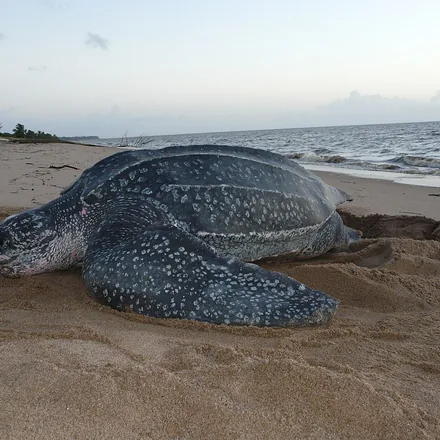
Leatherback Turtle
The largest turtle on Earth, a jellyfish hunter that dives deeper than most whales and crosses whole oceans. Where: Nesting on steep, high energy south coast beaches with deep water access. Best: January to June.
Reptiles
51 species
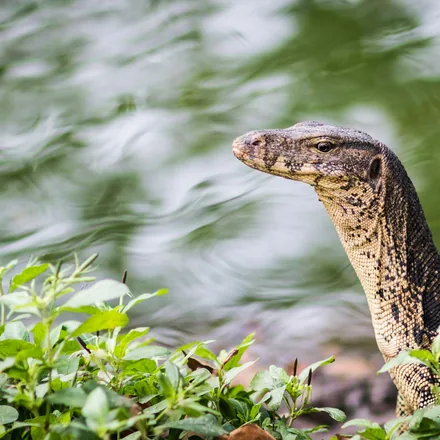
Asian Water Monitor Common
Varanus salvator
Dark and powerfully built with pale spots and a keeled swimming tail, the water monitor forages along rivers, mangroves and even urban waterways. It eats almost anything, from fish and frogs to carrion and eggs.
Where: Any tank, river, lagoon or canal below about 1,000 m, including in the middle of Colombo. Best: Year round. The largest ever recorded, at 3.21 m, was a Sri Lankan animal. Also on: Bundala National Park, Yala National Park, Colombo and the wetlands, Wilpattu National Park, Udawalawe National Park, Tangalle and Kalametiya.
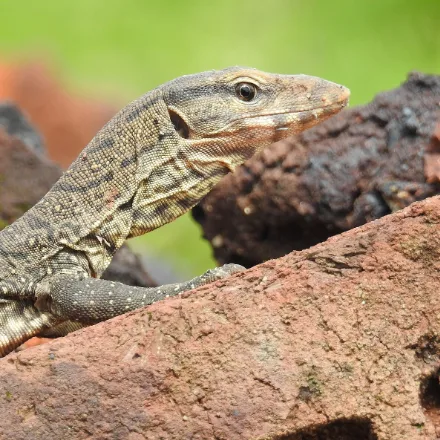
Bengal Monitor Common
Varanus bengalensis
Bengal monitors forage widely across dry forest and scrub, digging out insects, eggs, frogs and small vertebrates. Unlike the water monitor they are not tied to rivers and can be found far from water.
Where: Dry zone scrub, forest, farmland, termite mounds and tree hollows below about 1,500 m. Best: February to September. Terrestrial, unlike the water monitor, and the two are constantly confused. Also on: Yala National Park, Wilpattu National Park, Minneriya and Kaudulla National Parks, Udawalawe National Park, Sigiriya, Dambulla and the Cultural Triangle, Kumana National Park.
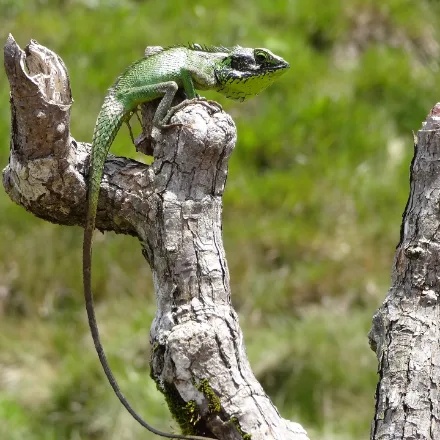
Black-lipped Lizard Common Endangered
Calotes nigrilabris
A large green agamid with a conspicuous black band along the lip, running back from the mouth. Breeding males develop swollen cheeks and stronger colour.
Where: Montane shrub, hedge and tree trunks above about 1,000 m. Best: Year round, sunny mornings. The easiest Endangered lizard on the island to photograph. Also on: Horton Plains and Nuwara Eliya, Knuckles Range, Ella and the Uva Highlands, Adam's Peak and Peak Wilderness.
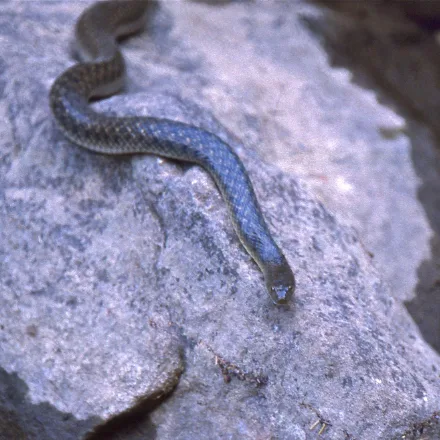
Checkered Keelback Common
Fowlea piscator
Olive brown with a chequerboard of dark squares, keeled scales that give a rough matt finish, and two black streaks running back and down from the eye.
Where: Tanks, paddy, canals, marsh and village wells to about 1,000 m. Best: Year round, day and night. The snake most visitors to Sri Lanka actually photograph. Also on: Bundala National Park, Yala National Park, Udawalawe National Park, Colombo and the wetlands, Kumana National Park, Gal Oya National Park.
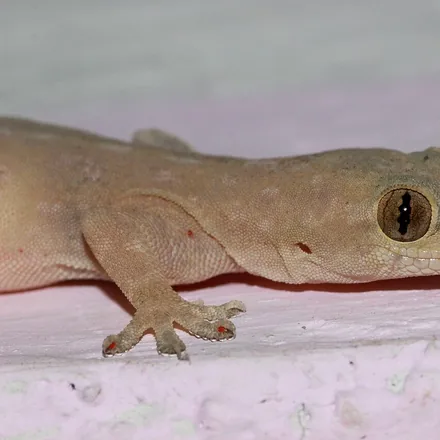
Common House Gecko Common
Hemidactylus frenatus
House geckos gather around lights at night to take moths and insects, and are the source of the chirping chatter heard from every wall in Thailand. Toe pads carry millions of setae that split into finer spatulae, generating adhesion through molecular attraction alone.
Where: Every lit wall, veranda and ceiling in the country. Best: Year round, after dark. The commonest house gecko in Sri Lanka is actually the Sri Lankan spotted house gecko, Hemidactylus parvimaculatus, which is a separate species; both are on the walls. Also on: Colombo and the wetlands, Kandy, Yala National Park, Jaffna and the Northern Peninsula, Mannar and the Gulf of Mannar, Tangalle and Kalametiya.
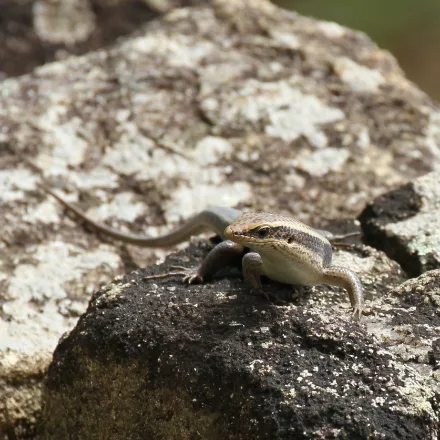
Common Lanka Skink Common
Lankascincus fallax
Small, glossy and bronze brown with a dark band along the flank and a pale line above it. Legs are small but functional, and it moves in short fast bursts before diving back into litter.
Where: Leaf litter and rotting logs in wet zone forest, sea level to about 2,000 m. Best: Year round, best in damp litter after rain. Turn damp litter anywhere in the wet zone and one appears within minutes. Also on: Sinharaja Forest Reserve, Knuckles Range, Horton Plains and Nuwara Eliya, Kitulgala and the Makandawa Rainforest, Kanneliya Forest Reserve, Adam's Peak and Peak Wilderness.
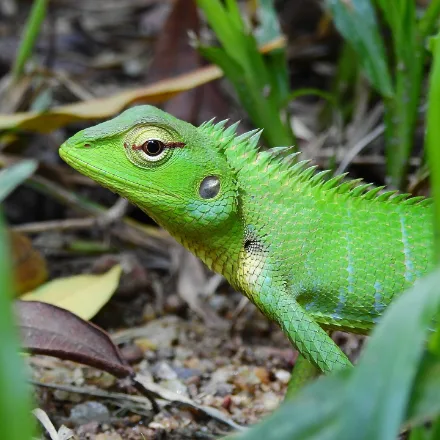
Green Forest Lizard Common
Calotes calotes
Bright green with five or six pale transverse bars, a big lanceolate crest running from the nape down the back, and in breeding males a brilliant crimson head and throat.
Where: Trunks and foliage in forest, plantation and garden from sea level to 1,500 m. Best: Year round, breeding colour strongest in the wetter months. The most photographed lizard in Sri Lanka, and the largest. Also on: Sinharaja Forest Reserve, Kandy, Knuckles Range, Wilpattu National Park, Kitulgala and the Makandawa Rainforest, Adam's Peak and Peak Wilderness.
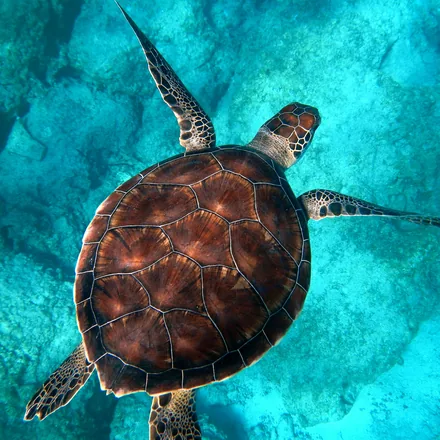
Green Sea Turtle Common
Chelonia mydas
Large and smooth shelled, the green turtle mows seagrass meadows and algae over shallow reefs, a diet that gives its body fat the greenish tinge behind its name. Females return across ocean basins to nest on the beach where they hatched.
Where: Nesting on sandy beaches and grazing seagrass and algal reef flats. Best: Nests year round, peaking February to July on the south coast. Ninety seven per cent of nests recorded at Rekawa are this species. Also on: Rekawa and Kosgoda, Trincomalee and Pigeon Island, Kalpitiya, Hikkaduwa and Unawatuna, Mannar and the Gulf of Mannar, Tangalle and Kalametiya.
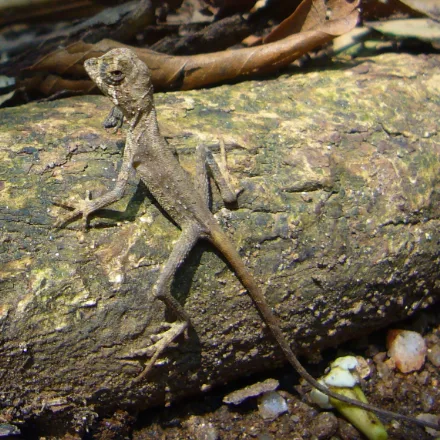
Kangaroo Lizard Common
Otocryptis wiegmanni
Small and brown with enormously enlarged hind legs and a tail roughly twice the body length. Males show a maroon patch on the throat.
Where: Shaded rainforest leaf litter near streams and along trail edges, sea level to 1,300 m. Best: Year round. The endemic agamid a first time visitor actually meets. Also on: Sinharaja Forest Reserve, Kandy, Knuckles Range, Kitulgala and the Makandawa Rainforest, Kanneliya Forest Reserve, Adam's Peak and Peak Wilderness.
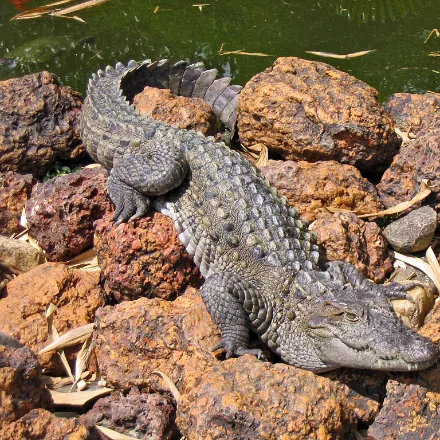
Mugger Crocodile Common Vulnerable
Crocodylus palustris
A heavy freshwater crocodile with a blunt, almost alligator-like head, the snout barely longer than it is wide. Adults are dark olive to grey brown, and a big male is a genuinely enormous animal at over three metres.
Where: Dry zone tanks, villus and reservoir margins below about 100 m. Best: Year round, best February to September. Sri Lanka holds this species at a density found nowhere else in its range. Also on: Yala National Park, Wilpattu National Park, Bundala National Park, Udawalawe National Park, Wasgamuwa National Park, Tangalle and Kalametiya.
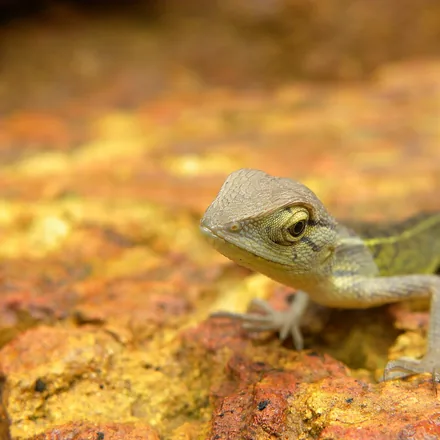
Oriental Garden Lizard Common
Calotes versicolor
A common, adaptable agamid in tan and grey with a low crest, seen basking on fences, walls and shrubs. In the breeding season males develop a vivid red and black head to court and compete.
Where: Open, disturbed and urban ground everywhere from sea level to 1,500 m. Best: Year round. Unavoidable, and the lizard most often mistaken for something rarer. Also on: Yala National Park, Colombo and the wetlands, Bundala National Park, Minneriya and Kaudulla National Parks, Kumana National Park, Wasgamuwa National Park.
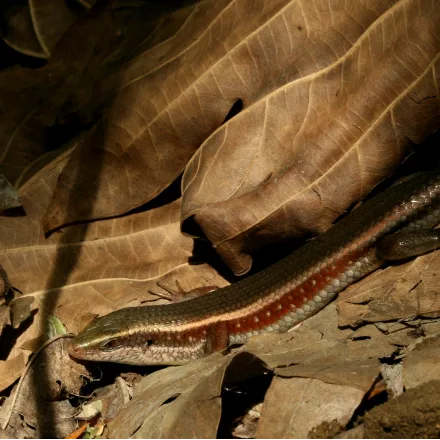
Sri Lankan Common Skink Common
Eutropis lankae
Robust and bronze brown with glossy, finely keeled scales, chestnut flanks and a pale line running from above the eye back along the body.
Where: Open sunny ground, rock, walls and ruins from sea level to 1,500 m. Best: Year round, sunny mornings. The commonest large skink in the country, and an endemic almost nobody names correctly. Also on: Minneriya and Kaudulla National Parks, Yala National Park, Wilpattu National Park, Bundala National Park, Sigiriya, Dambulla and the Cultural Triangle, Kumana National Park.
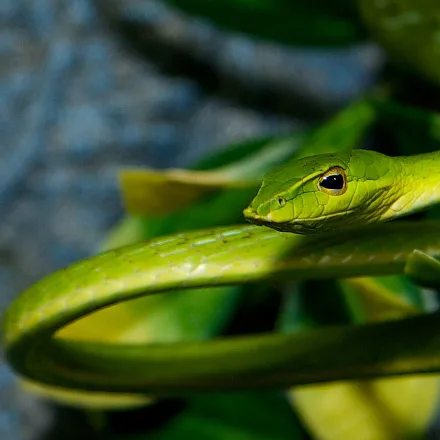
Green Vine Snake Regular
Ahaetulla nasuta
Extremely slender and bright green, with a long pointed snout and a body that sways gently as if in a breeze. When threatened it gapes and inflates, showing black and white skin between the scales.
Where: Low bushes and forest edge in the wet and intermediate zones. Best: Year round, daytime. The easiest good snake to see in Sri Lanka, because it does not run. Also on: Sinharaja Forest Reserve, Kandy, Knuckles Range, Kitulgala and the Makandawa Rainforest.
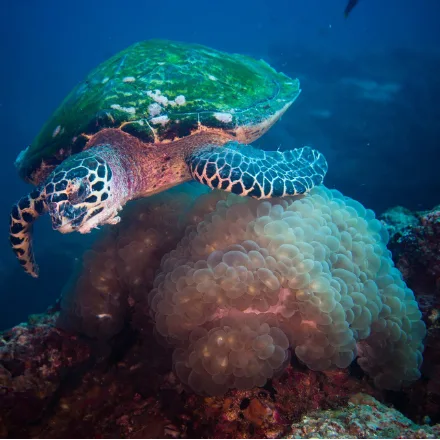
Hawksbill Turtle Regular Critically Endangered
Eretmochelys imbricata
Smaller and more colourful than the green turtle, with a narrow hawk like beak and overlapping amber and brown shell plates, the hawksbill threads coral crevices to pluck out sponges. Those same shell plates were the source of tortoiseshell.
Where: Coral reef, feeding on sponges; nesting on coarse sand pocket beaches and now very rare. Best: Reef season by coast; nesting almost nonexistent. Six nests out of 2,660 at Rekawa. This is a reef sighting, not a beach one. Also on: Trincomalee and Pigeon Island, Kalpitiya, Rekawa and Kosgoda, Hikkaduwa and Unawatuna, Mannar and the Gulf of Mannar, The Great and Little Basses Reefs.
Hump-nosed Lizard Regular Vulnerable
Lyriocephalus scutatus
A large, deep bodied green lizard with a rounded knob at the tip of the snout, a lyre shaped bony arch on the crown and no external ear opening. Males are bright green with a yellow throat pouch, females duller brown.
Where: Wet zone forest with dense understorey, from near sea level to 1,650 m. Best: Year round, best January to March and July to August. The emblem of Sri Lankan herpetology, and the endemic agamid a visitor genuinely gets. Also on: Sinharaja Forest Reserve, Knuckles Range, Kandy, Kitulgala and the Makandawa Rainforest, Kanneliya Forest Reserve, Adam's Peak and Peak Wilderness.
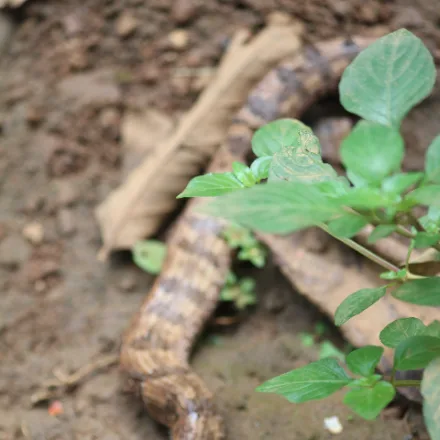
Hump-nosed Pit Viper Regular
Hypnale hypnale
A short, stout, grey brown pit viper with a distinctly upturned snout tip and a double row of dark blotches. Young animals wave a pale tail tip to lure lizards within reach.
Where: Leaf litter in wet and intermediate zone forest, tea and rubber estates and garden edges. Best: Year round, dusk and night. The commonest cause of snakebite in the country, and the reason to wear closed shoes. Also on: Sinharaja Forest Reserve, Knuckles Range, Kandy, Kitulgala and the Makandawa Rainforest, Adam's Peak and Peak Wilderness.
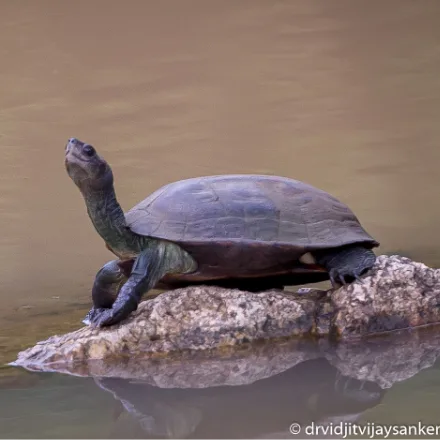
Indian Black Turtle Regular Near Threatened
Melanochelys trijuga
A domed dark brown to black shell with three low but distinct ridges running front to back, and a dark head streaked and spotted with yellow, orange or red on the temples.
Where: Dry zone tanks, villus, paddy and marsh, and walking overland after rain. Best: October to January and after any heavy rain. Two subspecies here, and the northern one is found nowhere else on earth. Also on: Wilpattu National Park, Bundala National Park, Yala National Park, Udawalawe National Park, Tangalle and Kalametiya, Kumana National Park.
Indian Star Tortoise Regular Vulnerable
Geochelone elegans
A strongly domed, knobbly tortoise with pale yellow lines radiating like a star from the raised centre of each scute on a black ground, and the pattern reversed on the underside.
Where: Dry and arid zone thorn scrub, dune country and grassy clearings below about 270 m. Best: Best after rain, October to December and March to April. Most people miss them because they are scanning for large mammals. Also on: Bundala National Park, Yala National Park, Wilpattu National Park, Kumana National Park, Jaffna and the Northern Peninsula, Sigiriya, Dambulla and the Cultural Triangle.
Kandyan Day Gecko Regular Endangered
Cnemaspis kandiana
Small and flat, with a round pupil and slender toes carrying no adhesive pads at all, so it grips rough rock rather than glass. Active by day on shaded boulders, buttress roots and cave mouths.
Where: Shaded vertical rock, boulders, buttress roots and cave mouths, sea level to 2,000 m. Best: Year round, morning on shaded rock. Diurnal, unlike almost every other gecko, which is why you can actually watch it. Also on: Sinharaja Forest Reserve, Kandy, Minneriya and Kaudulla National Parks, Sigiriya, Dambulla and the Cultural Triangle.
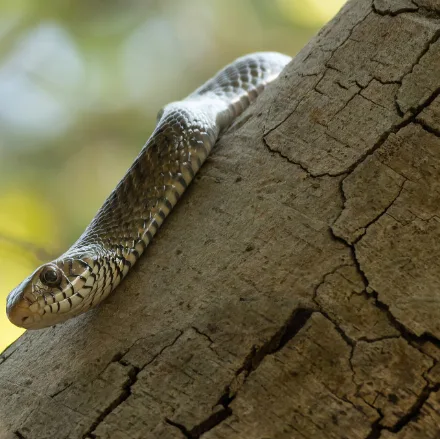
Oriental Rat Snake Regular
Ptyas mucosa
Slender but very long, olive to yellow brown with faint dark banding toward the tail, the oriental rat snake is a swift day hunter. Harmless to people, it feeds heavily on rats, frogs and toads.
Where: Paddy, scrub, gardens, forest edge and roadsides island wide. Best: Year round, daytime. The big snake crossing the road, and the cause of most cobra panics in Sri Lanka. Also on: Yala National Park, Udawalawe National Park, Wilpattu National Park, Colombo and the wetlands, Jaffna and the Northern Peninsula, Mannar and the Gulf of Mannar.
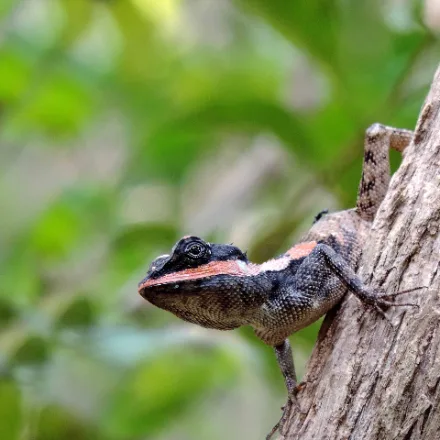
Painted-lip Lizard Regular
Calotes ceylonensis
A medium sized agamid of the dry and intermediate zones, with a bright red to orange stripe running along the upper lip and back past the ear. Males have swollen cheeks and a black throat.
Where: Riverine and monsoon forest, plantation and home garden below about 500 m in the dry and intermediate zones. Best: Year round. One of the easiest endemic lizards on a standard dry zone itinerary. Also on: Minneriya and Kaudulla National Parks, Kumana National Park, Wilpattu National Park, Sigiriya, Dambulla and the Cultural Triangle, Wasgamuwa National Park, Gal Oya National Park.
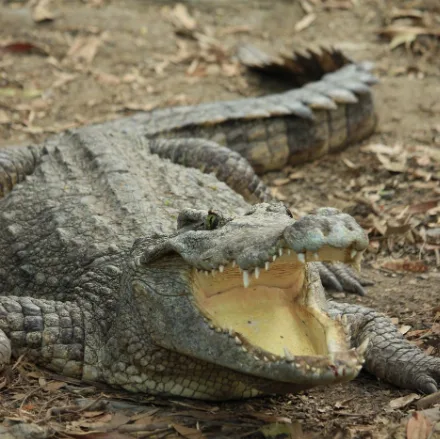
Saltwater Crocodile Regular
Crocodylus porosus
Massive and heavily armoured with a broad powerful snout, the saltwater crocodile tolerates the sea and once patrolled Thailand's coasts, estuaries and mangroves. Large males can exceed six metres and are formidable apex predators.
Where: Tidal rivers, estuaries, mangrove creeks, coastal lagoons and urban canals, mostly outside the protected areas. Best: December to April on the southwest coast. A different animal in a different place from the mugger, and the two are constantly conflated. Also on: Colombo and the wetlands, Mirissa, Arugam Bay and the East Coast Lagoons, Tangalle and Kalametiya, Rekawa and Kosgoda.
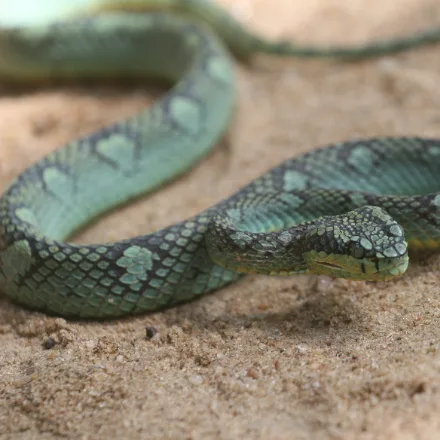
Sri Lankan Green Pit Viper Regular
Trimeresurus trigonocephalus
Bright green, marbled with black, with a black stripe through the temple and a prehensile tail. Males show blue tones, females stay green. The heat sensing pit between eye and nostril is visible at close range.
Where: Low branches at head height in rainforest, cardamom and tea from 150 m to 1,800 m. Best: Year round, night walks. The endemic snake most visiting naturalists come home with. Also on: Sinharaja Forest Reserve, Knuckles Range, Kandy, Kitulgala and the Makandawa Rainforest, Kanneliya Forest Reserve, Adam's Peak and Peak Wilderness.
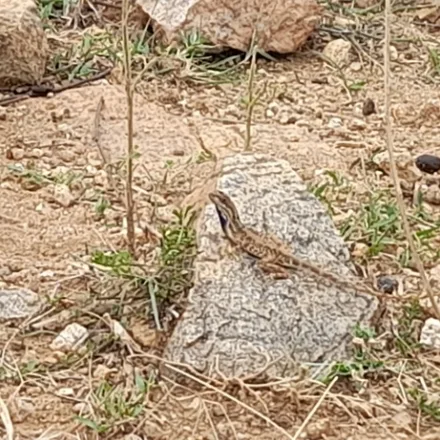
Bahir's Fan-throated Lizard Occasional Endangered
Sitana bahiri
Very small and sandy brown, running fast and low over open ground. The male extends a throat fan that reaches back onto the belly, and it has only four toes on each hind foot.
Where: Coastal scrub, sand and open dry ground in the southeast. Best: Year round, display strongest in the breeding season. Endangered, described only in 2015, and the display is worth the wait. Also on: Bundala National Park, Yala National Park.
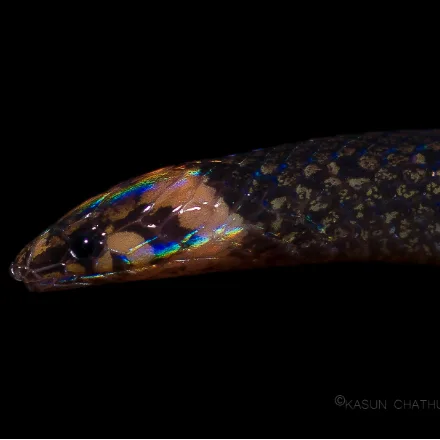
Common Rough-sided Snake Occasional Endangered
Aspidura trachyprocta
Short, cylindrical and glossy, blackish to reddish brown with a dark line down the spine and striping along the flanks. The head is barely distinguishable from the neck.
Where: Humus, leaf litter and compost in montane forest and tea country, 750 m to over 2,000 m. Best: Year round, more surface active in cool wet weather. Turning a log in the highlands is the way to find one. Also on: Horton Plains and Nuwara Eliya, Knuckles Range, Kandy, Ella and the Uva Highlands.
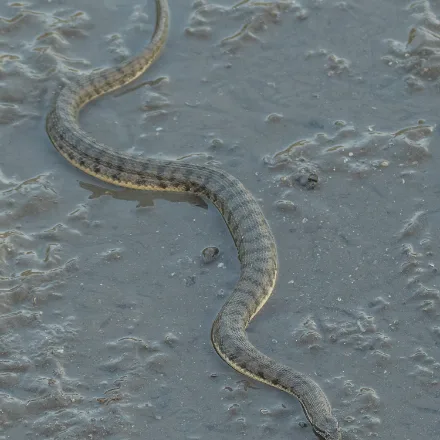
Dog-faced Water Snake Occasional
Cerberus schneiderii
Dog-faced water snakes hunt gobies and mudskippers in mangrove creeks and on exposed mud, using a lateral sidewinding gait to cross soft ground. They are rear-fanged, sluggish and harmless to people.
Where: Lagoons, estuaries and mangrove creeks at Puttalam, Negombo and Kalametiya. Best: Year round.
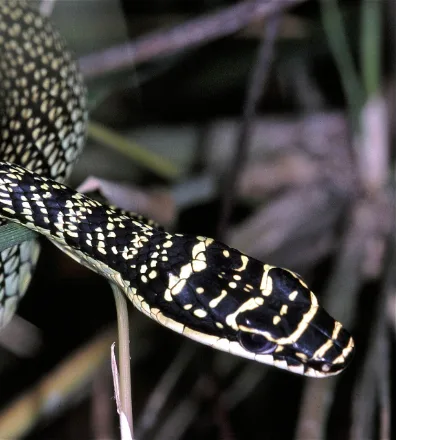
Golden Tree Snake Occasional
Chrysopelea ornata
Bright yellow green patterned with a fine black net, the golden tree snake races up walls and trees after geckos and lizards. Like its flying cousins it can flatten out and glide between trees.
Where: Coconut palms, garden trees and forest edge in the wet and intermediate zones. Best: Year round, daytime. The Sri Lankan animals are a distinct subspecies, and this species takes the wet zone while the Sri Lankan flying snake takes the dry. Also on: Kandy, Colombo and the wetlands, Sinharaja Forest Reserve.
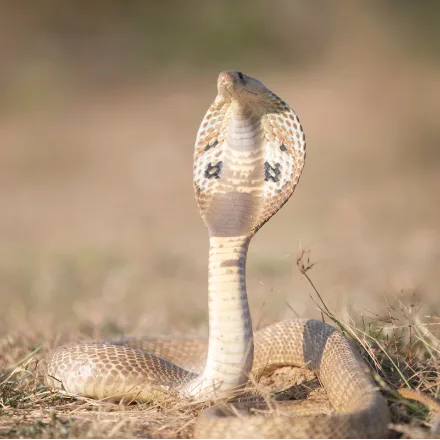
Indian Cobra Occasional
Naja naja
A smooth scaled, medium sized cobra that rears and spreads a broad hood marked with a pale spectacle. Colour runs from pale sandy brown to near black depending on where in the island it is.
Where: Paddy margins, village gardens, scrub and the ruins of the ancient cities. Best: Year round. One of very few venomous snakes a visitor has a realistic chance of seeing. Also on: Yala National Park, Wilpattu National Park, Bundala National Park, Jaffna and the Northern Peninsula, Kumana National Park, Wasgamuwa National Park.
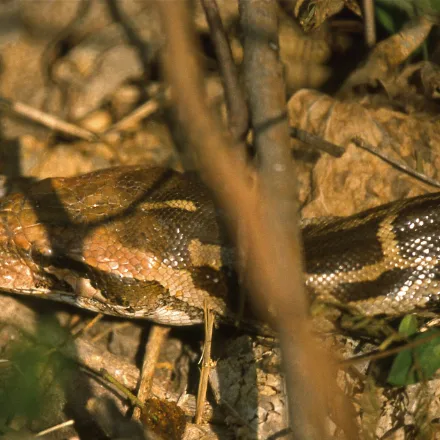
Indian Rock Python Occasional Near Threatened
Python molurus
Massively built, pale brown with dark saddle shaped blotches and an arrowhead mark on the crown. A big one is as thick as a thigh and moves in a slow straight line rather than in curves.
Where: Tank margins, riverine scrub and rock outcrops in the dry zone. Best: Year round, best in the dry season at shrinking waterholes. Sri Lanka's largest snake, and a dry season waterhole is where to find it. Also on: Yala National Park, Wilpattu National Park, Bundala National Park, Udawalawe National Park, Sigiriya, Dambulla and the Cultural Triangle, Arugam Bay and the East Coast Lagoons.
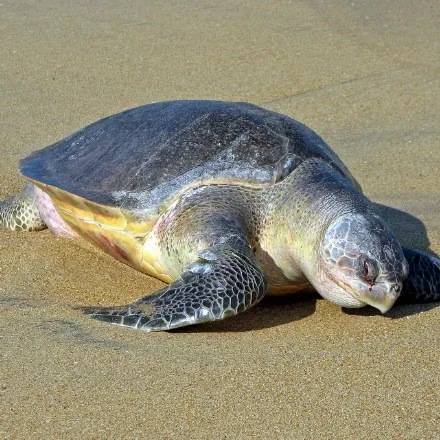
Olive Ridley Turtle Occasional Vulnerable
Lepidochelys olivacea
Compact and olive grey with a rounded, high domed shell, this turtle feeds on crabs, jellyfish and other invertebrates over soft bottoms. In some parts of its range females storm ashore to nest in vast synchronised waves.
Where: Nesting on open sandy beaches, and feeding in shallow coastal water. Best: November to March, peaking December to January. Out of phase with the green turtle, so the season is the northeast monsoon rather than the spring. Also on: Rekawa and Kosgoda, Kalpitiya, Bundala National Park, Mirissa, Tangalle and Kalametiya, Kumana National Park.
Rhino-horned Lizard Occasional Endangered
Ceratophora stoddartii
A small, lichen coloured montane lizard. The male carries a smooth forward curving horn about two thirds the length of its snout; the female has a stub or nothing at all.
Where: Mossy montane cloud forest between about 1,200 m and 2,300 m. Best: January to March, early morning. Confined to the highest hills, and precisely the colour of the lichen it sits on. Also on: Horton Plains and Nuwara Eliya, Knuckles Range, Adam's Peak and Peak Wilderness.
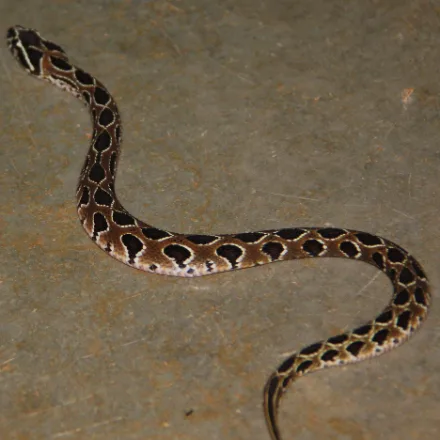
Russell's Viper Occasional
Daboia russelii
A thick bodied viper marked with three rows of large dark ovals ringed first in black and then in white, on a warm brown ground. Strongly keeled scales give it a matt, rough look.
Where: Open dry zone grassland, paddy bunds and scrub, avoiding closed forest. Best: Year round, most active at dusk. The leading cause of snakebite death in Sri Lanka, and it lives where people walk. Also on: Yala National Park, Bundala National Park, Wilpattu National Park, Kumana National Park.
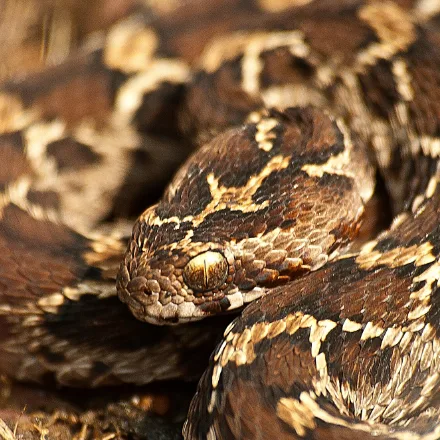
Saw-scaled Viper Occasional
Echis carinatus
Short, stout and sandy coloured, with a pale cross or arrowhead on the crown and an undulating pale line along each flank. It coils into a shifting figure of eight when threatened.
Where: Arid thorn scrub and sandy ground in the far north and northwest only. Best: Year round, after dark. Absent from every national park most visitors go to. Also on: Kalpitiya, Jaffna and the Northern Peninsula, Mannar and the Gulf of Mannar.
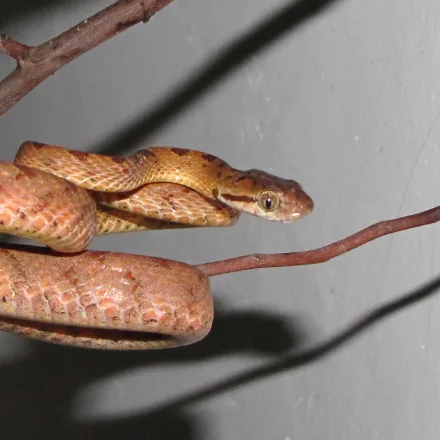
Sri Lankan Cat Snake Occasional
Boiga ceylonensis
Slender and brown grey with dark crossbands, a thick dark streak from eye to jaw, and a conspicuously broad head with a large vertical pupilled eye.
Where: Wet zone forest, plantation and gardens, and frequently inside buildings. Best: Year round, night. Comes indoors to hunt the geckos on the wall. Also on: Sinharaja Forest Reserve, Kandy, Kitulgala and the Makandawa Rainforest.
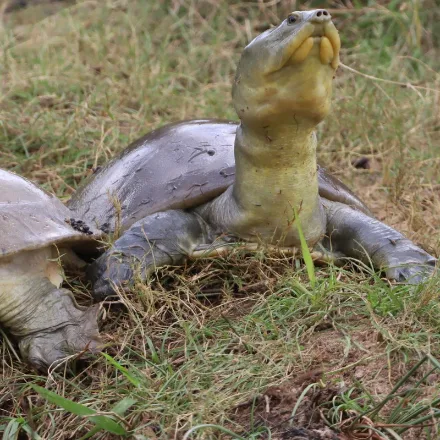
Sri Lankan Flapshell Turtle Occasional Vulnerable
Lissemys ceylonensis
A soft, leathery, pancake flat olive shell flecked with pale yellow spots, a tubular snorkel of a snout, and flaps of skin on the underside that fold back to hide the hind legs.
Where: Shallow muddy tanks, ponds, canals and paddy across the dry and intermediate zones. Best: Year round, best in the dry season as water levels drop. The only turtle or tortoise species found solely in Sri Lanka. Also on: Udawalawe National Park, Yala National Park, Wilpattu National Park, Bundala National Park, Kumana National Park.
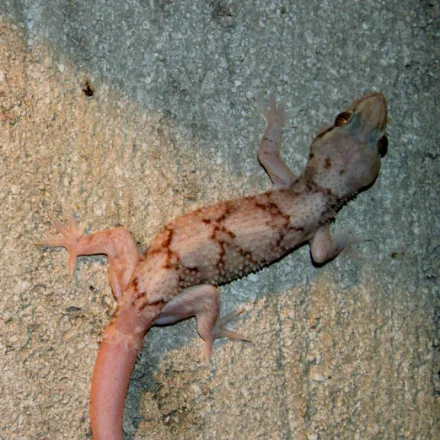
Sri Lankan Termite Hill Gecko Occasional
Hemidactylus depressus
Strongly flattened body and a depressed tail with toothed lateral edges, marked with four or five dark angular crossbands. The toes are webbed at the base.
Where: Trees, boulders, caves and termite mounds in the intermediate and dry zones, and inside buildings. Best: Year round, after dark with a torch. Nothing like the gecko on your bedroom ceiling. Also on: Knuckles Range, Kandy, Yala National Park.
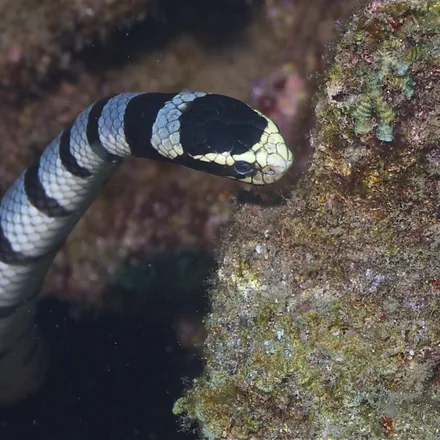
Banded Sea Krait Rare
Laticauda colubrina
Ringed in blue grey and black with a paddle shaped tail, the banded sea krait forages over reefs for eels, then hauls out onto rocks and beaches. It is highly venomous but exceptionally docile toward divers.
Where: Coral reef and boulder slopes on both coasts. Best: May to September on the east coast. Listed for Sri Lanka but scarce here, unlike further east. Highly venomous and entirely inoffensive.
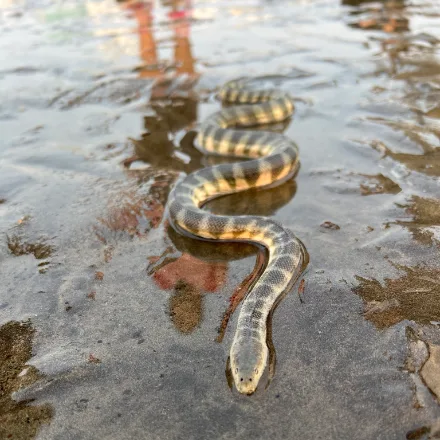
Beaked Sea Snake Rare
Hydrophis schistosus
Beaked sea snakes hunt catfish and pufferfish in turbid coastal water and estuaries, and are frequently hauled up in trawl and gill nets. The venom is potently neurotoxic and myotoxic, and bites usually happen to fishermen sorting catch.
Where: Shallow coastal water and estuaries all round the island, mostly recorded as fishing bycatch. Best: Year round; west coast November to April, east coast May to September. The most dangerous sea snake in Sri Lankan waters, and almost every bite is to a fisherman handling a net. Also on: Kalpitiya, Trincomalee and Pigeon Island, Mannar and the Gulf of Mannar.
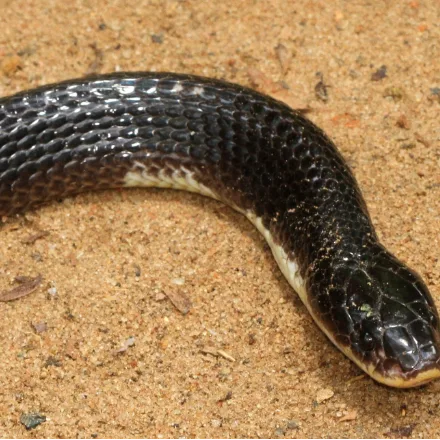
Common Krait Rare
Bungarus caeruleus
Glossy blue black with around forty narrow white crossbars, usually in pairs, and a flat head barely wider than the neck. The row of enlarged hexagonal scales down the spine is the giveaway.
Where: Dry zone villages, paddy, termite mounds and rodent burrows. Best: Year round, strictly after dark. Almost never seen by visitors, and the most dangerous snake in the country. Also on: Wilpattu National Park.
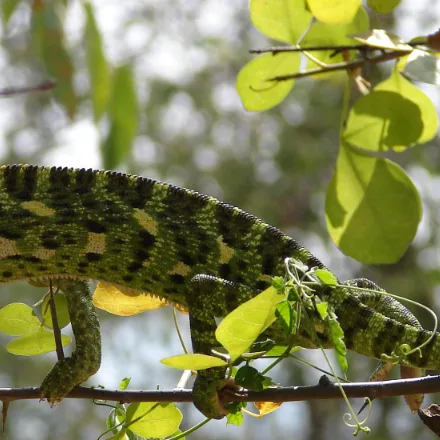
Indian Chameleon Rare
Chamaeleo zeylanicus
Unmistakable: a laterally flattened body, a casque on the head, independently swivelling turret eyes, feet like tongs and a tail carried in a coil. Green through brown to near black depending on mood.
Where: Dry and arid zone thorn scrub and open woodland in the north and northwest. Best: Year round. The only chameleon on the island, and genuinely scarce here. Also on: Wilpattu National Park, Kalpitiya, Mannar and the Gulf of Mannar, Jaffna and the Northern Peninsula.
Large Shieldtail Rare Vulnerable
Rhinophis saffragamus
Cylindrical, iridescent dark brown with a yellowish belly, a blunt flattened head and no neck to speak of. The tail ends in a large flat obliquely cut disc studded with nodules.
Where: Underground in moist soil from the lowlands to about 1,000 m, surfacing after heavy rain. Best: After heavy rain, and when soil is dug. Nobody finds a shieldtail by walking a trail. They come up when the ground is turned. Also on: Sinharaja Forest Reserve, Kandy.
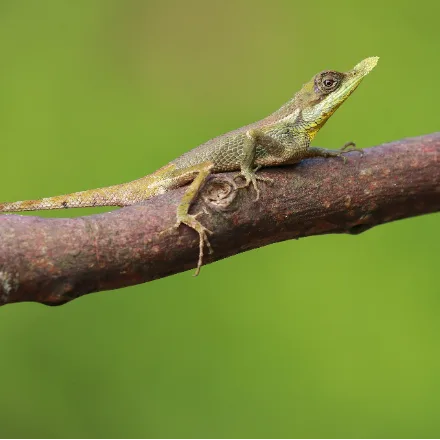
Leaf-nosed Lizard Rare Endangered
Ceratophora tennentii
Reddish brown to olive, with a flattened leaf shaped flap on the snout rather than a cylindrical horn. Males are greener than females and the appendage is larger.
Where: Submontane cloud forest and shaded stream forest, 760 m to 1,220 m. Best: February to April and August to September. Its entire world range is one mountain massif. Also on: Knuckles Range.
Leatherback Turtle Rare Vulnerable
Dermochelys coriacea
Vast and barrel bodied, the leatherback swaps a hard shell for a ridged, rubbery carapace and can weigh over half a tonne. It feeds almost entirely on jellyfish and ranges from the tropics to cold seas.
Where: Nesting on steep, high energy south coast beaches with deep water access. Best: January to June. Sri Lanka and the Andaman and Nicobar Islands hold the only leatherback nesting populations in South Asia. Also on: Rekawa and Kosgoda, Bundala National Park, Tangalle and Kalametiya.
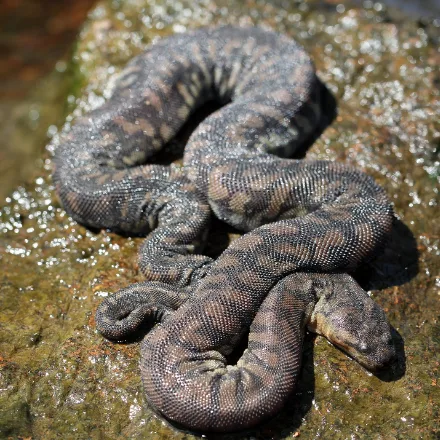
Little File Snake Rare
Acrochordus granulatus
File snakes are entirely aquatic, non-venomous and almost helpless on land, with skin far too large for the body. The rough granular scales work like sandpaper, letting them coil around and hold fish.
Where: Estuaries, lagoons and shallow muddy coastal water. Best: Year round. One of the commonest marine snakes here, and almost never seen by anyone who is not fishing. Also on: Colombo and the wetlands, Kalpitiya.
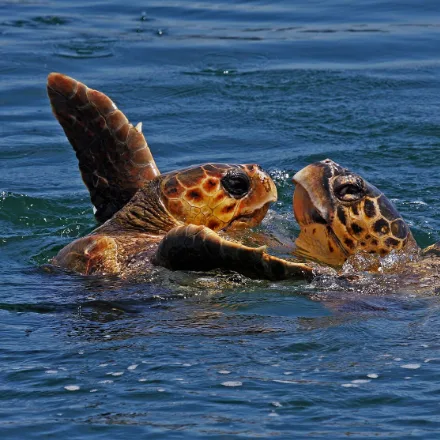
Loggerhead Turtle Rare Vulnerable
Caretta caretta
Loggerheads have a disproportionately large head and immensely strong jaws for crushing shellfish, crabs and urchins. Hatchlings imprint on the magnetic signature of their natal beach and return to it as adults decades later.
Where: Coastal shelf water; nesting on south coast beaches and very rare indeed. Best: November to April. Seven nests out of 2,660 at Rekawa, which is two or three a year at the best monitored beach in the country. Also on: Rekawa and Kosgoda, Trincomalee and Pigeon Island.
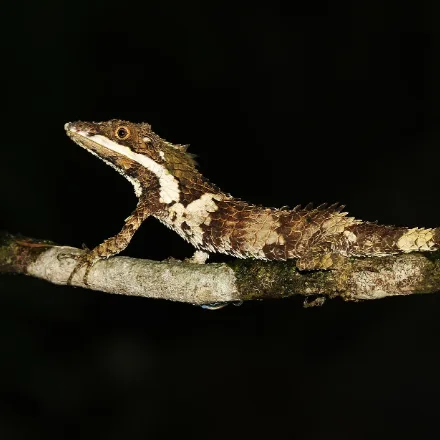
Pygmy Lizard Rare Endangered
Cophotis ceylanica
Small, strongly flattened side to side, olive green with dark cross bands and occasional orange patches, with a tall crest of spines along the neck and no visible ear opening.
Where: Moss covered trunks and epiphyte clumps in montane cloud forest, 1,300 m to 2,200 m. Best: January to March. A moss mimic that does not move when approached. Guides find them, visitors do not. Also on: Horton Plains and Nuwara Eliya, Knuckles Range, Adam's Peak and Peak Wilderness.
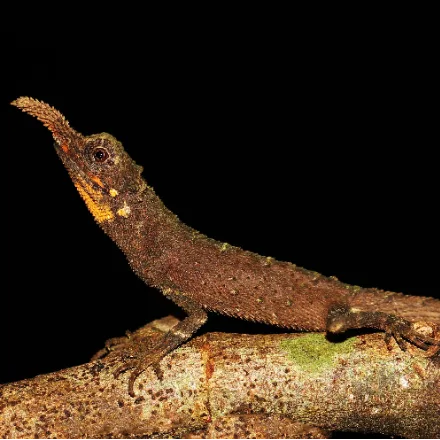
Rough-horned Lizard Rare Endangered
Ceratophora aspera
Tiny and brown, with a short rough granular appendage on the snout rather than a smooth horn, and the ear opening hidden under skin. Females often carry four diamond shaped marks along the back.
Where: Leaf litter on the floor of lowland wet zone rainforest below about 900 m. Best: January to early April and July to August. A four centimetre brown lizard in brown litter, and often in pairs. Also on: Sinharaja Forest Reserve, Kanneliya Forest Reserve.
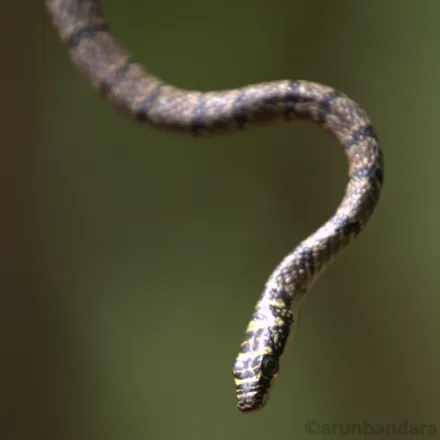
Sri Lankan Flying Snake Rare
Chrysopelea taprobanica
Pale greenish yellow with dark crossbands and a line of orange red spots between them, and a black head marked in yellow. Slimmer and shorter than the golden tree snake it shares the island with.
Where: Old trees, scrub and buildings in the dry and intermediate zones. Best: Year round, daytime. Takes the dry zone while the golden tree snake takes the wet, so a cross island trip can produce both. Also on: Minneriya and Kaudulla National Parks, Wilpattu National Park, Sigiriya, Dambulla and the Cultural Triangle, Wasgamuwa National Park.
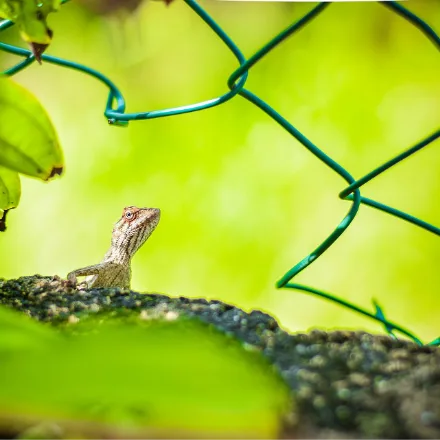
Whistling Lizard Rare
Calotes liolepis
Slender, with a very long head and a tail often twice the body length. It shifts between green and brown, and sits motionless and flattened against a trunk.
Where: Submontane forest and shade tree plantation, mostly below 1,000 m. Best: January to March and July to August. Cryptic and motionless on trunks. The whistle is the best field clue there is. Also on: Sinharaja Forest Reserve, Knuckles Range, Kitulgala and the Makandawa Rainforest.
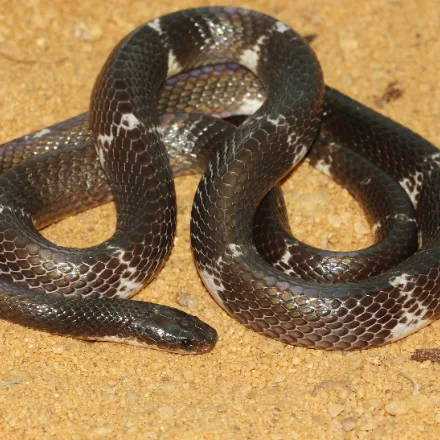
Sri Lankan Krait Very rare Near Threatened
Bungarus ceylonicus
Smaller and slighter than the common krait, black with narrow white crossbands that fork and branch as they run down the flanks. Nocturnal and rarely far from cover.
Where: Wet zone hill forest, tea and rubber smallholdings and shaded gardens to about 1,700 m. Best: Year round, night. Endemic, and about six confirmed bites exist in over a century of medical literature. Also on: Sinharaja Forest Reserve, Knuckles Range, Adam's Peak and Peak Wilderness.
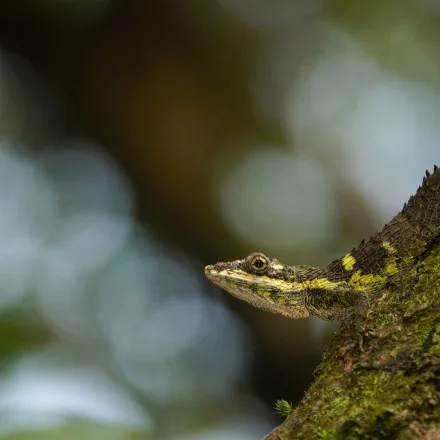
Knuckles Pygmy Lizard Ultra rare Critically Endangered
Cophotis dumbara
A very small compressed lizard, green grey and mottled to match lichen and moss, with a spiny neck crest and a short prehensile tail. Barely six centimetres from snout to vent.
Where: Wet moss and lichen on montane cloud forest bark in one massif only. Best: Year round, and effectively unfindable without a specialist. Described in 2006 and Critically Endangered within a year. Here because it exists, not because you will see one. Also on: Knuckles Range.
Amphibians
31 species
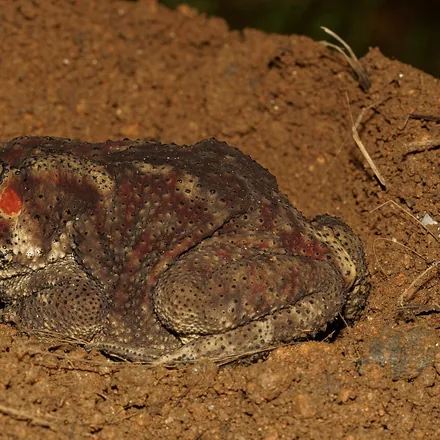
Asian Common Toad Common
Duttaphrynus melanostictus
Squat and dry skinned with dark tipped warts and bold bony ridges on the head, this toad is one of the most abundant amphibians in Asia. It hops rather than leaps and gathers wherever lights draw insects.
Where: Beaches, riverbanks, paddy, gardens and hotel car parks island wide, and scarce inside closed forest. Best: Year round, after dark. The reference toad. Learn it first and everything else is measured against it. Also on: Colombo and the wetlands, Kandy, Yala National Park, Sinharaja Forest Reserve, Minneriya and Kaudulla National Parks, Kumana National Park.
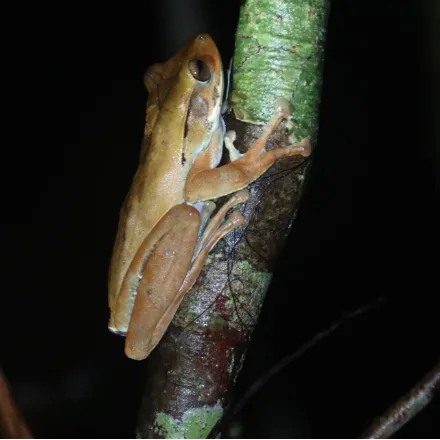
Common Hourglass Tree Frog Common
Polypedates cruciger
A classic long limbed tree frog with big flattened toe discs and a dark hourglass figure across the shoulders and back. Fawn to grey brown, and capable of going noticeably paler.
Where: Secondary forest, banana plots, gardens, bathrooms and water tanks to about 1,500 m. Best: Year round, after dark. Check the bathroom before you check the forest. This is not a joke. Also on: Sinharaja Forest Reserve, Kandy, Colombo and the wetlands, Kitulgala and the Makandawa Rainforest.
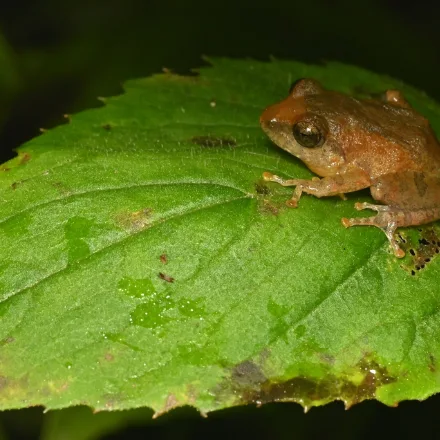
Common Shrub Frog Common Vulnerable
Pseudophilautus popularis
A small brown shrub frog with a ring of pale blue or white dots around the ear drum and yellow webbing between the toes. Males call from perches barely knee high, which is why the sound seems to come from the ground.
Where: Low perches in wet zone forest, buffer scrub and village gardens to about 1,000 m. Best: Year round, dusk onward, best in the wetter months. The endemic frog most visitors hear without realising it is a frog at all. Also on: Sinharaja Forest Reserve, Kandy, Kitulgala and the Makandawa Rainforest.
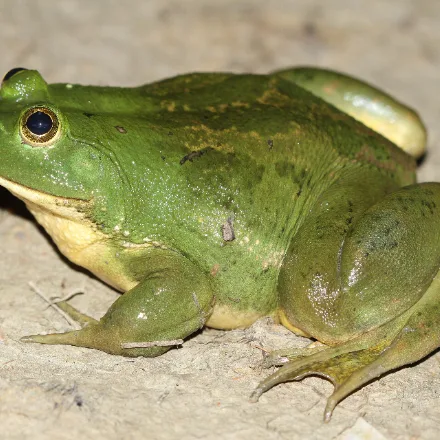
Indian Green Pond Frog Common
Euphlyctis hexadactylus
A plain grass green pond frog, far greener than the skittering frog it shares water with, and separated from it by a rough, warty throat.
Where: Lowland tanks, lotus ponds and marshes, often on floating vegetation. Best: Year round, daytime and night. Green, and the throat is warty. Those two things separate it from the skittering frog. Also on: Bundala National Park, Udawalawe National Park, Colombo and the wetlands, Tangalle and Kalametiya.
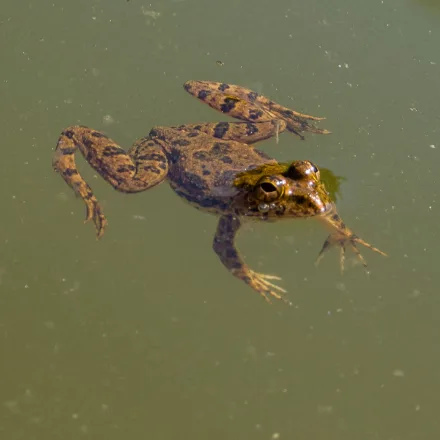
Skittering Frog Common
Euphlyctis cyanophlyctis
A medium sized aquatic frog with fully webbed toes and a smooth throat, floating with only the eyes and nostrils above the waterline.
Where: Still and flowing water everywhere from the coast to 1,800 m. Best: Year round. Walk any tank bund and it will demonstrate the skittering for you. Also on: Yala National Park, Udawalawe National Park, Colombo and the wetlands, Horton Plains and Nuwara Eliya, Kumana National Park, Gal Oya National Park.
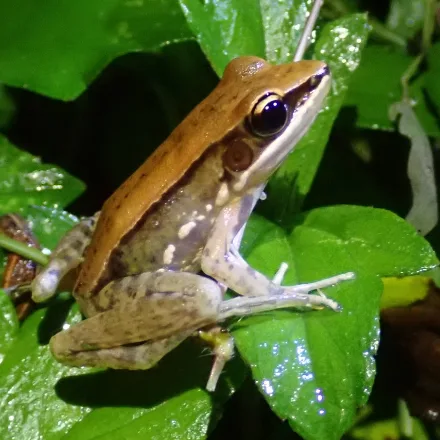
Sri Lanka Wood Frog Common
Hydrophylax gracilis
A slim frog with a bronze line running from the corner of the mouth back to the groin and longitudinal stripes along the shank. Toe discs are only weakly developed.
Where: Paddy, marsh, stream margins and tank edges to about 1,200 m. Best: Year round, night. The most catchable endemic frog in Sri Lankan farmland. Also on: Sinharaja Forest Reserve, Colombo and the wetlands, Kandy, Kitulgala and the Makandawa Rainforest.
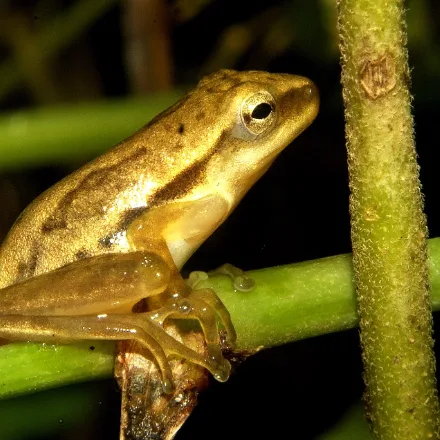
Chunam Tree Frog Regular
Polypedates maculatus
A pale fawn tree frog with irregular dark spotting or no pattern at all, able to blanch almost white. Lacks the hourglass of its endemic cousin.
Where: Lowland and dry zone buildings, gardens and scrub below about 500 m. Best: Year round, night. Not endemic. Check the shoulders before you tick the endemic one. Also on: Minneriya and Kaudulla National Parks, Wilpattu National Park, Wasgamuwa National Park.
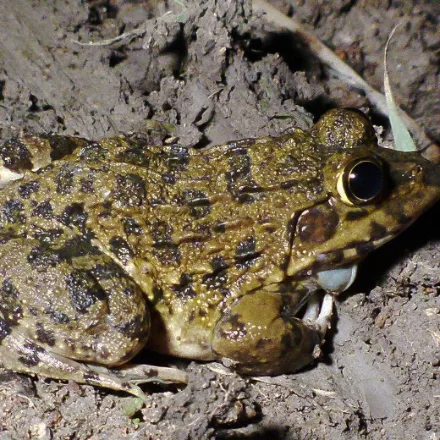
Jerdon's Bullfrog Regular
Hoplobatrachus crassus
A large olive green to yellow frog blotched dark, often with a yellow stripe down the spine, with very long hind legs and a shovel shaped digging blade on the heel.
Where: Seasonally flooded grassland, dry plains and cultivation to about 700 m. Best: With the first monsoon rains, night. Sri Lanka's largest frog, and the dry zone becomes very loud when it emerges. Also on: Bundala National Park, Wilpattu National Park, Yala National Park, Kumana National Park.
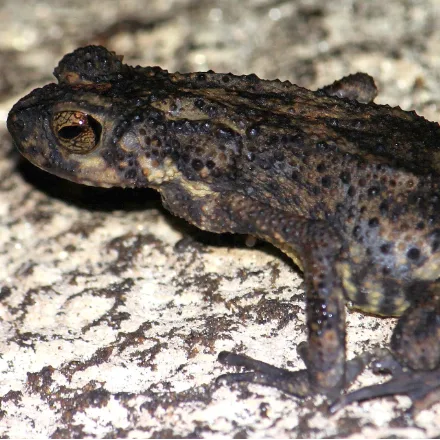
Kelaart's Dwarf Toad Regular Vulnerable
Adenomus kelaartii
A small brown toad blotched darker and sometimes flecked red or blue, with skin that varies from smooth to spiny between individuals. Males call from boulders in midstream.
Where: Leaf litter, sandbanks and rock crevices beside upland streams, 30 m to 1,230 m. Best: Year round, and unusually it is active by day as well as night. The endemic genus you can find on an afternoon walk. Also on: Sinharaja Forest Reserve, Knuckles Range, Kitulgala and the Makandawa Rainforest, Kanneliya Forest Reserve, Adam's Peak and Peak Wilderness.
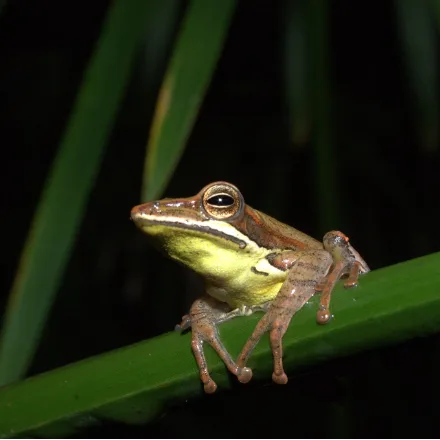
Montane Hourglass Tree Frog Regular Endangered
Taruga eques
A montane tree frog with a pointed triangular snout, reddish orange in females and brown in males, and a small spur on the heel that separates the genus from Polypedates in the hand.
Where: Montane forest and highland pond margins, 1,200 m to 2,135 m. Best: Year round, night, breeding after rain. The foam nest building is the thing to try to see, not just the frog. Also on: Horton Plains and Nuwara Eliya, Knuckles Range, Ella and the Uva Highlands, Adam's Peak and Peak Wilderness.
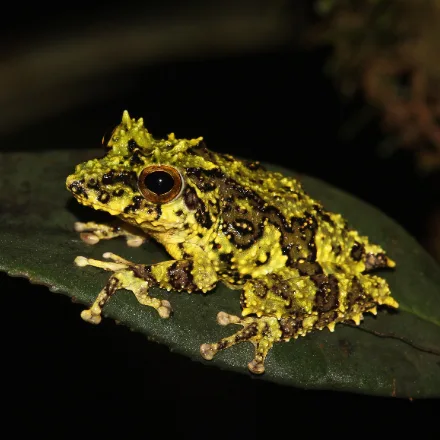
Schmarda's Shrub Frog Regular Endangered
Pseudophilautus schmarda
A warty, lumpy montane shrub frog, dark green and red brown above with yellow flanks and bright yellow spots below, carrying small horn-like tubercles over the eyes.
Where: Montane cloud forest, pine plantation and abandoned tea, 810 m to 2,300 m. Best: Year round, night. Heard first, seen second. The lichen mottling is close to perfect. Also on: Horton Plains and Nuwara Eliya, Knuckles Range, Adam's Peak and Peak Wilderness, Ella and the Uva Highlands.
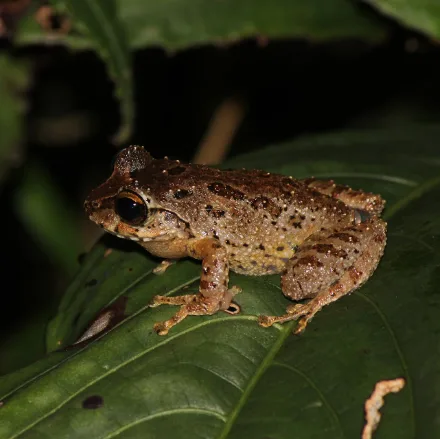
Small-eared Shrub Frog Regular Endangered
Pseudophilautus microtympanum
One of the larger shrub frogs, light brown or grey with dark bands and sometimes an orange brown stripe down the spine. The ear drum is conspicuously tiny, which is what the name refers to.
Where: Montane grassland as juveniles, closed canopy forest as adults. Best: Year round, night. Small ones in the open and large ones in the forest are the same species at different ages. Also on: Horton Plains and Nuwara Eliya.
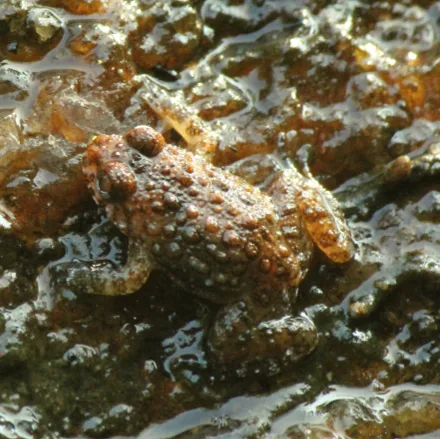
Sri Lanka Rock Frog Regular Vulnerable
Nannophrys ceylonensis
An extremely flattened frog with a truncate snout, olive green to yellowish brown mottled darker with barred legs, matching algae covered wet stone almost exactly.
Where: Wet rock beside fast flowing wet zone streams and waterfall splash zones to 1,200 m. Best: Year round, night with a torch. The endemic genus a normal traveller can actually get. Also on: Sinharaja Forest Reserve, Kandy, Kitulgala and the Makandawa Rainforest, Kanneliya Forest Reserve, Adam's Peak and Peak Wilderness.
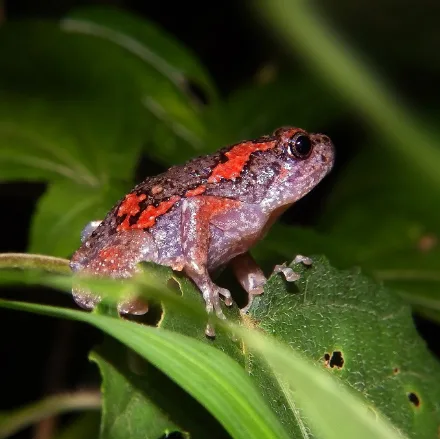
Sri Lankan Painted Frog Regular
Uperodon taprobanicus
A stout greyish black frog with bold symmetrical reddish brown patches down each side and a coloured band running from behind the eye to the base of the arm.
Where: Dry forest, plantation, paddy and the edges of buildings to about 1,300 m. Best: After heavy rain, night. Breeds explosively in temporary pools. Rain is the whole trigger. Also on: Minneriya and Kaudulla National Parks, Wilpattu National Park, Yala National Park, Wasgamuwa National Park.
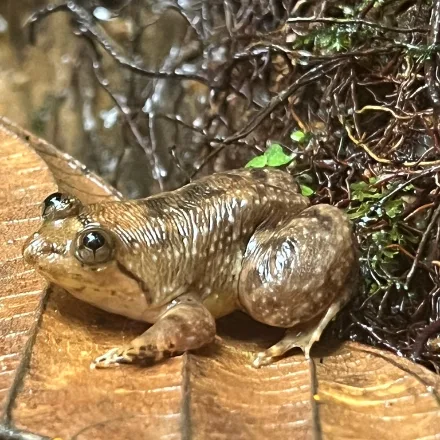
Corrugated Water Frog Occasional Near Threatened
Lankanectes corrugatus
A heavily corrugated, ridged frog built for slow moving marshy water rather than fast streams. Females are considerably larger than males.
Where: Slow moving marshy water and sluggish rivers in the wet zone. Best: Year round, night. An endemic subfamily, which is a branch of the amphibian tree found nowhere else on earth. Also on: Sinharaja Forest Reserve, Knuckles Range, Kitulgala and the Makandawa Rainforest.
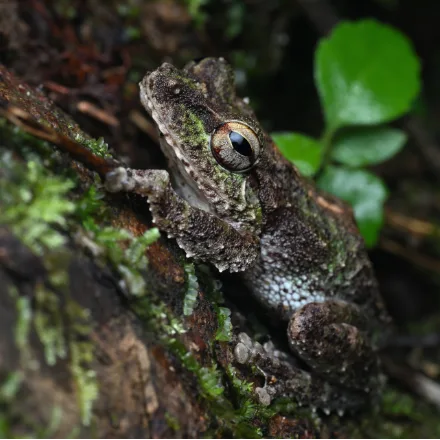
Hollow-snouted Shrub Frog Occasional Vulnerable
Pseudophilautus cavirostris
A comparatively long, slender lowland shrub frog in forest browns, with a concave snout profile that no other Sri Lankan frog shares. The hollow is only obvious in side view, which is how guides confirm it.
Where: Lowland and lower montane rainforest in the wet zone. Best: Year round, night, best in the wetter months. One of the few shrub frogs guides treat as a target rather than a hope. Also on: Sinharaja Forest Reserve, Kitulgala and the Makandawa Rainforest.
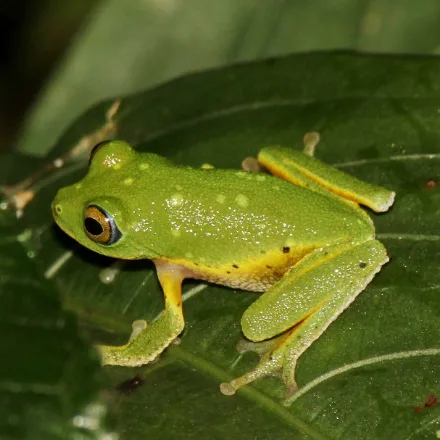
Leaf-nesting Shrub Frog Occasional Endangered
Pseudophilautus femoralis
A bright leaf green montane shrub frog with a creamy yellow or pale pink belly and a blunt, rounded snout. Green enough to vanish against the foliage it sits on.
Where: Montane forest of the central highlands. Best: Year round, night. Look for the eggs as well as the frog. A green clutch glued under a leaf is this species and nothing else. Also on: Horton Plains and Nuwara Eliya.
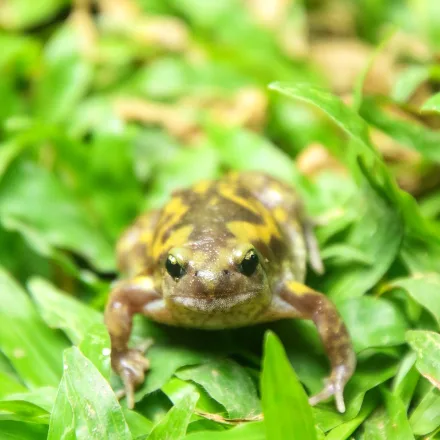
Marbled Balloon Frog Occasional
Uperodon systoma
An almost spherical frog that genuinely resembles a water filled balloon, with shovel-like tubercles on the hind feet for reversing into soil.
Where: Underground in the lowland dry and intermediate zones, surfacing to breed. Best: A few nights a year during heavy monsoon rain. Either invisible or briefly everywhere, and the difference is a week of rain. Also on: Wilpattu National Park, Minneriya and Kaudulla National Parks.
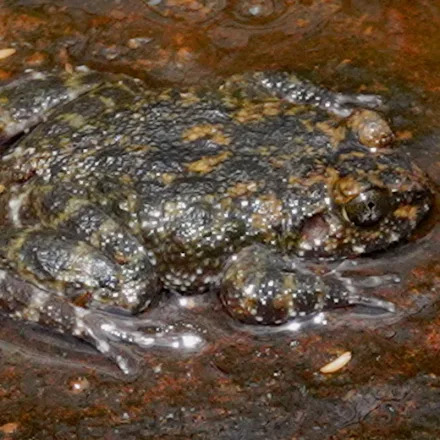
Marbled Rock Frog Occasional Endangered
Nannophrys marmorata
A flattened rock frog with a smoothly rounded snout and a broad short head, marbled with dark streaking above and banded dark on the legs.
Where: Wet boulders in fast forest streams in one mountain range only, 200 m to 1,200 m. Best: Year round, night. Its entire world range is about a hundred square kilometres. Also on: Knuckles Range.
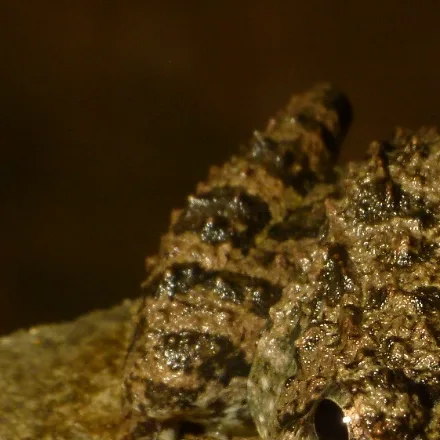
Montane Paddy Frog Occasional Endangered
Minervarya greenii
A small paddy frog with rounded longitudinal skin folds along the back and a distinct fringe of skin along the inner side of the first toe.
Where: Highland ditches, marsh edges and cultivation above about 1,500 m. Best: Year round, night. The vegetable belt around Nuwara Eliya is both its habitat and its threat. Also on: Horton Plains and Nuwara Eliya, Ella and the Uva Highlands.
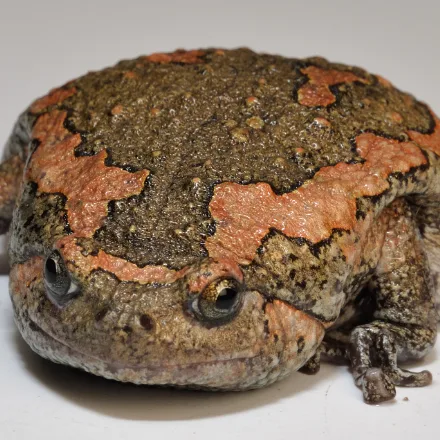
Sri Lanka Narrow-mouthed Frog Occasional Endangered
Microhyla zeylanica
A very small triangular bodied frog with a pointed snout and no toe discs, restricted to montane wetlands. Above fifteen hundred metres, altitude alone nearly identifies it.
Where: Montane pools and wetlands above about 1,500 m. Best: Year round, daytime at pool edges. One of the few montane frogs still tied to open water, and the water is drying out. Also on: Horton Plains and Nuwara Eliya.
Sri Lanka Pug-snout Frog Occasional Near Threatened
Uperodon obscurus
A squat, globular frog with a tiny pointed snout, a very narrow mouth and expanded triangular finger discs. A burrower that also climbs.
Where: Forest, marsh, degraded forest and rural gardens through the wet zone to about 1,000 m. Best: Year round, night. Heard far more often than seen. A loud call from a crevice with nothing visible in it. Also on: Sinharaja Forest Reserve, Kandy.
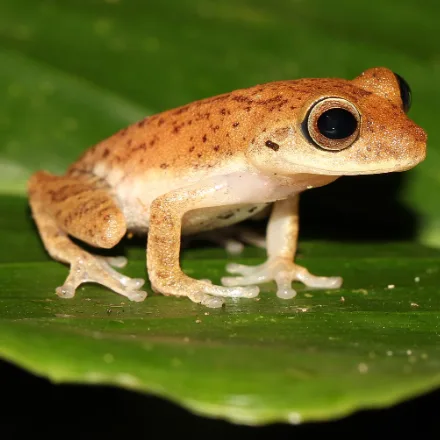
Golden Shrub Frog Rare Endangered
Pseudophilautus auratus
A small closed canopy specialist with a warm golden bronze back that lifts out of a torch beam in a way its drab relatives never do. Found on foliage in deep forest rather than at the edge.
Where: Foliage inside closed canopy rain and cloud forest, 513 m to 1,270 m. Best: Year round, night, best in the wetter months. Forest edge will not produce it. The interior will. Also on: Sinharaja Forest Reserve, Kanneliya Forest Reserve.
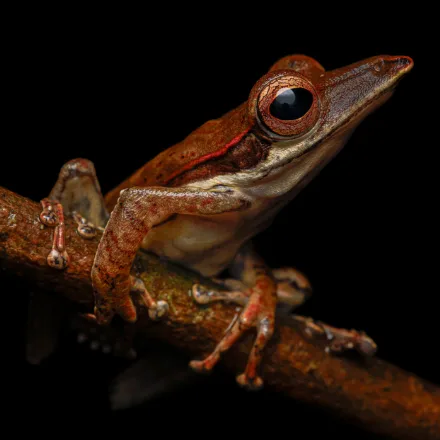
Southern Whipping Frog Rare Endangered
Taruga longinasus
The longest nosed of the three whipping frogs, with a markedly projecting snout and the heel spur that marks the genus. A lowland rainforest animal.
Where: Southwestern lowland rainforest, over stream pools. Best: Year round, night. A lowland outlier in a mountain genus. Also on: Sinharaja Forest Reserve, Kanneliya Forest Reserve.
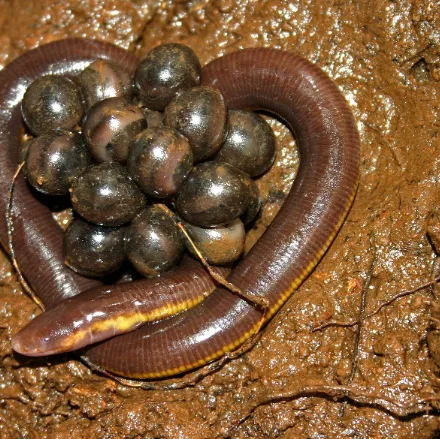
Ceylon Caecilian Very rare Vulnerable
Ichthyophis glutinosus
A steely blue grey burrower with a bold pale yellow band running the length of each side and over three hundred rings around the body. Blind eyes and a short retractile tentacle between eye and nostril.
Where: Damp earth and leaf litter in forest, swamp margin and pasture to 1,355 m. Best: Year round, and only when soil or a rotting log is turned. Nobody finds a caecilian by walking. They turn up when the ground does. Also on: Sinharaja Forest Reserve, Kandy.
Nagao's Pug-snout Frog Very rare Endangered
Uperodon nagaoi
A small dark brown frog with yellow spots beside the eye and along the upper lip, reddish orange blotches on the snout, flanks and belly, and triangular finger discs for climbing.
Where: Water held in rotting tree holes in lowland rainforest, about 125 m to 150 m. Best: Year round, night. Its entire life cycle happens inside a hollow trunk, which is why it is so hard to see. Also on: Sinharaja Forest Reserve, Kanneliya Forest Reserve.
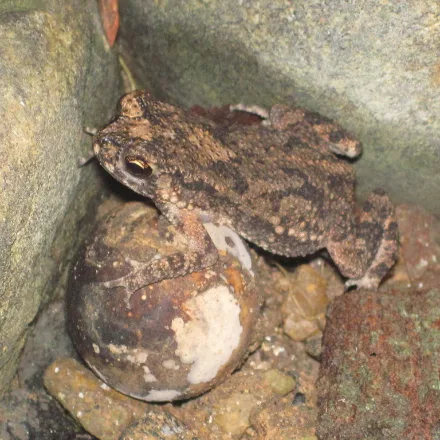
Noellert's Toad Very rare Critically Endangered
Duttaphrynus noellerti
A spiny warted endemic toad, reddish ash to reddish brown marbled with dark brown, with a well defined dark patch running from behind the ear onto the flanks and limbs.
Where: Lowland rainforest of the southwest wet zone. Best: Year round, night. Critically Endangered and worsening. A conservation datapoint rather than a sighting. Also on: Sinharaja Forest Reserve.
Pattipola Caecilian Very rare Endangered
Ichthyophis orthoplicatus
A uniformly dark, glossy, strongly ringed burrower with no yellow lateral band, which separates it immediately from the island's other two caecilians.
Where: Moist montane soil in the wet and intermediate zones, including the high country. Best: After heavy rain, when soil is turned. The highest living caecilian on the island, and the only one without a stripe. Also on: Horton Plains and Nuwara Eliya.
Taylor's Caecilian Very rare Vulnerable
Ichthyophis pseudangularis
The smallest and most slender of the island's caecilians, with a yellow lateral stripe like the Ceylon caecilian but far fewer body rings, 269 to 304 against over 329.
Where: Moist soil near streams, lakes and swamps in the wet and intermediate lowlands. Best: After heavy rain, when soil is turned. Separated from the Ceylon caecilian by counting the rings around its body. Also on: Sinharaja Forest Reserve.
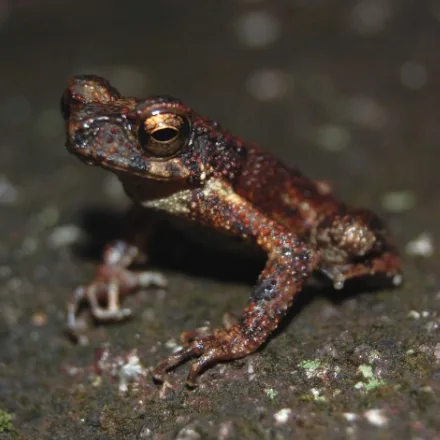
Kandyan Dwarf Toad Ultra rare Endangered
Adenomus kandianus
A small yellowish brown toad with a distinctly reddish head, a fine gold line down the spine, chocolate brown parotoid glands and black and gold speckled lips.
Where: Montane cloud forest, 1,100 m to 1,879 m. Best: Year round, and effectively unreachable. Declared extinct, then found again in 2009. Peak Wilderness needs a permitted trek and Pidurutalagala is a restricted military zone. Also on: Adam's Peak and Peak Wilderness.
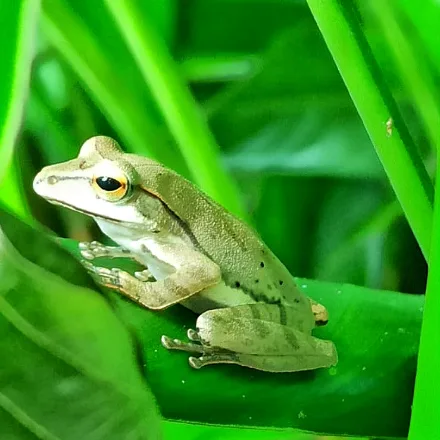
Starry Shrub Frog Ultra rare Critically Endangered
Pseudophilautus stellatus
Bright green, scattered with pinkish white spots each outlined in dark brown, and banded dark on white flanks. The spots are the stars the name refers to.
Where: Cloud forest canopy in the Peak Wilderness Sanctuary, 1,540 m to 1,679 m. Best: Year round, and effectively unfindable. Lost for 156 years, then found ten metres up in the canopy where nobody had looked. Here as a record, not a target. Also on: Adam's Peak and Peak Wilderness.
Planning
Amphibians need rain and darkness. The productive hours are the first two after dusk on a wet night, and the productive months are the start of each monsoon: May to September in the wet zone southwest, and February to April in the Knuckles and the hills. Bring a torch, walk stream margins slowly and look at leaf surfaces at eye level rather than at the ground. Reptiles are the opposite: warm, bright mornings on forest tracks and rock. Sri Lanka’s endemic frogs are small, thin-skinned and highly susceptible to disease transfer, several of the lizards are Critically Endangered with ranges of a few square kilometres, and the island has a serious venomous snake fauna including the Russell’s viper, the cobra and two kraits.
Find guided night walks and rainforest trips in Sri Lanka
Some links on this page are affiliate links. If you book through them, Wildseer may earn a small commission at no extra cost to you.
Frequently asked questions
How many endemic amphibians does Sri Lanka have?
Well over a hundred, concentrated in the shrub frog genus Pseudophilautus, and new species are still being described. It is one of the densest endemic amphibian radiations anywhere on earth and it is almost entirely confined to the wet zone southwest and the hill country.
Are there dangerous snakes in Sri Lanka?
Yes. The Russell’s viper, the Indian cobra, the common krait and the saw-scaled viper are all present and all medically significant, and snakebite is a genuine rural health problem here. They are not a meaningful risk to a visitor who watches where they put their feet and does not attempt to handle anything.
Where can you see sea turtles in Sri Lanka?
Five species nest on Sri Lankan beaches, which is unusual anywhere in the world. The south coast nesting beaches are the place, and a community run night walk on a wild beach is the honest way to see it. Facilities that buy eggs, hold hatchlings in tanks and release them in daylight for an audience do measurable harm.
What is the best time to see frogs in Sri Lanka?
The first weeks of each monsoon, after dark and in rain. In the wet zone southwest that means May to September; in the Knuckles and the hill country, February to April is the better window.
Explore Sri Lanka wildlife by group
 Mammals of Sri Lanka
 Birds of Sri Lanka
 Fish of Sri Lanka
 Sharks and rays of Sri Lanka
 Reef invertebrates of Sri Lanka
 Insects and spiders of Sri Lanka
Part of the Wildlife in Sri Lanka guide.
Explore Sri Lanka wildlife by place
- Adams Peak wildlife
- Arugam Bay marine life
- Bundala wildlife
- Colombo wildlife
- Ella wildlife
- Gal Oya wildlife
- Great Basses marine life
- Hikkaduwa marine life
- Horton Plains wildlife
- Jaffna wildlife
- Kalpitiya marine life
- Kandy wildlife
- Kanneliya wildlife
- Kitulgala wildlife
- Knuckles wildlife
- Kumana wildlife
- Mannar marine life
- Minneriya wildlife
- Mirissa marine life
- Rekawa marine life
- Sigiriya wildlife
- Sinharaja wildlife
- Tangalle marine life
- Trincomalee marine life
- Udawalawe wildlife
- Wasgamuwa wildlife
- Wilpattu wildlife
- Yala wildlife
Image credits
Square thumbnails are cropped from the original. Wide banner images are cropped to a band. Other images are resized only. No other changes have been made.
- Green forest lizard in breeding colour: Anas Mohamed Nuski | Pexels Licence, cropped
- Hump-nosed Lizard: Nyanatusita | CC BY-SA 3.0, cropped
- Indian Star Tortoise: Selvaganesh17 | CC BY-SA 4.0, cropped
- hawksbill-turtle (resized): Daniel Sasse | CC BY-SA 4.0, cropped
- Rhino-horned Lizard: Calynn | CC BY-SA 4.0, cropped
- Leatherback Turtle (cropped to square): Julien Renoult | CC BY 4.0, cropped
- Asian Water Monitor: John Thomas | Unsplash License, cropped
- Bengal Monitor (cropped to square): Dr. Raju Kasambe | CC BY-SA 4.0, cropped
- Black-lipped Lizard: Cherubino | CC BY-SA 3.0, cropped
- Checkered Keelback: Bernard DUPONT from FRANCE | CC BY-SA 2.0, cropped
- Common House Gecko (cropped to square): Firos AK | CC BY-SA 4.0, cropped
- Common Lanka Skink: Peyman Zehtab Fard | CC BY 2.0, cropped
- Green Forest Lizard: Rehman Abubakr | CC BY-SA 4.0, cropped
- Green Sea Turtle: Randall Ruiz | Unsplash License, cropped
- Kangaroo Lizard: Nyanatusita | CC BY-SA 3.0, cropped
- Mugger Crocodile: Karunakar Rayker from India | CC BY-SA 2.0, cropped
- Oriental Garden Lizard (cropped to square): Ajay Kuyiloor | CC BY-SA 3.0, cropped
- Sri Lankan Common Skink: Gihan Jayaweera | CC BY-SA 4.0, cropped
- Green Vine Snake: Stephane Lemieux - STEFBYSTEF | CC BY-SA 3.0, cropped
- Hawksbill Turtle (cropped to square): Daniel Sasse | CC BY-SA 4.0, cropped
- Hump-nosed Pit Viper: Praveenp | CC BY-SA 4.0, cropped
- Indian Black Turtle: Dr Vidjit Vijaysanker | CC BY-SA 4.0, cropped
- Oriental Rat Snake (cropped to square): Tisha Mukherjee | CC BY-SA 4.0, cropped
- Painted-lip Lizard: Sumudusoyza007 | CC BY-SA 4.0, cropped
- Saltwater Crocodile: Rutpratheep Nilpechr | Pexels Licence, cropped
- Sri Lankan Green Pit Viper: Gihan Jayaweera | CC BY-SA 3.0, cropped
- Bahir’s Fan-throated Lizard: P Jeganathan | CC BY 4.0, cropped
- Common Rough-sided Snake: Kasun withanage | CC BY-SA 4.0, cropped
- Dog-faced Water Snake (cropped to square): Wich’yanan L | CC BY 4.0, cropped
- Golden Tree Snake (cropped to square): Bernard DUPONT from FRANCE | CC BY-SA 2.0, cropped
- Indian Cobra: Pexels contributor | Pexels Licence, cropped
- Indian Rock Python: Bernard DUPONT from FRANCE | CC BY-SA 2.0, cropped
- Olive Ridley Turtle (cropped to square): Bernard Gagnon | CC BY-SA 3.0, cropped
- Russell’s Viper: StefanSTS | CC BY-SA 3.0, cropped
- Saw-scaled Viper: Uajith | CC BY-SA 3.0, cropped
- Sri Lankan Cat Snake: Jayendra Chiplunkar | CC BY-SA 3.0, cropped
- Sri Lankan Flapshell Turtle: spacegecko | CC BY 4.0, cropped
- Sri Lankan Termite Hill Gecko: Gihan Jayaweera | CC BY-SA 4.0, cropped
- Banded Sea Krait (cropped to square): Elias Levy | CC BY 2.0, cropped
- Beaked Sea Snake (cropped to square): Shaunak Modi | CC BY 4.0, cropped
- Common Krait: Davidvraju | CC BY-SA 4.0, cropped
- Indian Chameleon: No machine-readable author provided. M.arunprasad assumed (based on copyright claims). | CC BY 2.5, cropped
- Leaf-nosed Lizard: Rangana Abeyrathne | CC BY-SA 4.0, cropped
- Little File Snake (cropped to square): Matt from Melbourne, Australia | CC BY 2.0, cropped
- Loggerhead Turtle (cropped to square): Eco cruising | CC BY-SA 4.0, cropped
- Pygmy Lizard: Buddhika.jm(Buddhika Mawella) | CC BY-SA 4.0, cropped
- Rough-horned Lizard: Buddhika.jm(Buddhika Mawella) | CC BY-SA 4.0, cropped
- Sri Lankan Flying Snake: Gihan Jayaweera | CC BY-SA 3.0, cropped
- Whistling Lizard: Dilma Jayatissa | CC BY-SA 4.0, cropped
- Sri Lankan Krait: Buddhika.jm(Buddhika Mawella) | CC BY-SA 4.0, cropped
- Knuckles Pygmy Lizard: desertnaturalist | CC BY 4.0, cropped
- Asian Common Toad (cropped to square): © 2016 Jee & Rani Nature Photography (License: CC BY-SA 4.0) | CC BY-SA 4.0, cropped
- Common Hourglass Tree Frog: Vsevolod Rudyi | CC BY 4.0, cropped
- Common Shrub Frog: Marius Burger | CC0, cropped
- Indian Green Pond Frog: David V. Raju | CC BY-SA 4.0, cropped
- Skittering Frog: Mike Prince from Bangalore, India | CC BY 2.0, cropped
- Sri Lanka Wood Frog: Théalie Dhellemmes | CC BY-SA 4.0, cropped
- Chunam Tree Frog: Dr. Raju Kasambe | CC BY-SA 4.0, cropped
- Jerdon’s Bullfrog: L. Shyamal | CC BY-SA 3.0, cropped
- Kelaart’s Dwarf Toad: Buddhika Mawella ( Buddhika.jm at English Wikipedia ) | CC BY 3.0, cropped
- Montane Hourglass Tree Frog: Gihan Jayaweera | CC BY-SA 3.0, cropped
- Schmarda’s Shrub Frog: Buddhika.jm(Buddhika Mawella) | CC BY-SA 4.0, cropped
- Small-eared Shrub Frog: Buddhika.jm | CC BY 3.0, cropped
- Sri Lanka Rock Frog: Buddhika.jm | CC BY-SA 3.0, cropped
- Sri Lankan Painted Frog: Rison Thumboor from Thrissur, India | CC BY 2.0, cropped
- Corrugated Water Frog: Sharon Reid | CC BY 4.0, cropped
- Hollow-snouted Shrub Frog: Mvshreeram | CC BY-SA 4.0, cropped
- Leaf-nesting Shrub Frog: Buddhika.jm | CC BY 3.0, cropped
- Marbled Balloon Frog: Dineshmee | CC BY-SA 4.0, cropped
- Marbled Rock Frog: desertnaturalist | CC BY 4.0, cropped
- Montane Paddy Frog: Shyamal | CC BY-SA 4.0, cropped
- Sri Lanka Narrow-mouthed Frog: Biswarup Ganguly | CC BY 3.0, cropped
- Golden Shrub Frog: Buddhika.jm(Buddhika Mawella) | CC BY-SA 4.0, cropped
- Southern Whipping Frog: Ioannis Magouras | CC BY 4.0, cropped
- Ceylon Caecilian: Davidvraju | CC BY-SA 4.0, cropped
- Noellert’s Toad: Vsevolod Rudyi | CC BY 4.0, cropped
- Kandyan Dwarf Toad: Milivoje Krvavac | CC BY-SA 4.0, cropped
- Starry Shrub Frog: Rekhakottoor | CC BY-SA 4.0, cropped
- Purple-faced langur in the canopy: kanchana Amilani | Unsplash License, cropped
- White-throated kingfisher on a branch: kanchana Amilani | Unsplash License, cropped
- Bluestripe snapper over a reef: Jeffry Surianto | Pexels Licence, cropped
- Reef manta rays near the surface: Emma Li | Pexels Licence, cropped
- Nudibranch crossing the sea floor: Chris Spain | Pexels Licence, cropped
- Clipper butterfly on a leaf: Pixabay | Pexels Licence, cropped
Square thumbnails are cropped from the original. Wide banner images are cropped to a band. Other images are resized only. No other changes have been made.
- Green forest lizard in breeding colour: Anas Mohamed Nuski | Pexels Licence, cropped
- Hump-nosed Lizard: Nyanatusita | CC BY-SA 3.0, cropped
- Indian Star Tortoise: Selvaganesh17 | CC BY-SA 4.0, cropped
- hawksbill-turtle (resized): Daniel Sasse | CC BY-SA 4.0, cropped
- Rhino-horned Lizard: Calynn | CC BY-SA 4.0, cropped
- Leatherback Turtle (cropped to square): Julien Renoult | CC BY 4.0, cropped
- Asian Water Monitor: John Thomas | Unsplash License, cropped
- Bengal Monitor (cropped to square): Dr. Raju Kasambe | CC BY-SA 4.0, cropped
- Black-lipped Lizard: Cherubino | CC BY-SA 3.0, cropped
- Checkered Keelback: Bernard DUPONT from FRANCE | CC BY-SA 2.0, cropped
- Common House Gecko (cropped to square): Firos AK | CC BY-SA 4.0, cropped
- Common Lanka Skink: Peyman Zehtab Fard | CC BY 2.0, cropped
- Green Forest Lizard: Rehman Abubakr | CC BY-SA 4.0, cropped
- Green Sea Turtle: Randall Ruiz | Unsplash License, cropped
- Kangaroo Lizard: Nyanatusita | CC BY-SA 3.0, cropped
- Mugger Crocodile: Karunakar Rayker from India | CC BY-SA 2.0, cropped
- Oriental Garden Lizard (cropped to square): Ajay Kuyiloor | CC BY-SA 3.0, cropped
- Sri Lankan Common Skink: Gihan Jayaweera | CC BY-SA 4.0, cropped
- Green Vine Snake: Stephane Lemieux - STEFBYSTEF | CC BY-SA 3.0, cropped
- Hawksbill Turtle (cropped to square): Daniel Sasse | CC BY-SA 4.0, cropped
- Hump-nosed Pit Viper: Praveenp | CC BY-SA 4.0, cropped
- Indian Black Turtle: Dr Vidjit Vijaysanker | CC BY-SA 4.0, cropped
- Oriental Rat Snake (cropped to square): Tisha Mukherjee | CC BY-SA 4.0, cropped
- Painted-lip Lizard: Sumudusoyza007 | CC BY-SA 4.0, cropped
- Saltwater Crocodile: Rutpratheep Nilpechr | Pexels Licence, cropped
- Sri Lankan Green Pit Viper: Gihan Jayaweera | CC BY-SA 3.0, cropped
- Bahir’s Fan-throated Lizard: P Jeganathan | CC BY 4.0, cropped
- Common Rough-sided Snake: Kasun withanage | CC BY-SA 4.0, cropped
- Dog-faced Water Snake (cropped to square): Wich’yanan L | CC BY 4.0, cropped
- Golden Tree Snake (cropped to square): Bernard DUPONT from FRANCE | CC BY-SA 2.0, cropped
- Indian Cobra: Pexels contributor | Pexels Licence, cropped
- Indian Rock Python: Bernard DUPONT from FRANCE | CC BY-SA 2.0, cropped
- Olive Ridley Turtle (cropped to square): Bernard Gagnon | CC BY-SA 3.0, cropped
- Russell’s Viper: StefanSTS | CC BY-SA 3.0, cropped
- Saw-scaled Viper: Uajith | CC BY-SA 3.0, cropped
- Sri Lankan Cat Snake: Jayendra Chiplunkar | CC BY-SA 3.0, cropped
- Sri Lankan Flapshell Turtle: spacegecko | CC BY 4.0, cropped
- Sri Lankan Termite Hill Gecko: Gihan Jayaweera | CC BY-SA 4.0, cropped
- Banded Sea Krait (cropped to square): Elias Levy | CC BY 2.0, cropped
- Beaked Sea Snake (cropped to square): Shaunak Modi | CC BY 4.0, cropped
- Common Krait: Davidvraju | CC BY-SA 4.0, cropped
- Indian Chameleon: No machine-readable author provided. M.arunprasad assumed (based on copyright claims). | CC BY 2.5, cropped
- Leaf-nosed Lizard: Rangana Abeyrathne | CC BY-SA 4.0, cropped
- Little File Snake (cropped to square): Matt from Melbourne, Australia | CC BY 2.0, cropped
- Loggerhead Turtle (cropped to square): Eco cruising | CC BY-SA 4.0, cropped
- Pygmy Lizard: Buddhika.jm(Buddhika Mawella) | CC BY-SA 4.0, cropped
- Rough-horned Lizard: Buddhika.jm(Buddhika Mawella) | CC BY-SA 4.0, cropped
- Sri Lankan Flying Snake: Gihan Jayaweera | CC BY-SA 3.0, cropped
- Whistling Lizard: Dilma Jayatissa | CC BY-SA 4.0, cropped
- Sri Lankan Krait: Buddhika.jm(Buddhika Mawella) | CC BY-SA 4.0, cropped
- Knuckles Pygmy Lizard: desertnaturalist | CC BY 4.0, cropped
- Asian Common Toad (cropped to square): © 2016 Jee & Rani Nature Photography (License: CC BY-SA 4.0) | CC BY-SA 4.0, cropped
- Common Hourglass Tree Frog: Vsevolod Rudyi | CC BY 4.0, cropped
- Common Shrub Frog: Marius Burger | CC0, cropped
- Indian Green Pond Frog: David V. Raju | CC BY-SA 4.0, cropped
- Skittering Frog: Mike Prince from Bangalore, India | CC BY 2.0, cropped
- Sri Lanka Wood Frog: Théalie Dhellemmes | CC BY-SA 4.0, cropped
- Chunam Tree Frog: Dr. Raju Kasambe | CC BY-SA 4.0, cropped
- Jerdon’s Bullfrog: L. Shyamal | CC BY-SA 3.0, cropped
- Kelaart’s Dwarf Toad: Buddhika Mawella ( Buddhika.jm at English Wikipedia ) | CC BY 3.0, cropped
- Montane Hourglass Tree Frog: Gihan Jayaweera | CC BY-SA 3.0, cropped
- Schmarda’s Shrub Frog: Buddhika.jm(Buddhika Mawella) | CC BY-SA 4.0, cropped
- Small-eared Shrub Frog: Buddhika.jm | CC BY 3.0, cropped
- Sri Lanka Rock Frog: Buddhika.jm | CC BY-SA 3.0, cropped
- Sri Lankan Painted Frog: Rison Thumboor from Thrissur, India | CC BY 2.0, cropped
- Corrugated Water Frog: Sharon Reid | CC BY 4.0, cropped
- Hollow-snouted Shrub Frog: Mvshreeram | CC BY-SA 4.0, cropped
- Leaf-nesting Shrub Frog: Buddhika.jm | CC BY 3.0, cropped
- Marbled Balloon Frog: Dineshmee | CC BY-SA 4.0, cropped
- Marbled Rock Frog: desertnaturalist | CC BY 4.0, cropped
- Montane Paddy Frog: Shyamal | CC BY-SA 4.0, cropped
- Sri Lanka Narrow-mouthed Frog: Biswarup Ganguly | CC BY 3.0, cropped
- Golden Shrub Frog: Buddhika.jm(Buddhika Mawella) | CC BY-SA 4.0, cropped
- Southern Whipping Frog: Ioannis Magouras | CC BY 4.0, cropped
- Ceylon Caecilian: Davidvraju | CC BY-SA 4.0, cropped
- Noellert’s Toad: Vsevolod Rudyi | CC BY 4.0, cropped
- Kandyan Dwarf Toad: Milivoje Krvavac | CC BY-SA 4.0, cropped
- Starry Shrub Frog: Rekhakottoor | CC BY-SA 4.0, cropped
- Purple-faced langur in the canopy: kanchana Amilani | Unsplash License, cropped
- White-throated kingfisher on a branch: kanchana Amilani | Unsplash License, cropped
- Bluestripe snapper over a reef: Jeffry Surianto | Pexels Licence, cropped
- Reef manta rays near the surface: Emma Li | Pexels Licence, cropped
- Nudibranch crossing the sea floor: Chris Spain | Pexels Licence, cropped
- Clipper butterfly on a leaf: Pixabay | Pexels Licence, cropped