
Thailand has ten wild primates: two gibbons, two langurs, four macaques and two slow lorises. Most visitors meet exactly one of them, the long-tailed macaque, usually on a temple step or a beach, usually going through a bag. It is the least interesting primate in the country and the only one most people ever photograph.
This page is about the other nine. The best primate experience in Thailand is free, happens at dawn, and involves no contact whatsoever: a white-handed gibbon pair calling across the canopy at Khao Yai is one of the great sounds in Asian forest, and almost nobody plans for it.
Start with the gibbons
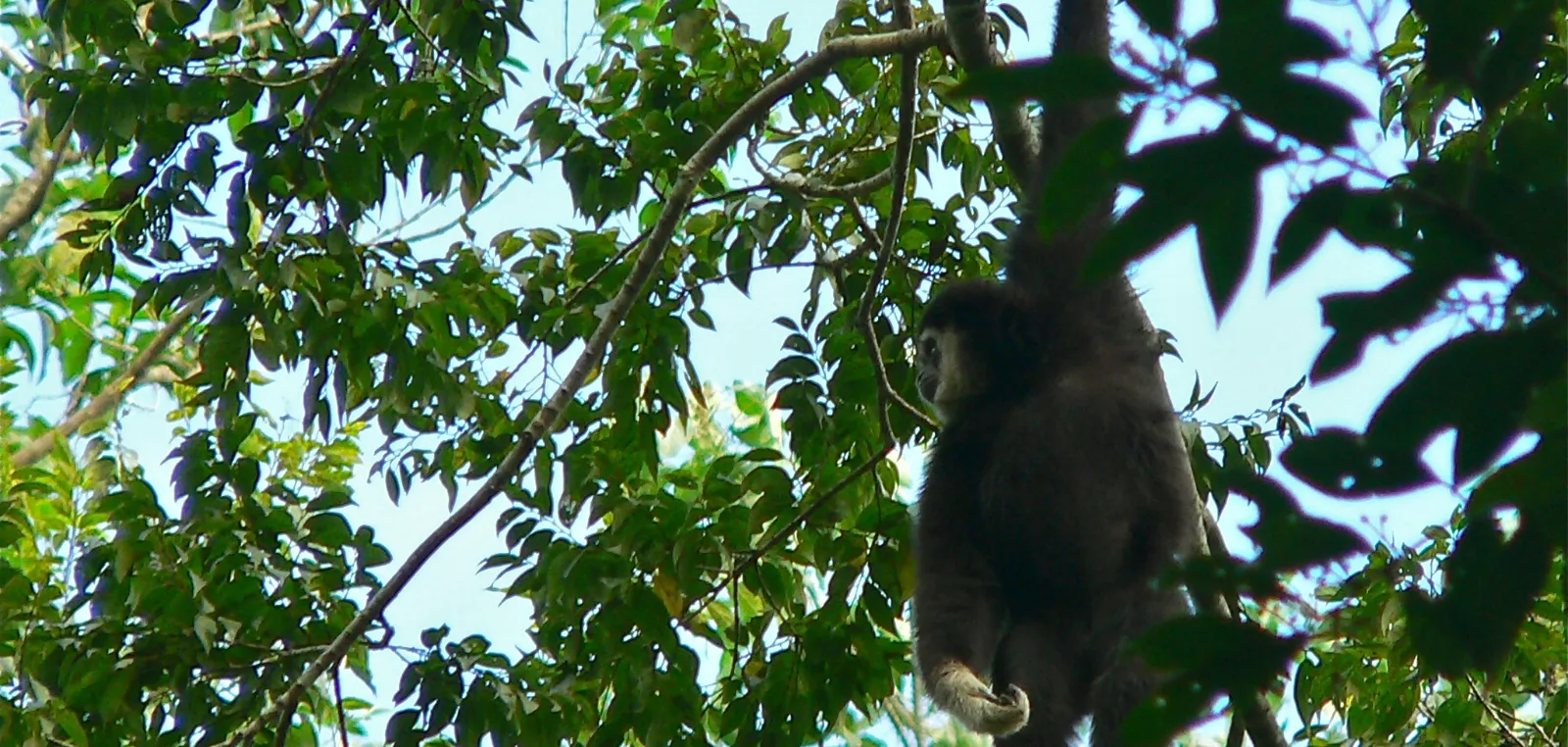
Gibbons are apes, not monkeys, and they are the reason to take Thai primates seriously. They are monogamous, they hold territory by singing, and a pair duetting at first light carries for well over a kilometre through closed forest. Khao Yai is the most reliable place in the country to hear it and a realistic place to see it, because the canopy along the main trails is low enough to watch them swing.
Khao Yai is also the only accessible park holding both Thai gibbon species. The pileated gibbon is the eastern one, scarcer and more localised, and Khao Yai sits close to the boundary where the two ranges meet.
Timing is everything and it is not negotiable. Be on a forest trail by 06:00. By eight the calling is over and you have missed it for the day.
5 places
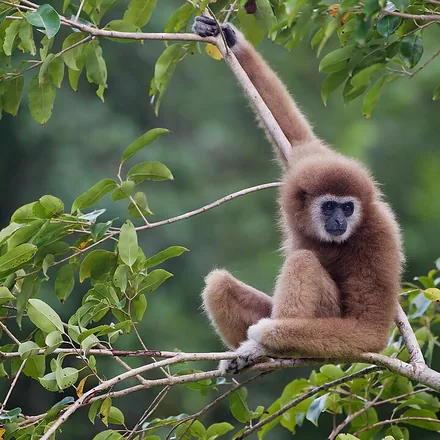
White-handed (Lar) Gibbon Common Endangered
Hylobates lar
You hear them before dawn even breaks, the whooping duet of gibbons that is the definitive soundtrack of Asian rainforest.
Where: Trail 6 and the forest around Haew Suwat. Best: Year round, 06:00-08:30. The dawn chorus carries across the whole valley; Khao Yai is the easiest place in Thailand to hear it.
Where: Heard from the raft houses on Cheow Lan Lake and along the Sok River trails at first light. Best: Year round, 05:30-08:00. The dawn duet is close to guaranteed on the lake; seeing one takes patience and a canopy scan.
Where: Canopy around Ban Krang campsite. Best: Year round, 06:00-08:30. The dawn calls start before the light does; the campsite is inside a territory.
Where: Tall evergreen forest above Km 34 on Doi Inthanon. Best: Year round, the first two hours after dawn. Heard far more than seen. The duet carries for a kilometre through the mist.
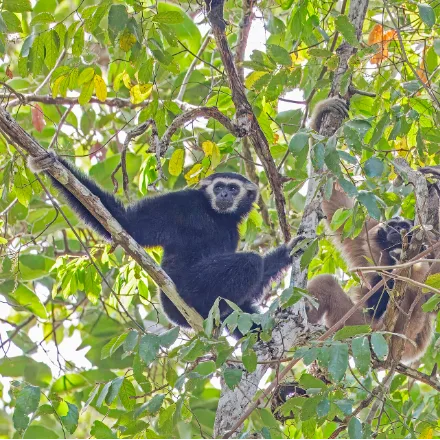
Pileated Gibbon Occasional Endangered
Hylobates pileatus
A canopy singer where males are inky black and females silver blonde, both crowned with a dark cap.
Where: Eastern forest blocks away from the main road. Best: Year round, first light. Khao Yai is one of the few parks where both gibbon species overlap.
The langurs, which are the ones worth looking for
The dusky langur is the best looking primate in Thailand and one of the easiest to find, which is an unusual combination. Grey, long-tailed, with white spectacle markings around the eyes and bright orange infants, it feeds on leaves rather than raiding bins, so it has no interest in you at all. That is precisely what makes watching it worthwhile.
The limestone country around Krabi and Railay is the classic place, on the cliff vegetation and in the trees above the boardwalks. Phuket’s Khao Phra Thaeo forest holds them too, and Khao Sam Roi Yot has them on the coastal karst.
Phayre’s leaf monkey is the northern equivalent, greyer and much scarcer, in the hill forest around Chiang Mai.
5 places
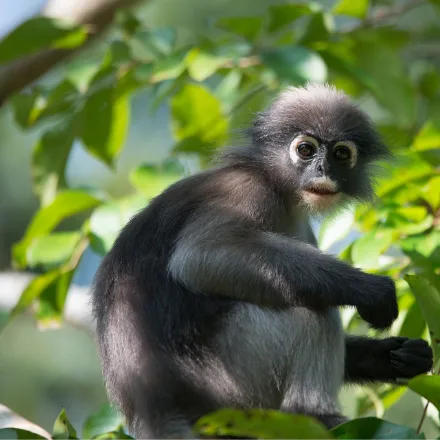
Dusky Langur (Spectacled Leaf Monkey) Common Endangered
Trachypithecus obscurus
White spectacles make the adults look permanently startled, and the bright orange babies are pure crowd pleasers.
Where: The limestone cliffs and forest edge at Railay and around Ao Nang. Best: Year round, early morning and late afternoon. Railay is the easiest place in Thailand to watch this monkey, often at eye level from the beach path.
Where: Khao Phra Thaeo, the Bang Pae road and wooded hillsides above Kathu and Kamala. Best: Year round, early morning and late afternoon. The easiest primate on the island, often at eye level from a roadside, sometimes with bright orange infants.
Where: Limestone edges near headquarters and the trail to Bang Hua Raet. Best: Year round, morning. Look for the white eye rings in mid-canopy; troops are used to walkers here.
Where: Limestone slopes above the visitor areas and around Phraya Nakhon. Best: Year round, morning. The park's signature primate and easy to find on the karst edges.
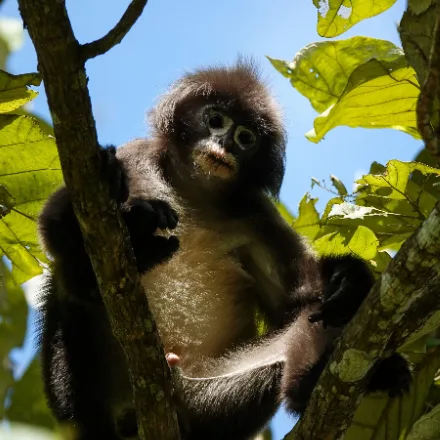
Phayre's Leaf Monkey Occasional Endangered
Trachypithecus phayrei
A grey langur with bold white spectacles around its eyes, a leaf specialist of the northern and western forests.
Where: Hill evergreen forest on Doi Chiang Dao and the upper Doi Inthanon slopes. Best: Year round, early morning. The northern langur. Look for the pale rings around the eyes and mouth in the canopy.
The macaques, and where they are worth watching
Four macaques live in Thailand, and in forest they are genuinely interesting animals, foraging, arguing, grooming and travelling in structured troops. That is the version worth going to find. The stump-tailed macaque at Kaeng Krachan, a heavy, red-faced, shaggy thing, is a proper sighting. The pig-tailed macaque at Khao Yai is another.
5 places
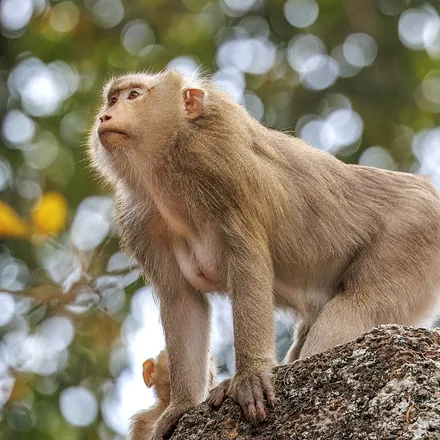
Northern Pig-tailed Macaque Common Vulnerable
Macaca leonina
Named for the short, curled pig tail, a powerful, ground loving monkey often seen troop marching along forest roads.
Where: Roadsides and the visitor centre area. Best: Year round, day. Roadside feeding is why these animals now raid cars.
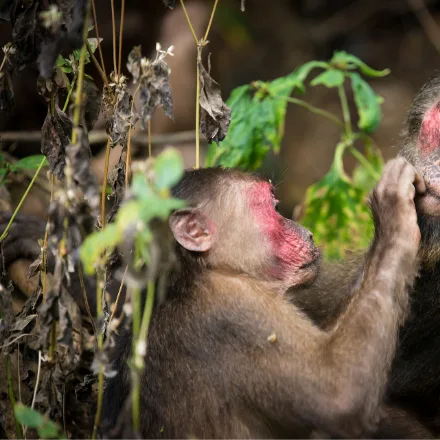
Stump-tailed Macaque Regular Vulnerable
Macaca arctoides
A shaggy, red-faced forest macaque with a stub of a tail and a habit of staying deep in the hills.
Where: Roadsides above Ban Krang. Best: Year round, day.
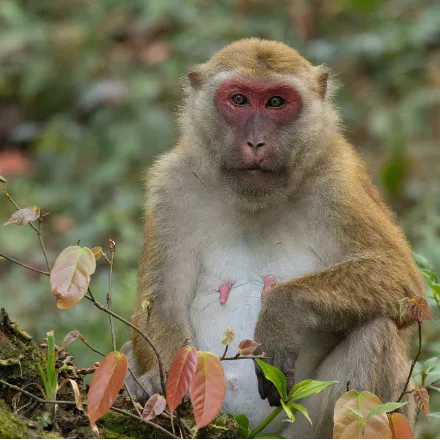
Assamese Macaque Occasional Near Threatened
Macaca assamensis
A stocky highland macaque of limestone hills and northern forests, easily missed among its commoner relatives.
Where: Limestone slopes around Doi Chiang Dao and the temple forest on Doi Suthep. Best: Year round, day. Stockier and shyer than the long-tailed macaque, and tied to broken limestone country.
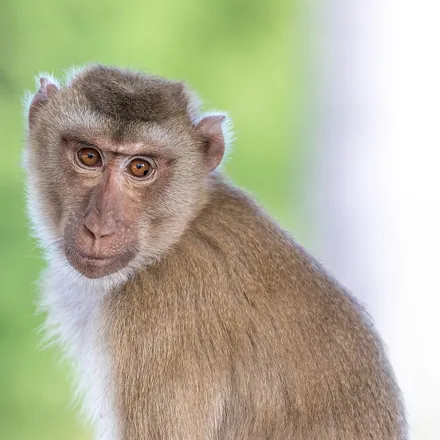
Long-tailed Macaque Regular Endangered
Macaca fascicularis
The bold, water-loving monkey of temples and mangroves, and the commonest primate in Southeast Asia.
Where: Lake shores and the boat landings on Cheow Lan. Best: Year round, day. Common around the raft houses, where they are a nuisance rather than a highlight.
Where: Railay, the cave temples and the Ao Nang headlands. Best: Year round, day. Bold around visitors and practised at taking food from bags.
Find dawn wildlife walks at Khao Yai, Khao Sok and Kaeng Krachan
Some links on this page are affiliate links. If you book through them, Wildseer may earn a small commission at no extra cost to you. No venue pays to appear here and none ever will.
Frequently asked questions
What monkeys live in Thailand?
Ten wild primates: white-handed and pileated gibbons, dusky langur and Phayre’s leaf monkey, long-tailed, pig-tailed, stump-tailed and Assamese macaques, and Bengal and Sunda slow lorises. Gibbons are apes rather than monkeys, but they are the ones worth planning around.
Where is the best place to see monkeys in Thailand?
Khao Yai for gibbons, at dawn on a forest trail, and it holds both Thai gibbon species. Krabi and Railay for dusky langurs on the limestone. Kaeng Krachan for stump-tailed macaque. Khao Sok for gibbons and langurs together from the lake.
More on Thailand wildlife
Part of the Wildlife in Thailand guide.
Image credits
Square thumbnails are cropped from the original. Wide banner images are cropped to a band. Other images are resized only. No other changes have been made.
- Male white-handed gibbon in the forest canopy (cropped to a banner): Bernard DUPONT | CC BY-SA 2.0
- White-handed Gibbon (cropped to square): JJ Harrison ( jjharrison89@facebook.com ) | CC BY 3.0, cropped
- Pileated Gibbon (cropped to square): Charles J. Sharp | CC BY-SA 4.0, cropped
- Dusky Langur (cropped to square): Rushenb | CC BY-SA 3.0, cropped
- Phayre’s Leaf Monkey (cropped to square): Rejoice Gassah | CC BY 4.0, cropped
- Northern Pig-tailed Macaque (cropped to square): Charles J. Sharp | CC BY-SA 4.0, cropped
- Stump-tailed Macaque (cropped to square): Rushen | CC BY-SA 2.0, cropped
- Assamese Macaque (cropped to square): Tisha Mukherjee | CC BY-SA 4.0, cropped
- Long-tailed Macaque (cropped to square): Basile Morin | CC BY-SA 4.0, cropped
Square thumbnails are cropped from the original. Wide banner images are cropped to a band. Other images are resized only. No other changes have been made.
- Male white-handed gibbon in the forest canopy (cropped to a banner): Bernard DUPONT | CC BY-SA 2.0
- White-handed Gibbon (cropped to square): JJ Harrison ( jjharrison89@facebook.com ) | CC BY 3.0, cropped
- Pileated Gibbon (cropped to square): Charles J. Sharp | CC BY-SA 4.0, cropped
- Dusky Langur (cropped to square): Rushenb | CC BY-SA 3.0, cropped
- Phayre’s Leaf Monkey (cropped to square): Rejoice Gassah | CC BY 4.0, cropped
- Northern Pig-tailed Macaque (cropped to square): Charles J. Sharp | CC BY-SA 4.0, cropped
- Stump-tailed Macaque (cropped to square): Rushen | CC BY-SA 2.0, cropped
- Assamese Macaque (cropped to square): Tisha Mukherjee | CC BY-SA 4.0, cropped
- Long-tailed Macaque (cropped to square): Basile Morin | CC BY-SA 4.0, cropped