
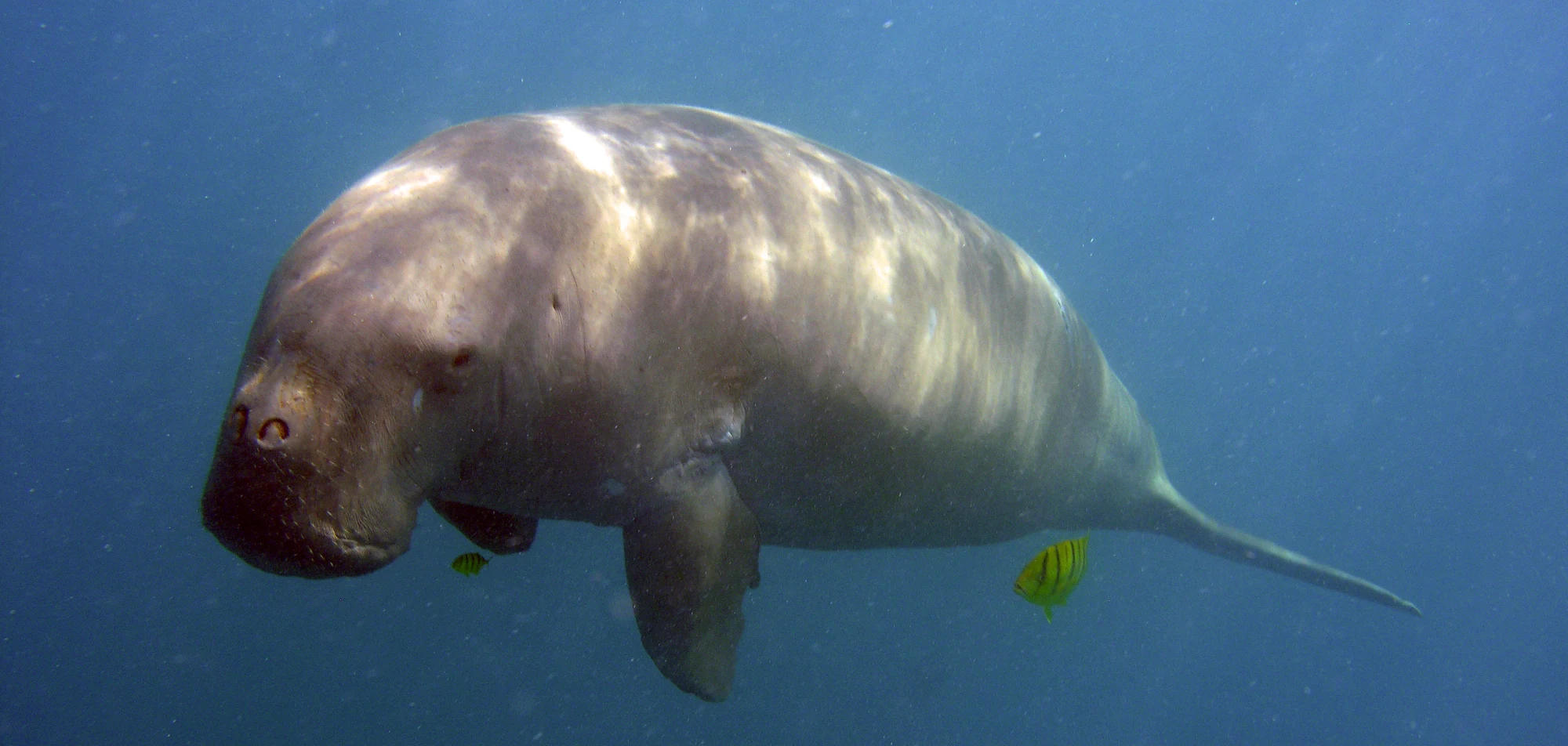
Thailand has one dugong population that matters, and it grazes a few square kilometres of seagrass off the Trang coast, mostly around Koh Libong. Everything else on this page follows from that. There is no second site to fall back on, no season that works everywhere, and no version of this trip that does not involve a small boat and an early start.
The animal itself is worth the effort. A dugong is the only marine mammal in the world that eats plants and nothing else, a three metre grey barrel with a downturned snout built for ploughing seagrass, and it is the closest thing the sea has to a grazing cow. Every record on this page is a row in the Wildseer database, with its place, its season and its likelihood stated rather than implied.
The dugong record, and what Occasional means here
One card, one animal, both of its Thai records stacked inside it. Occasional is an honest word: several mornings in the right window give you a real chance, one morning does not.
2 places
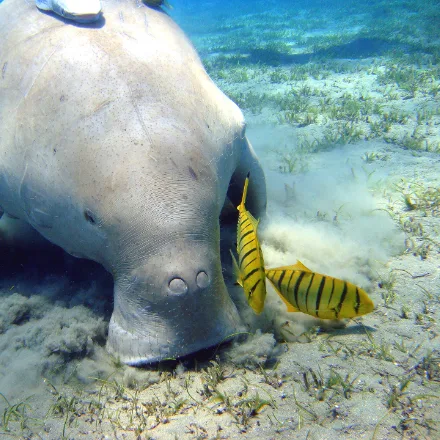
Dugong Occasional Vulnerable
Dugong dugon
The gentle sea cow said to have inspired mermaid legends, grazing seagrass meadows in warm shallow seas.
Trang: Seagrass meadows off Koh Libong, from a longtail at high tide. Best: Dec-Apr, calm mornings on a spring tide. Thailand's most important dugong population. Local boatmen at Koh Libong know the feeding trails.
Thailand: Koh Libong (Trang), Andaman seagrass meadows. Best: Calm season, seagrass shallows. Trang, especially Koh Libong, holds Thailand's most important dugong population.
Koh Libong, and why the seagrass decides everything
The seagrass beds between Koh Libong and the mainland are the largest in Thailand and among the largest in the Andaman Sea. Seagrass is not seaweed. It is a flowering plant with roots, and it needs shallow water, light, and a sheltered bottom that does not shift, which is a narrow set of conditions and the reason dugong populations sit where they sit rather than spreading along a coast.
An adult dugong eats in the region of thirty kilograms of it a day, and it does not graze the tops: it ploughs, pulling up whole plants including the rhizome, which leaves a bare winding trail across the meadow. Those trails are visible from the surface at low water, and finding fresh ones is how a morning on the water is actually spent. A trail that ends is a trail an animal is still working on.
The tide is the whole of it. The animals move onto the shallow meadows on a rising tide to feed and drop back to deeper channels as the water leaves. A spring tide moves more water and brings them further in, which is why local timing is measured in days rather than months.
The vulnerability is the same as the opportunity. A population tied to one meadow is a population that a change to that meadow removes, and the pressures here are the familiar ones: boat strike in shallow water, netting, and sediment washing off the land, which cuts the light the seagrass needs.
What a dugong actually is
It is a sirenian, which puts it in an order of four surviving species and, oddly, closer to elephants than to any whale or seal. The relationship shows: the front flippers have nails on some individuals, the skin is thick and sparsely bristled, and the upper lip is a mobile, muscular pad that works much as a very short trunk would.
The tail is the quick way to separate it from a manatee. A dugong has a fluked, dolphin-like tail with a notch in the middle; a manatee has a rounded paddle. There are no manatees in Asia, so in Thai water the question does not arise, but it is the character every guide book leads with and it is worth knowing why.
Males grow tusks, which are enlarged incisors that erupt through the upper lip and are used against other males rather than for feeding. Females can grow them too and usually do not erupt them. Both sexes are slow: a female is unlikely to breed before her sixth year and raises one calf at a time, roughly every three to seven years, which is the arithmetic behind the Vulnerable listing. A population that loses adults faster than that cannot replace them.
The mermaid story is not a stretch when you have seen one. A dugong raises its head clear of the water to breathe, holds a calf against its body with a flipper, and has a face that reads, in poor light and at distance, as more thoughtful than a face on a fish has any right to be.
What else is on the seagrass, and it is the reason to go anyway
This is the part most dugong pages leave out. A seagrass meadow is a habitat, not a backdrop, and Trang’s holds a community you will not meet on a coral reef: two seahorses that anchor to the blades, a ray that hunts buried shellfish, a conch the size of a hand, and green turtles that graze the same plant as the dugong. Several of these are more findable than the dugong itself, which is worth knowing before you book the morning.
11 places
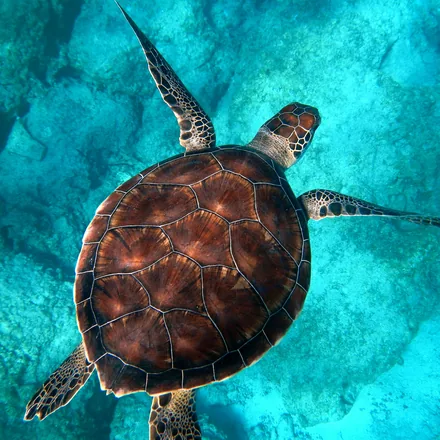
Green Sea Turtle Regular
Chelonia mydas
The great grazing turtle of the tropics, the only sea turtle that turns vegetarian as an adult.
Where: Seagrass meadows around Koh Libong and Koh Muk. Best: Nov-Apr, best Dec-Mar on the seagrass.
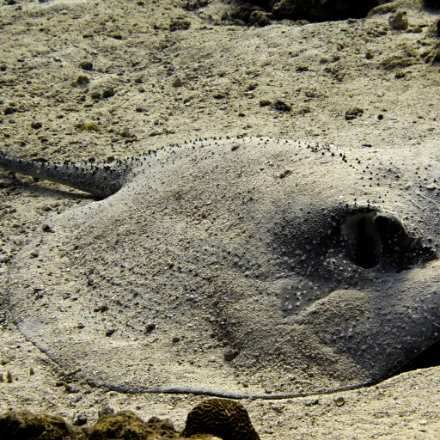
Porcupine Ray Rare Vulnerable
Urogymnus asperrimus
The only large stingray with no sting at all, protected instead by a hide of blunt thorns.
Where: Sand flats near seagrass. Best: Nov-Apr.
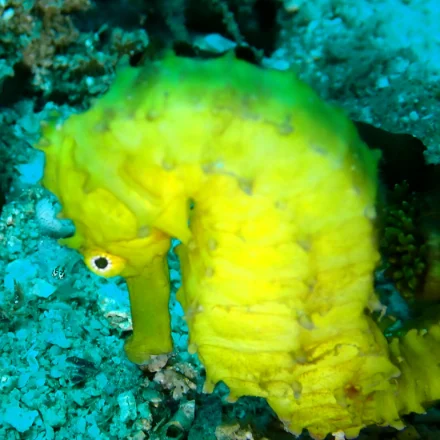
Tiger Tail Seahorse Rare Endangered
Hippocampus comes
A slender seahorse banded down the tail like a tiger, the male carrying and giving birth to the young.
Where: Seagrass margins and sponge rubble off Koh Libong. Best: Nov-Apr, calm water on the seagrass margins. Ask boatmen rather than searching blind; the beds are large.
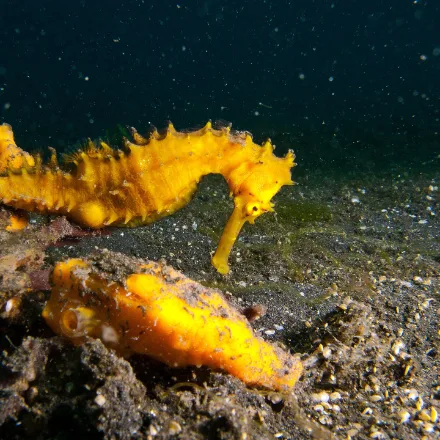
Thorny Seahorse Rare Vulnerable
Hippocampus histrix
Covered in long sharp spines and able to shift colour to match whatever it has wrapped its tail around.
Where: Seagrass and rubble margins. Best: Nov-Apr, calm water.
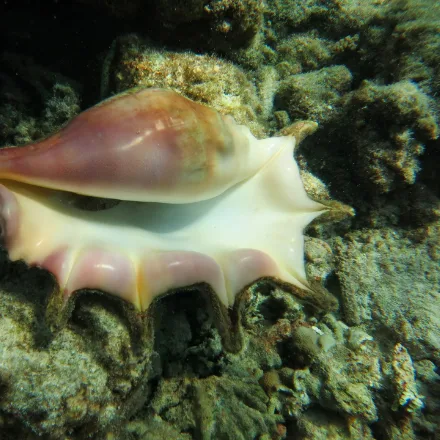
Giant Spider Conch Occasional
Lambis truncata
It does not crawl, it pole-vaults, hooking a claw-shaped foot into the sand and flipping itself forward.
Where: Seagrass beds. Best: Nov-Apr.
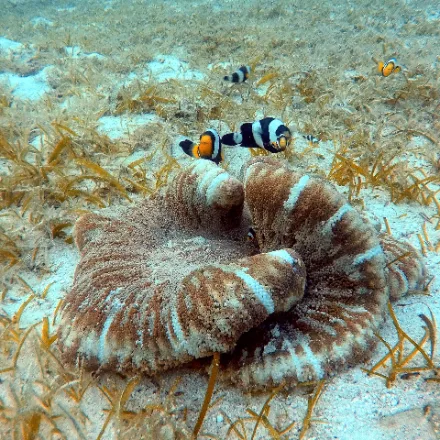
Haddon's Carpet Anemone Occasional
Stichodactyla haddoni
A metre-wide sticky carpet on open sand that will genuinely hold onto a bare hand, and can pull a small fish under.
Where: Sandy shallows and seagrass margins. Best: Nov-Apr.
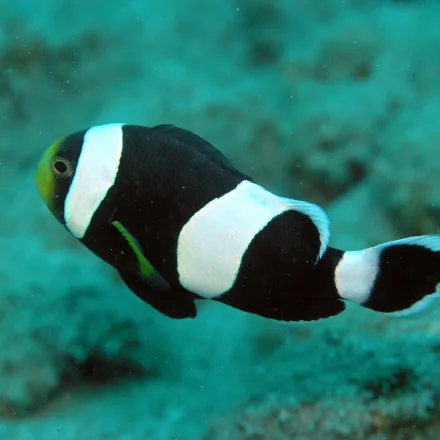
Saddleback Anemonefish Occasional
Amphiprion polymnus
The one anemonefish that lives out on open sand rather than the reef, in a host buried up to its mouth.
Where: Carpet anemones on sandy shallows. Best: Nov-Apr.
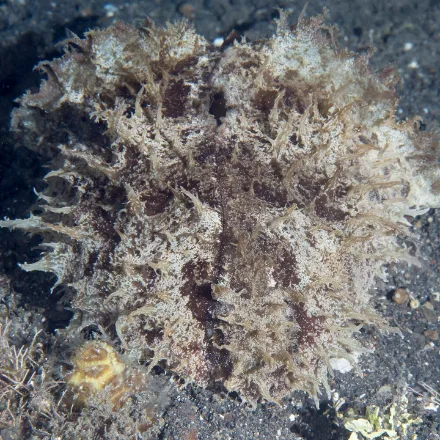
Wedge Sea Hare Occasional
Dolabella auricularia
Ejects a cloud of purple ink that does not hide it but jams the chemical senses of whatever is attacking.
Where: Seagrass at low tide. Best: Nov-Apr.
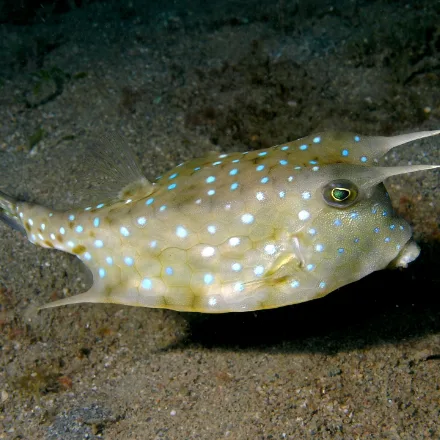
Longhorn Cowfish Occasional
Lactoria cornuta
A box of armour with horns front and back, that hunts by blowing jets of water into the sand.
Where: Seagrass and rubble. Best: Nov-Apr.
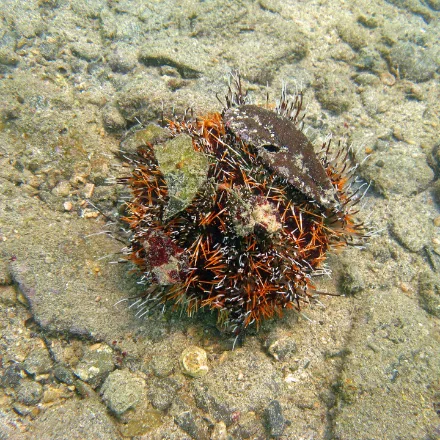
Pincushion Urchin Common
Tripneustes gratilla
Decorates itself with shell, weed and rubbish held on with its tube feet, apparently as a sunshade.
Where: Seagrass and rubble. Best: Nov-Apr.
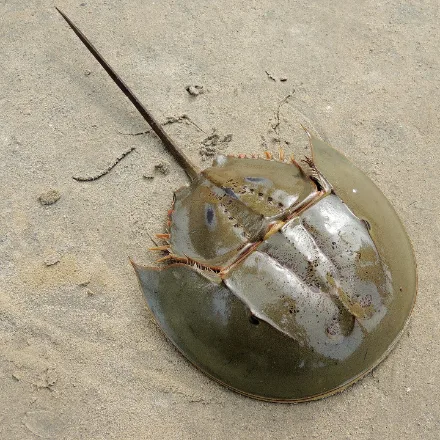
Indo-Pacific Horseshoe Crab Rare Endangered
Tachypleus gigas
Not a crab at all, closer to a spider, and its blue blood is used worldwide to test every injectable drug for contamination.
Where: Muddy shores and estuaries on spring tides. Best: Around the full and new moon.
The season, and the honest odds
December to April. The Andaman side is dry and calm in that window, and calm water is not a comfort question here but a visibility one: a dugong surfaces for a few seconds and is grey against grey, and chop hides it completely. Outside the window the southwest monsoon puts wind on this coast and the mornings that work become scarce.
Within the season, mornings beat afternoons, and a rising spring tide beats a neap. First light through mid-morning is when the animals are on the shallow meadows and the surface is still enough to read.
The realistic position, stated plainly: the database records the dugong here as Occasional. Several mornings in the right week give you a genuine chance. A single morning is a coin toss at best, and there is no site in Thailand where the answer is better. What is close to certain is the meadow itself, the turtles on it, and the trails the animals leave behind, which are the clearest evidence in Thai water that something large is grazing out there whether or not it shows itself to you.
Find boat trips and coastal stays around Trang
Some links on this page are affiliate links. If you book through them, Wildseer may earn a small commission at no extra cost to you. No venue pays to appear here and none ever will.
Frequently asked questions
Where can you see dugongs in Thailand?
The seagrass meadows off Koh Libong in Trang province, on the Andaman coast. It is the only place in Thailand with a population worth travelling for, and the animals are recorded there as Occasional rather than reliable.
When is the best time to see a dugong in Thailand?
December to April, in the morning, on a rising spring tide. The season is set by the monsoon, because calm water is what makes a briefly surfacing grey animal visible at all, and the tide is what brings the dugongs onto the shallow meadows to feed.
How many dugongs are left in Thailand?
The Trang meadows hold the country’s most important population and it is small. Numbers are monitored by aerial survey and move between years, so any single figure dates quickly. The listing is Vulnerable globally, and the Thai population is at the edge of its range with a single core site, which is a fragile arrangement however the count reads in a given year.
Is a dugong the same as a manatee?
No, though they are close relatives in the same order. The quickest character is the tail: a dugong’s is fluked and notched like a dolphin’s, a manatee’s is a rounded paddle. There are no manatees anywhere in Asia, so a sirenian in Thai water is a dugong.
What do dugongs eat?
Seagrass, and effectively nothing else, which makes them the only strictly herbivorous marine mammal in the world. An adult takes in the region of thirty kilograms a day and pulls up whole plants rather than cropping the tops, leaving the bare winding feeding trails that are the easiest sign of them from a boat.
More on Thailand wildlife
Part of the Wildlife in Thailand guide.
Image credits
Square thumbnails are cropped from the original. Wide banner images are cropped to a band. Other images are resized only. No other changes have been made.
- Dugong hero, where to see dugongs in Thailand: Vardhanjp | CC BY-SA 4.0, cropped
- Dugong (cropped to square): Julien Willem | CC BY-SA 3.0, cropped
- Green Sea Turtle: Randall Ruiz | Unsplash License, cropped
- Porcupine Ray: Rucha Karkarey | CC BY-SA 4.0, cropped
- Tigertail Seahorse (cropped to square): Jakkarin Burananit | CC BY 4.0, cropped
- Thorny Seahorse (cropped to square): prilfish | CC BY 2.0, cropped
- Giant Spider Conch (cropped to square): Ahmed Abdul Rahman | CC BY-SA 4.0, cropped
- Haddon’s Carpet Anemone (resized): Singgih Afifa Putra | CC BY-SA 4.0, cropped
- Saddleback Anemonefish (cropped to square): Jens Petersen (Jnpet) | CC BY-SA 3.0, cropped
- Wedge Sea Hare (cropped to square): Rickard Zerpe | CC BY 2.0, cropped
- Longhorn Cowfish (cropped to square): Nick Hobgood | CC BY-SA 3.0, cropped
- Pincushion Urchin (cropped to square): 紫堂 | CC BY-SA 2.0, cropped
- Indo-Pacific Horseshoe Crab (cropped to square): Shubham Chatterjee | CC BY-SA 3.0, cropped
Square thumbnails are cropped from the original. Wide banner images are cropped to a band. Other images are resized only. No other changes have been made.
- Dugong hero, where to see dugongs in Thailand: Vardhanjp | CC BY-SA 4.0, cropped
- Dugong (cropped to square): Julien Willem | CC BY-SA 3.0, cropped
- Green Sea Turtle: Randall Ruiz | Unsplash License, cropped
- Porcupine Ray: Rucha Karkarey | CC BY-SA 4.0, cropped
- Tigertail Seahorse (cropped to square): Jakkarin Burananit | CC BY 4.0, cropped
- Thorny Seahorse (cropped to square): prilfish | CC BY 2.0, cropped
- Giant Spider Conch (cropped to square): Ahmed Abdul Rahman | CC BY-SA 4.0, cropped
- Haddon’s Carpet Anemone (resized): Singgih Afifa Putra | CC BY-SA 4.0, cropped
- Saddleback Anemonefish (cropped to square): Jens Petersen (Jnpet) | CC BY-SA 3.0, cropped
- Wedge Sea Hare (cropped to square): Rickard Zerpe | CC BY 2.0, cropped
- Longhorn Cowfish (cropped to square): Nick Hobgood | CC BY-SA 3.0, cropped
- Pincushion Urchin (cropped to square): 紫堂 | CC BY-SA 2.0, cropped
- Indo-Pacific Horseshoe Crab (cropped to square): Shubham Chatterjee | CC BY-SA 3.0, cropped