
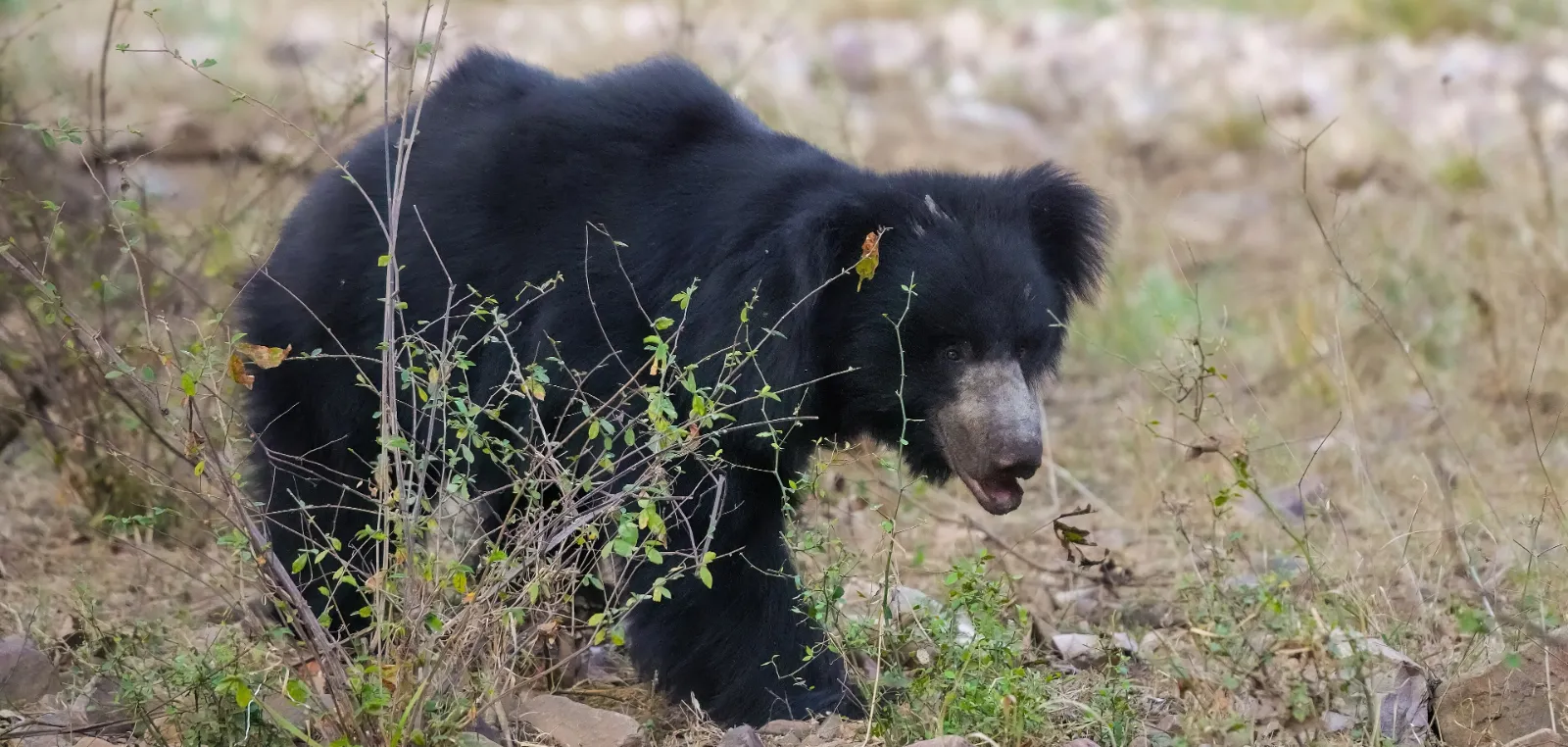
The sloth bear is the hardest of Sri Lanka’s three headline mammals and the one that turns a good trip into a memorable one. Leopards are findable across most of the year and elephants are close to guaranteed. Bears are neither. They are nocturnal for most of the calendar, they live in dense dry-zone scrub, and a visitor doing a standard week in February or March will almost certainly not see one.
Then, for a few weeks in June and July, the palu trees fruit. The bears climb into them in daylight to feed, in the open, sometimes for hours, and an animal that was effectively invisible becomes findable. Everything on this page is built around that window, because outside it the honest answer to where to see a sloth bear in Sri Lanka is that you probably will not.
The six parks, and the odds at each
One card, six places. Note how uniform the timing is: every entry says June and July, and the two are not a coincidence but the same fruiting event across the dry zone. Occasional means several drives in the right weeks give you a real chance. Rare means treat it as a bonus.
6 places
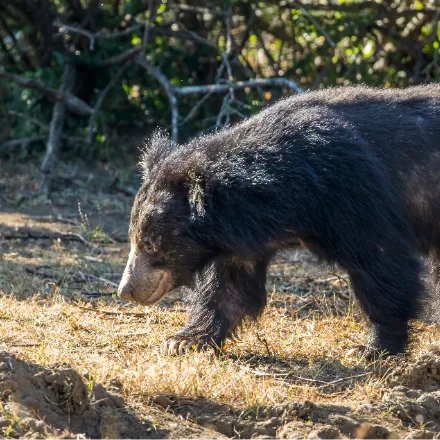
Sloth Bear Occasional Vulnerable
Melursus ursinus
A shaggy, long-clawed insect specialist that vacuums termites out of a mound loudly enough to hear from fifty metres.
Wilpattu: Palu trees along the tracks and around the villus. Best: Jun-Jul, morning. The best sloth bear park in the country, and the palu season is the whole reason to time a trip for it.
Yala: Block 1 scrub and fruiting trees. Best: Jun-Jul, early morning. Possible but well behind Wilpattu. This animal charges when surprised.
Wasgamuwa: Dry evergreen forest away from the main tracks. Best: Jun-Jul. Very few vehicles, correspondingly few sightings reported.
Gal Oya: Forest and rock outcrops around the reservoir. Best: June and July, when the palu fruit ripens.
Minneriya: Dry forest and old termite mounds away from the open tank bed. Best: Year round, best June to July when fruit is on.
Kumana: Dry scrub and fruiting trees away from the lagoons. Best: June to July when fruit is on.
The palu season, and why it moves
Manilkara hexandra, the palu, is a slow-growing dry-zone tree that produces a small sweet yellow fruit, and when it does the whole forest reorganises around it. Bears climb, monkeys feed above them, and the fallen fruit brings in everything from deer to jackals. For the bears it is the calorie surplus of the year, and they take it in daylight because the surplus is worth more than the cover.
The date is set by rainfall rather than the calendar, so the window shifts between years and between parts of the dry zone. June and July is the reliable framing, but a fortnight either side is normal, and in a poor year the fruiting is patchy and the effect is weaker. This is the single most useful question to ask locally on arrival, because the answer changes what your drives are worth.
It also means a sloth bear trip is an unusually honest thing to plan. The window is narrow, it is public knowledge, and nobody can promise you an animal inside it. What can be said is that outside it your realistic chance drops close to zero, which makes the timing decision most of the work.
Wilpattu, which is the answer
Wilpattu is the only park on this page where sloth bear is Occasional rather than Rare, and that gap is larger than it sounds. The park is built around villus, natural sand-rimmed lakes set in dry forest, and the tracks run past mature palu along their margins. The combination of fruiting trees and open track edge is what makes the animals visible rather than merely present.
It is also the quieter park. Yala’s Block 1 carries far more vehicles, and while the bear density there is real, the sightings are shared. Wilpattu in June and July is the trip to take if the bear is the priority rather than the bonus.
Morning is the time. The bears feed in the trees through the first hours of light and drop down as the heat builds, which puts the useful window in roughly the same two hours that everything else in a dry zone park happens.
What a sloth bear actually is
It is a termite specialist that looks like nothing else. The muzzle is long, mobile and nearly hairless, the nostrils close voluntarily, and the animal is missing its upper front incisors entirely, which leaves a gap it uses as a nozzle. It digs into a termite mound, blows the loose soil clear, then sucks the insects out through that gap hard enough to be heard from a hundred metres away in quiet forest. Anyone who has heard it before seeing it does not forget the sound.
The shaggy black coat that gives it the misleading name is unusually long and loose over the shoulders, and there is a pale V or Y across the chest that varies between individuals. Cubs ride on their mother’s back, which no other bear does routinely, and they do it for the first year or more.
The species is Vulnerable and Sri Lanka’s animals are an endemic subspecies, Melursus ursinus inornatus, smaller than the Indian ones and with a shorter coat. Numbers are not confidently known, the dry zone parks hold most of them, and the pressure is the familiar one: the forest between the parks has gone to cultivation, so the populations are increasingly islands.
Find safaris and park drives in Sri Lanka’s dry zone
Some links on this page are affiliate links. If you book through them, Wildseer may earn a small commission at no extra cost to you. No venue pays to appear here and none ever will.
Frequently asked questions
When is the best time to see sloth bears in Sri Lanka?
June and July, when the palu fruit ripens in the dry zone and the bears climb into the trees in daylight to feed. The exact timing is set by rainfall rather than the calendar and moves by a fortnight either way between years, so it is worth asking locally on arrival. Outside that window the bears are nocturnal and the realistic chance drops close to zero.
Where is the best place to see a sloth bear in Sri Lanka?
Wilpattu. It is the only one of the six parks where sloth bear is recorded as Occasional rather than Rare, its tracks run past mature palu trees along the villu margins, and it carries far fewer vehicles than Yala. Morning drives, in the palu window.
What are the chances of seeing a sloth bear in Sri Lanka?
In Wilpattu across several morning drives in late June or July, a genuine chance. On a single drive, or anywhere in the wrong month, low. This is the one animal on the island where the timing decision matters more than the park decision.
Are Sri Lankan sloth bears different from Indian ones?
Yes. The island’s animals are a separate subspecies, Melursus ursinus inornatus, smaller than the mainland form and with a noticeably shorter coat. The species overall is listed as Vulnerable.
Why is it called a sloth bear?
A naming error that stuck. The first specimen reached Europe in the late eighteenth century and its long curved claws and shaggy coat led to it being described as a kind of sloth. It is a true bear, and one of the most specialised: a termite eater with a gap in its front teeth that works as a vacuum nozzle.
More on Sri Lanka wildlife
- Wilpattu wildlife
- Yala wildlife
- Safari in Sri Lanka
- Where to see leopards in Sri Lanka
- Mammals of Sri Lanka
Part of the Wildlife in Sri Lanka guide.
Image credits
Square thumbnails are cropped from the original. Wide banner images are cropped to a band. Other images are resized only. No other changes have been made.
- where-to-see-sloth-bears-sri-lanka: Giles Laurent | CC BY-SA 4.0, cropped
- Sloth Bear: Charles J. Sharp | CC BY-SA 4.0, cropped
Square thumbnails are cropped from the original. Wide banner images are cropped to a band. Other images are resized only. No other changes have been made.
- where-to-see-sloth-bears-sri-lanka: Giles Laurent | CC BY-SA 4.0, cropped
- Sloth Bear: Charles J. Sharp | CC BY-SA 4.0, cropped