
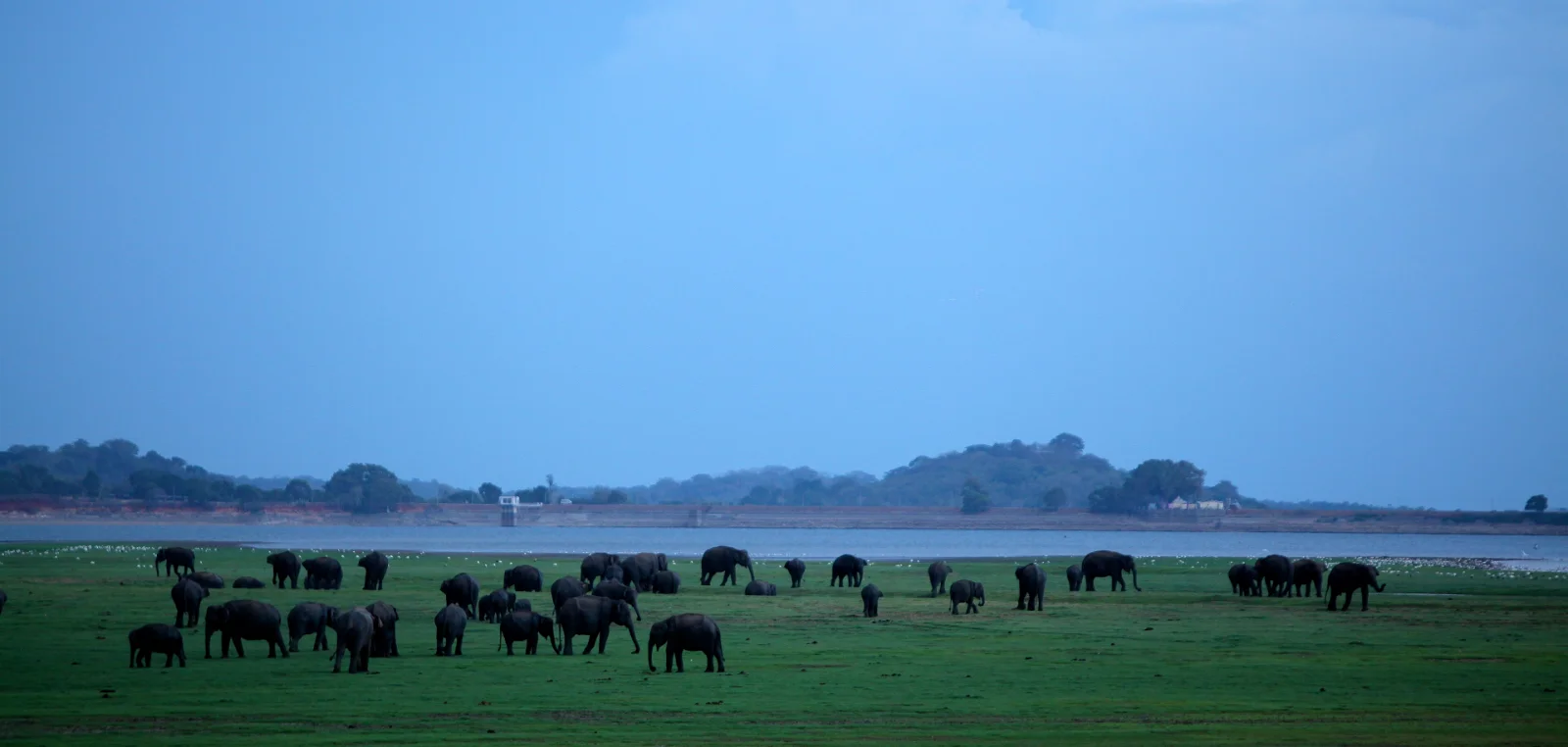
Sri Lanka holds somewhere near six thousand wild elephants, one of the largest populations of Asian elephants anywhere, on an island roughly the size of Ireland. The density is the point. In most of the species’ range you go looking for elephants and often do not find them. Here the question is not whether you will see one but which of several very different ways you would like to.
There are three sightings on this island that are genuinely worth planning a trip around, and they are not interchangeable. One is a reservoir bed in the dry season with several hundred animals on it at once. One is a park where the elephants are simply always there, every drive, all year. One is a lake where they swim between islands with their trunks up. The eight parks below are ranked by how likely you actually are to connect, and every month and likelihood comes from the Wildseer database rather than from a brochure.
The eight parks, ranked by your actual odds
One card, eight places. Common means essentially every drive produces elephants, Regular means most multi-day visitors connect, Occasional means treat them as a bonus and go for the habitat.
8 places
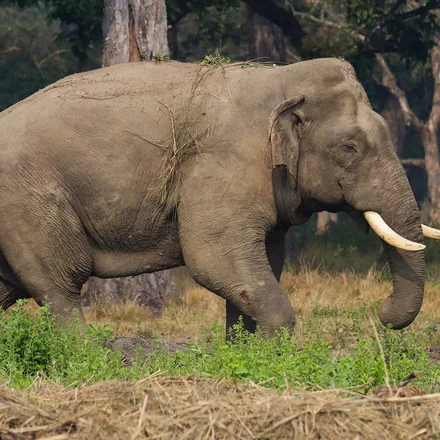
Asian Elephant Common Endangered
Elephas maximus
The largest land animal in Asia, and a herd crossing open grassland at dusk moves over the ground faster than its size suggests.
Udawalawe: Grassland and the reservoir margins throughout the park. Best: Year round. The most reliable elephants in Sri Lanka, seen on essentially every drive, and without the seasonal gamble the Gathering involves.
Minneriya: The receding tank bed as the water drops, in the late afternoon. Best: July to October for the Gathering. The Gathering is the largest assembly of wild Asian elephants anywhere on earth, with hundreds on the tank bed at once. Which tank they use shifts between Minneriya and Kaudulla year to year, so ask on the day.
Gal Oya: Swimming between islands on the Senanayake Samudraya reservoir, seen from a boat. Best: March to July. The only place in Asia where elephants are regularly watched swimming, trunks up like snorkels. A boat changes the sightline completely.
Wasgamuwa: Riverine forest and grassland along the Mahaweli. Best: Year round.
Yala: Waterholes and open scrub in Block 1. Best: February to July.
Arugam Bay: The Panama road and the lagoon scrub behind the town at dusk. Best: May to September. Elephants on the road after dark are routine here, moving between the lagoon scrub and water.
Wilpattu: Villu margins and open woodland. Best: February to October.
Kumana: Scrub and lagoon margins. Best: May to September.
Udawalawe, if you only get one chance
Udawalawe is the answer to the question most people are really asking, which is not where the elephants are most spectacular but where they are most certain. It is open grassland and reservoir margin rather than closed forest, the herds are resident rather than migratory, and they are visible on essentially every drive in every month of the year. If your trip has one park in it and you want an elephant, this is the one that does not gamble.
The openness is what makes it work and also what makes it different. In thick dry-zone scrub you get a grey shape and a moving branch. Here you watch a herd cross half a kilometre of grass, and you can see the structure of it: the matriarch setting the pace, calves tucked in behind the front rank, a young bull trailing at a distance because he has been pushed out and has not worked out where to go yet. That is a better hour than a brief glimpse of a bigger group.
Late afternoon is the time, when the animals move down to the water. There is no season to plan around, which is unusual on this island and is the whole argument for the place.
The Gathering, and the one detail that catches people out
From roughly July to October the dry zone runs out of water and the elephants go to the last of it. What forms on the exposed bed of Minneriya tank is the largest assembly of wild Asian elephants anywhere on earth: several hundred animals, in family groups that spend the rest of the year apart, feeding on the grass that grows as the water retreats. There is nothing else like it in the range of the species, and it is entirely a wild event driven by rainfall rather than by anything anyone has arranged.
The detail that catches people out is that the Gathering is not fixed to one tank. Minneriya is the famous name, but the herds follow the water, and in several recent years the main concentration has been on the neighbouring Kaudulla tank instead, or has moved between the two within a single season. Book the region and the window, not the specific park, and ask on the day where the animals actually are. Anyone who tells you in advance exactly which tank you will be standing at in three months is guessing.
Late afternoon again, and the peak is usually August and September. It is worth understanding that a poor monsoon makes the Gathering better and a wet year makes it weaker, because it is scarcity that concentrates them. A year of good rain across the dry zone spreads the elephants out and the assembly never really forms.
Gal Oya, where they swim
Gal Oya is the sighting almost nobody comes to Sri Lanka expecting, and it is the one people talk about afterwards. The park is built around the Senanayake Samudraya reservoir, which is studded with islands, and the elephants swim between them. You watch from a boat, at water level, as an animal that weighs three tonnes crosses open water with only the top of its head and a raised trunk showing, using it as a snorkel.
It is the only place in Asia where this is watched regularly, and the change in sightline is most of why it lands. From a vehicle you always look slightly down at an elephant. From a boat you are level with it, at forty metres, on its terms, in an element where you are the clumsy one. March to July is the window, when the water is low enough that the crossings are frequent.
The park is also the least visited on this page by a wide margin, which is part of the experience and part of the risk: fewer eyes means fewer sightings found for you.
Why you probably will not see a tusker
Visitors who have seen African elephants often spend a Sri Lankan drive waiting for tusks that never appear, and assume they have been unlucky. They have not. In Asian elephants only males grow tusks at all, and in Sri Lanka the great majority of bulls are tuskless. Estimates vary, but somewhere around ninety three percent of Sri Lankan males carry no tusks worth the name. A full tusker here is a genuine rarity rather than the default, and the handful of well known ones are followed individually.
The reason is the uncomfortable part. Centuries of capture and killing removed tusked bulls from the breeding population faster than tuskless ones, and the trait is heritable. What you are looking at across a Sri Lankan park is the shape of a population that has been selectively stripped of its tusks by people. It is one of the clearest examples anywhere of human pressure rewriting an animal’s appearance.
What the males have instead is a different set of features. Many otherwise tuskless bulls carry tushes, short teeth that just show at the lip and never grow into anything more. And the temporal gland sits in a bulge behind the eye, streaming a dark fluid down the cheek when a bull is in musth: a periodic state, lasting weeks or months, in which testosterone runs at many times its baseline and the animal ranges far outside its usual ground.
What a herd is, and how it talks
A Sri Lankan elephant herd is a matriline. An old cow, her daughters, their daughters and all the dependent calves, moving as a single unit with the oldest female setting the direction. She is the group’s memory: where water held through the last bad drought, which routes between valleys still work, which have been fenced. In a species that lives sixty or seventy years, that memory is a survival asset the herd cannot replace quickly, and it is the reason the loss of an old cow costs a family group far more than the loss of any other individual.
Bulls leave that structure at adolescence and do not come back. They live alone or in loose bachelor associations, joining females only to breed. So a single elephant in a Sri Lankan park is almost always a male, and any group of five or more is almost always females and young, and that one distinction organises most of a day’s sightings without any further information.
The other thing to know is that a silent herd is not a quiet one. Most elephant communication happens below the range of human hearing, in rumbles down at 14 to 24 hertz, and low frequencies carry: several kilometres through air, further again as vibration through the ground, which elephants detect through the fat pads of their feet. Family groups spread across a park stay coordinated on channels nobody standing there can hear. Occasionally a rumble carries enough energy in its upper harmonics to be felt rather than heard, which is the closest most people come to noticing any of it.
An adult eats around a hundred and fifty kilograms of vegetation a day and digests it poorly, which is why an elephant is almost always feeding, sixteen to eighteen hours out of twenty four, and why a herd is almost always moving. That appetite is also the whole of Sri Lanka’s conservation problem in one sentence. The island has six thousand elephants and no unfenced space left to hold them, so herds meet cultivation at the edges of every dry zone park, and the resulting conflict kills a few hundred elephants and a smaller but comparable number of people every year. Food conditioning makes it worse: an animal that learns to associate people or vehicles with food stops keeping its distance, and an elephant that has stopped keeping its distance is on a short path to being killed.
Wildseer is a guide to wild animals in wild places. We do not review, rate or comment on zoos, sanctuaries, tour operators or attractions of any kind, in either direction, and we never will. Which places are responsible, and which are worth your time and money, is a judgement for you to make.
Find wildlife safaris and park drives in Sri Lanka
Some links on this page are affiliate links. If you book through them, Wildseer may earn a small commission at no extra cost to you. No venue pays to appear here and none ever will.
Frequently asked questions
Where is the best place to see elephants in Sri Lanka?
Udawalawe if you want certainty, because elephants are seen on essentially every drive in every month. Minneriya between July and October if you want the spectacle, because that is when the Gathering forms. Gal Oya from March to July if you want the sighting nobody else comes home with, which is elephants swimming between islands seen from a boat.
When is the Gathering at Minneriya?
Roughly July to October, peaking in August and September, as the tank bed dries and the grass comes through. It is a wild event driven by rainfall, so the timing shifts year to year, and the herds may concentrate on the neighbouring Kaudulla tank instead. Ask locally on the day rather than committing to one park months in advance.
How many wild elephants are there in Sri Lanka?
Around six thousand, which is one of the largest wild Asian elephant populations in the world and by far the highest density. They are listed as Endangered, and the pressure on them is habitat loss and conflict at the edges of farmland rather than a shortage of protected parks.
Why do so few Sri Lankan elephants have tusks?
Only male Asian elephants grow tusks at all, and in Sri Lanka roughly ninety three percent of bulls are tuskless. Centuries of capture and killing removed tusked males from the breeding population faster than tuskless ones, and the trait is inherited. A full tusker here is genuinely rare.
Can you see elephants in Sri Lanka all year round?
Yes, at Udawalawe and Wasgamuwa, where the herds are resident and there is no season to plan around. Everywhere else has a window: February to July at Yala, March to July at Gal Oya, May to September on the east coast, and July to October for the Gathering.
More on Sri Lanka wildlife
Part of the Wildlife in Sri Lanka guide.
Image credits
Square thumbnails are cropped from the original. Wide banner images are cropped to a band. Other images are resized only. No other changes have been made.
- Where to See Elephants in Sri Lanka: Al Jazeera English | CC BY-SA 2.0, cropped
- Asian Elephant (cropped to square): Shadow Ayush | CC BY-SA 4.0, cropped
Square thumbnails are cropped from the original. Wide banner images are cropped to a band. Other images are resized only. No other changes have been made.
- Where to See Elephants in Sri Lanka: Al Jazeera English | CC BY-SA 2.0, cropped
- Asian Elephant (cropped to square): Shadow Ayush | CC BY-SA 4.0, cropped