
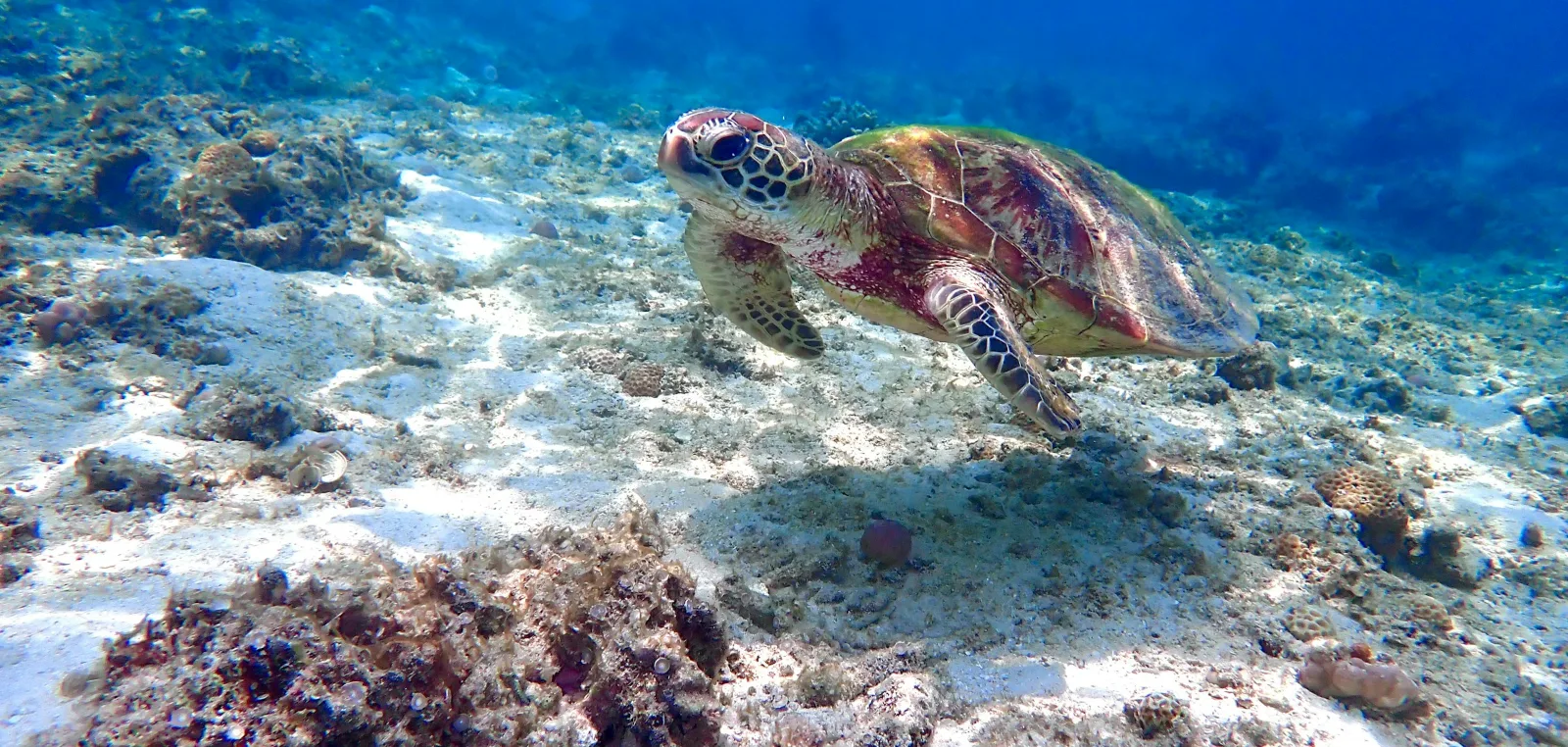
Five sea turtle species are recorded in Thai waters and they are not remotely equal. Green turtles are genuinely reliable on the right reefs and seagrass, hawksbills turn up often enough to plan around, and the other three range from rare to effectively gone as a visitor experience. Most pages on this subject list all five as though you might see any of them. You will not.
This page separates them, gives you the sites and the honest odds for each, covers the nesting season for anyone travelling between November and February, and covers the nesting season and how a hatchling finds the sea.
Green turtle, the one you can actually plan around
The green turtle is a grazer, which is why it is findable: it feeds on seagrass and algae in shallow, predictable places rather than ranging across open water. Anywhere with a decent seagrass meadow and light boat traffic is worth snorkelling, and you do not need to dive.
The Similans are the classic, particularly the shallow bays at Donald Duck Bay and Anita’s Reef. Trang and Koh Libong hold the largest seagrass beds in the country, which is also why the dugongs are there. Around Koh Tao, Shark Bay and the Ang Thong meadows are reliable enough that many operators quote them as near certain in calm conditions.
6 places
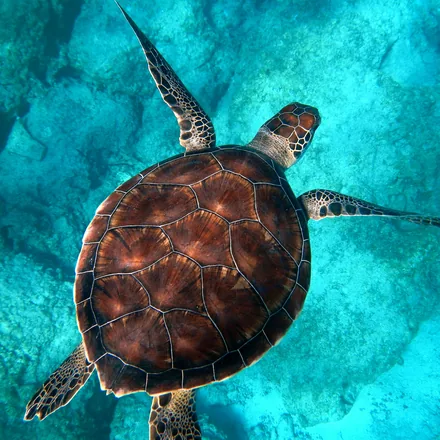
Green Sea Turtle Regular
Chelonia mydas
The great grazing turtle of the tropics, the only sea turtle that turns vegetarian as an adult.
Where: Seagrass and shallow reef at Donald Duck Bay and Anita's Reef. Best: Nov-Apr, nesting Nov-Feb.
Where: Seagrass meadows around Koh Libong and Koh Muk. Best: Nov-Apr, best Dec-Mar on the seagrass.
Where: Seagrass and shallow reef around Koh Tao and the Ang Thong islands. Best: Feb-Sep, best Apr-Aug.
Where: Shallow reef and seagrass around Phi Phi Don. Best: Nov-Apr, nesting Nov-Feb.
Where: Seagrass and shallow reef around the Hong Islands and Koh Poda. Best: Nov-Apr.
Where: Seagrass and shallow reef at Racha Yai and around Koh Bon. Best: Nov-Apr, best Dec-Mar.
Hawksbill, on coral rather than grass
The hawksbill is the sponge eater, so it lives on coral rather than seagrass, and it is the one to look for on the bommies and walls rather than in the shallows. It is smaller, sharper faced, and the shell overlaps like roof tiles.
It is Critically Endangered globally, and the reason is its shell, which is the tortoiseshell of the historic trade. The tortoiseshell trade remains the single largest pressure on the species.
5 places
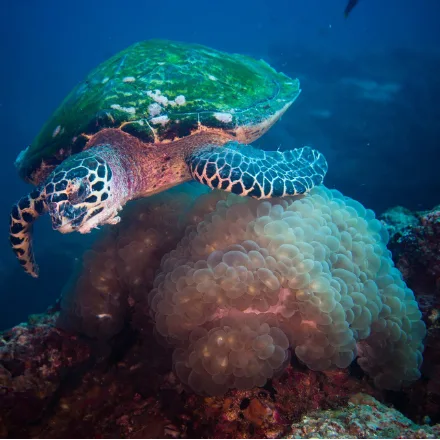
Hawksbill Turtle Occasional Critically Endangered
Eretmochelys imbricata
The reef's sponge specialist, its beautiful shell also the reason it was hunted to the edge.
Where: Coral bommies and sponge-covered walls throughout. Best: Nov-Apr.
Where: Soft coral walls of Hin Muang. Best: Nov-Apr.
Where: Coral bommies at Bida Nok. Best: Nov-Apr.
Where: Coral around Koh Poda and Chicken Island. Best: Nov-Apr.
Where: Coral at Racha Yai and the Kata and Karon reef edges. Best: Nov-Apr. Watch for it threading coral crevices for sponges.
The three you almost certainly will not see
Olive ridley, leatherback and loggerhead are all on the Thai list and none of them is a realistic sighting. The olive ridley nests in small numbers on the Andaman coast, the leatherback is down to a handful of nesting events on beaches where it was once regular, and the loggerhead has no confirmed regular nesting in Thailand at all.
We list them because they are real and because the nesting beaches matter, not because you should plan around them. If you see a leatherback in Thai water you have had a genuinely remarkable piece of luck.
3 places
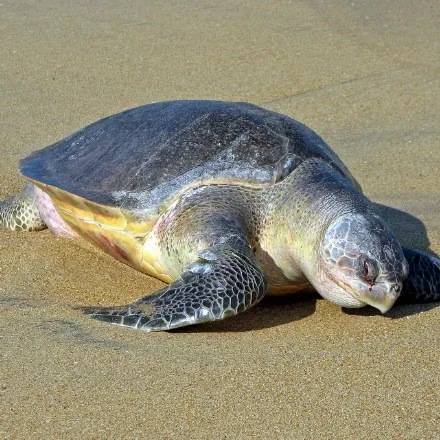
Olive Ridley Turtle Rare Vulnerable
Lepidochelys olivacea
The smallest and most numerous sea turtle, famous elsewhere for mass nestings of thousands at once.
Where: The nesting beach at Mai Khao within Sirinat National Park. Best: Nov-Feb, at night on a rising tide. Mai Khao is one of the last Thai nesting beaches. Light and flash turn a nesting female back to the sea.
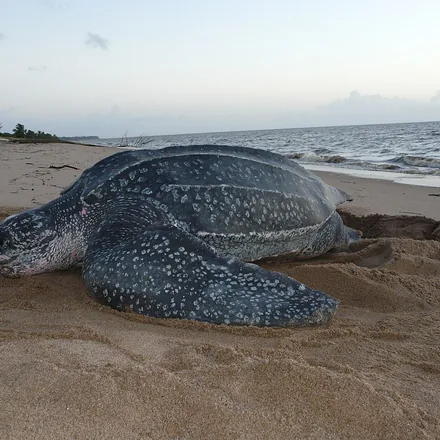
Leatherback Turtle Ultra rare Vulnerable
Dermochelys coriacea
The largest turtle on Earth, a jellyfish hunter that dives deeper than most whales and crosses whole oceans.
Where: Historically the Mai Khao nesting beach. Best: Nov-Feb. Nesting has all but stopped here. Included as an honest record of what the beach has lost.
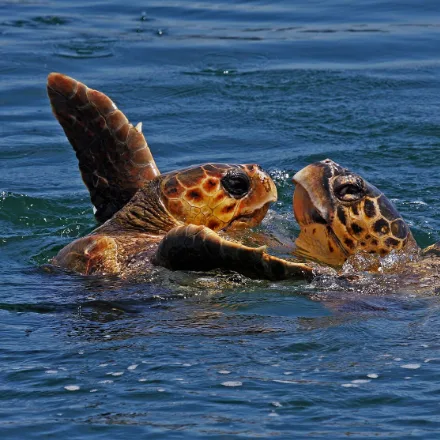
Loggerhead Turtle Ultra rare Vulnerable
Caretta caretta
Jaws powerful enough to crush a queen conch, and it navigates ocean basins by reading the earth's magnetic field.
Where: Offshore water. Best: Year round, best Feb-Sep.
Nesting season, and where it happens
The Andaman nesting season runs roughly from November to February, and Mai Khao beach on Phuket’s northwest coast, inside Sirinat National Park, is the best known site. It is an eleven kilometre stretch of undeveloped sand, and it is protected precisely because it was once a major leatherback beach.
Nesting is a night event and a slow one. A female hauls out, digs, lays and covers over a couple of hours, and any light or movement during the approach can turn her back to the sea before she lays. Night access to the nesting beaches is through licensed monitoring projects, in small groups and under red light, and most nights nothing comes ashore.
Turtle release events are a different thing and are timed for visitors rather than for turtles. Hatchlings released in daylight face far higher predation and lose the sea finding cue they get from a naturally dark horizon; hatchlings held in tanks for weeks or months lose condition and the swim frenzy that carries them offshore. If a release is scheduled for an audience at a convenient hour, it is being run for the audience.
Find snorkelling and diving trips to the Similans, Trang and Koh Tao
Some links on this page are affiliate links. If you book through them, Wildseer may earn a small commission at no extra cost to you. No venue pays to appear here and none ever will.
Frequently asked questions
Where is the best place to see turtles in Thailand?
For green turtles, the seagrass and shallow reef at the Similans, around Koh Tao and the Ang Thong islands, and the meadows at Trang and Koh Libong. For hawksbills, the coral bommies at the Similans, Hin Muang and Bida Nok. Green turtles are the reliable ones and you can snorkel rather than dive for them.
What sea turtles live in Thailand?
Five species: green, hawksbill, olive ridley, leatherback and loggerhead. Only green and hawksbill are realistic sightings. The other three range from rare to effectively absent, and the loggerhead has no confirmed regular Thai nesting.
When is turtle nesting season in Thailand?
Roughly November to February on the Andaman coast. Mai Khao beach on Phuket, inside Sirinat National Park, is the best known nesting site and was historically a major leatherback beach.
Why are Thailand’s turtles endangered?
Historic egg collection, entanglement in fishing gear, plastic ingestion, boat strikes, coastal development on nesting beaches, and for the hawksbill the tortoiseshell trade. Seagrass loss matters too, because it is what green turtles eat.
More on Thailand wildlife
- Reptiles and Amphibians of Thailand
- Similan Islands in February
- Snorkelling in Thailand
- Diving in Thailand
- Phuket wildlife
Part of the Wildlife in Thailand guide.
Image credits
Square thumbnails are cropped from the original. Wide banner images are cropped to a band. Other images are resized only. No other changes have been made.
- Green sea turtle swimming over a shallow coral reef (cropped to a banner): natary t | Unsplash License
- Green Sea Turtle: Randall Ruiz | Unsplash License, cropped
- Hawksbill Turtle (cropped to square): Daniel Sasse | CC BY-SA 4.0, cropped
- Olive Ridley Turtle (cropped to square): Bernard Gagnon | CC BY-SA 3.0, cropped
- Leatherback Turtle (cropped to square): Julien Renoult | CC BY 4.0, cropped
- Loggerhead Turtle (cropped to square): Eco cruising | CC BY-SA 4.0, cropped
Square thumbnails are cropped from the original. Wide banner images are cropped to a band. Other images are resized only. No other changes have been made.
- Green sea turtle swimming over a shallow coral reef (cropped to a banner): natary t | Unsplash License
- Green Sea Turtle: Randall Ruiz | Unsplash License, cropped
- Hawksbill Turtle (cropped to square): Daniel Sasse | CC BY-SA 4.0, cropped
- Olive Ridley Turtle (cropped to square): Bernard Gagnon | CC BY-SA 3.0, cropped
- Leatherback Turtle (cropped to square): Julien Renoult | CC BY 4.0, cropped
- Loggerhead Turtle (cropped to square): Eco cruising | CC BY-SA 4.0, cropped