
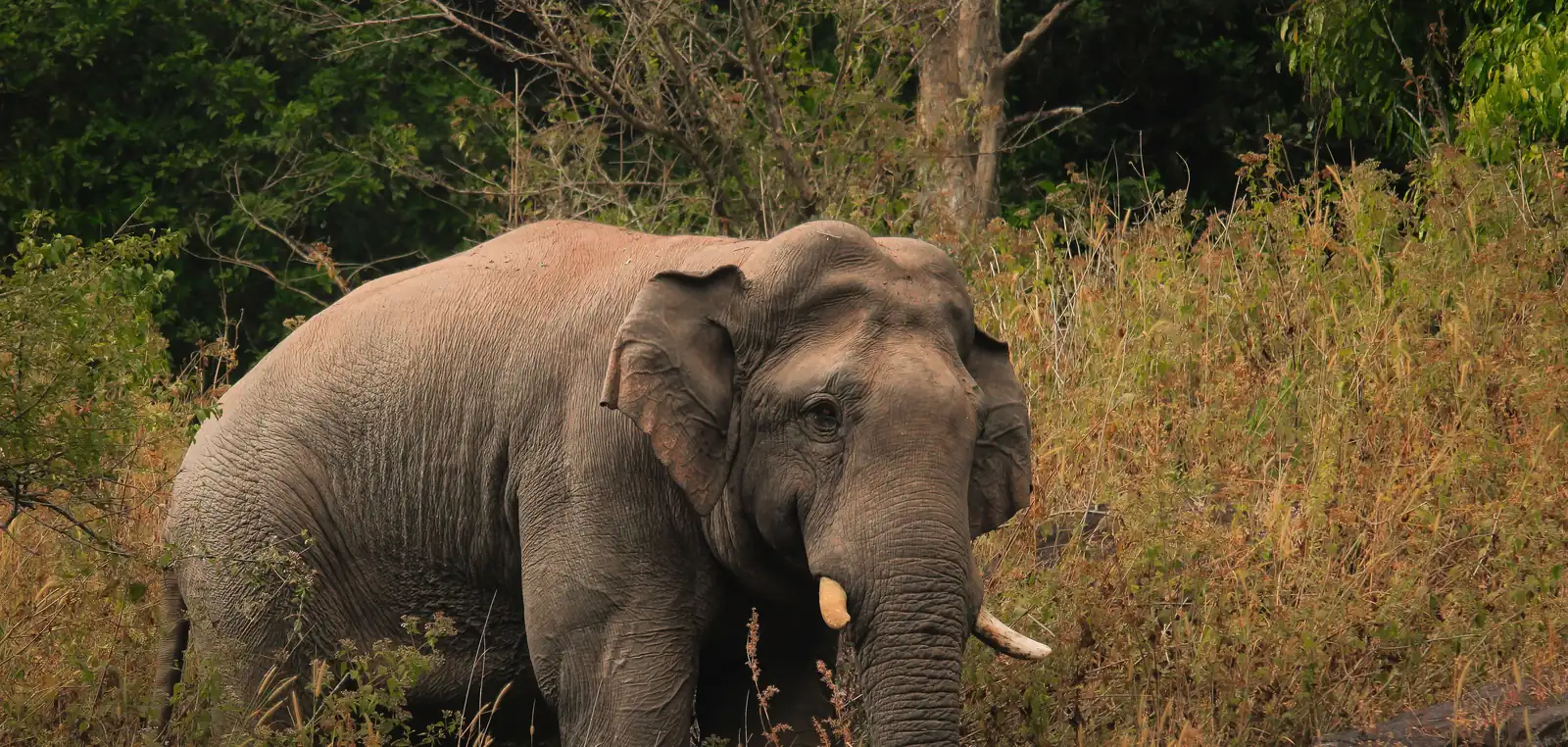
December is the month Thailand’s wildlife calendar is built around. The cool dry season has settled over the interior, the Andaman has flattened out and the dive boats are running, and the Gulf mudflats are full of shorebirds that have flown in from Siberia. Around 118 species in this guide are at their seasonal best.
This page is a seasonal shortlist, not the full catalogue. It leads with the animals whose window is open now, then the pick of what is here in any month, then what December costs you. For complete lists by group, follow the links at the foot of the page.
Highlights
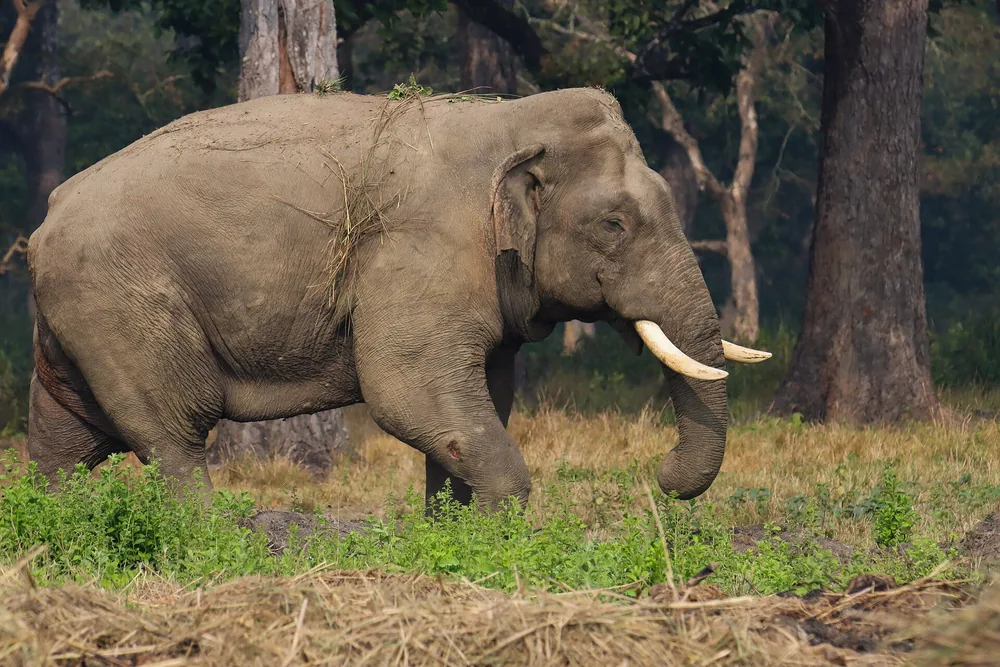
Asian Elephant
The largest land animal in Asia, and a genuinely wild one is worth seeking out over the camp elephants most tourists meet. Where: Khao Yai, Kui Buri, Kaeng Krachan. Best: Dry season (Nov-Apr), dawn and dusk.
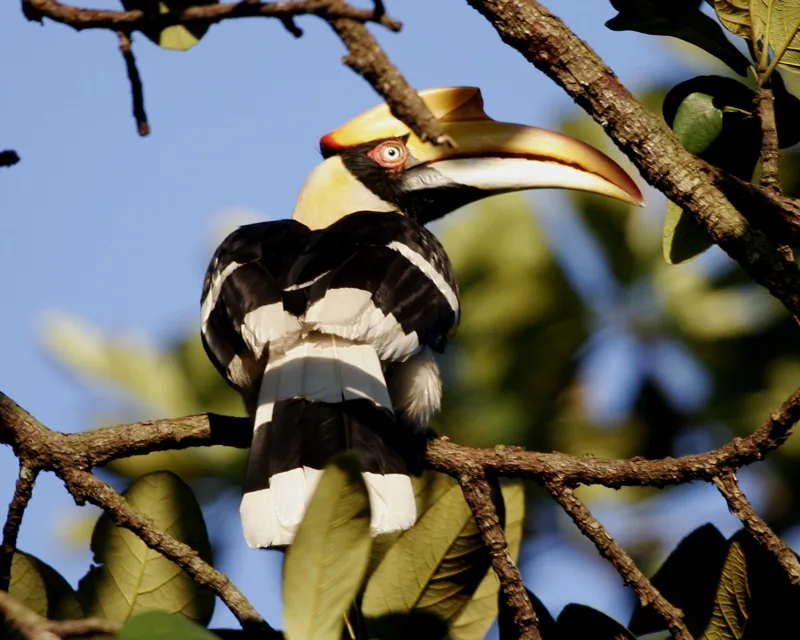
Great Hornbill
A three metre wingbeat you hear before you see, the flagship bird of Asian rainforest canopy. Where: Khao Yai, Khao Sok, Kaeng Krachan. Best: Year round, early morning at fruiting figs.
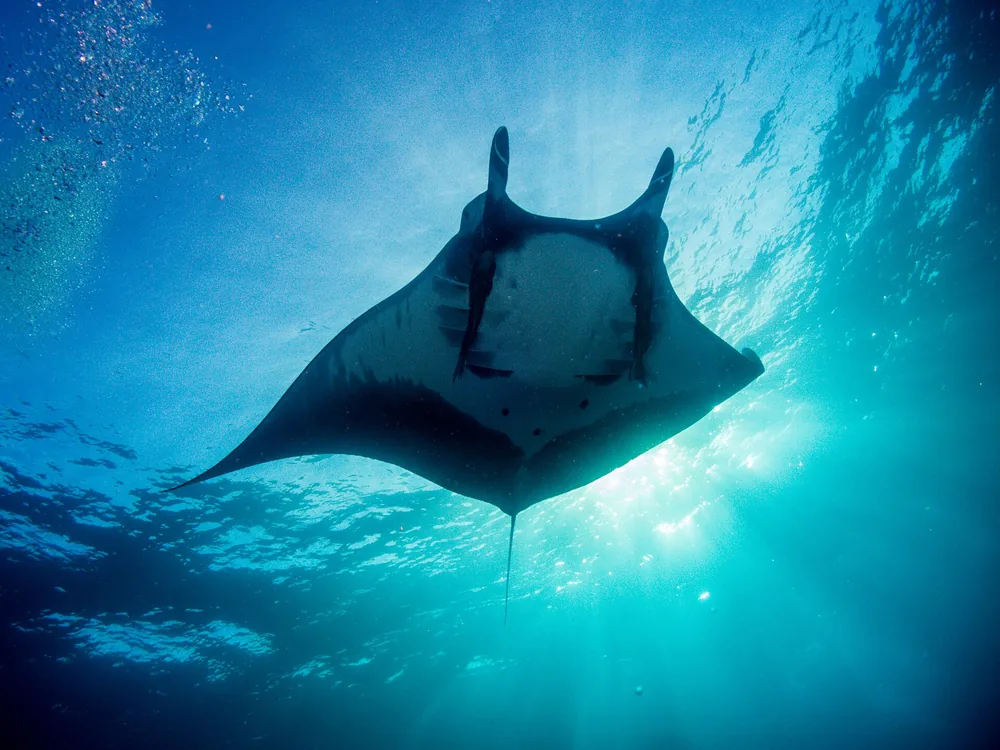
Giant Manta Ray
The largest ray on the planet, an ocean wanderer that can span seven metres and loops through plankton clouds in slow somersaults. Where: Hin Daeng and Hin Muang, Koh Bon and Koh Tachai area. Best: Peak Feb-Apr.
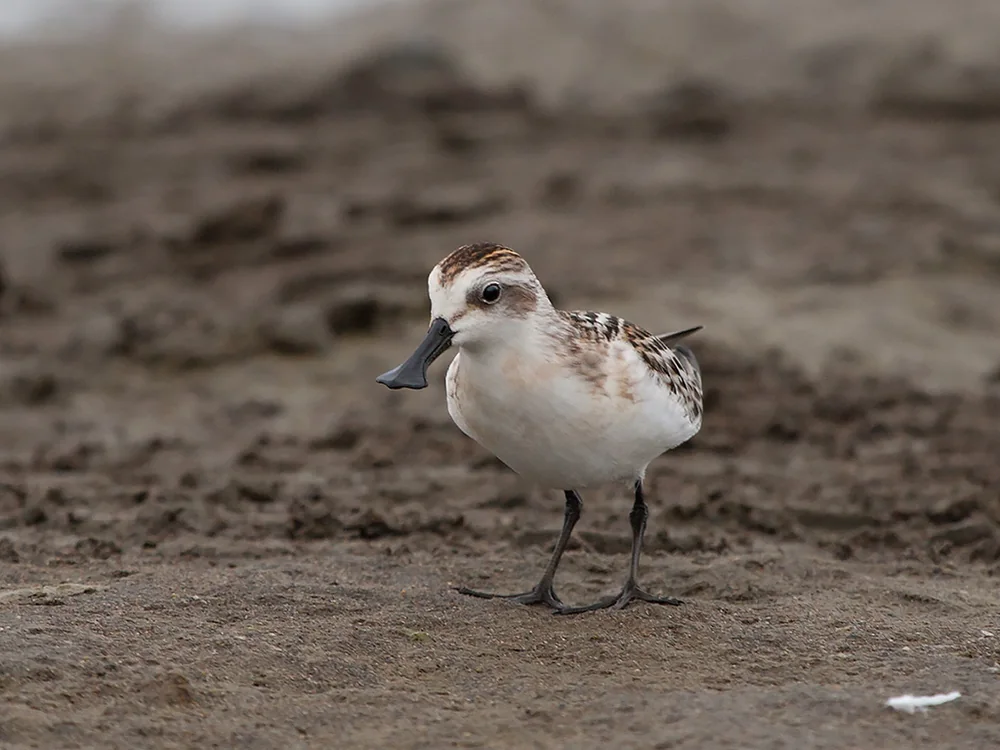
Spoon-billed Sandpiper
One of the world's rarest and most charismatic shorebirds, tiny and armed with an unmistakable spatula bill. Where: Pak Thale, Laem Pak Bia (Inner Gulf). Best: Nov-Mar (winter).
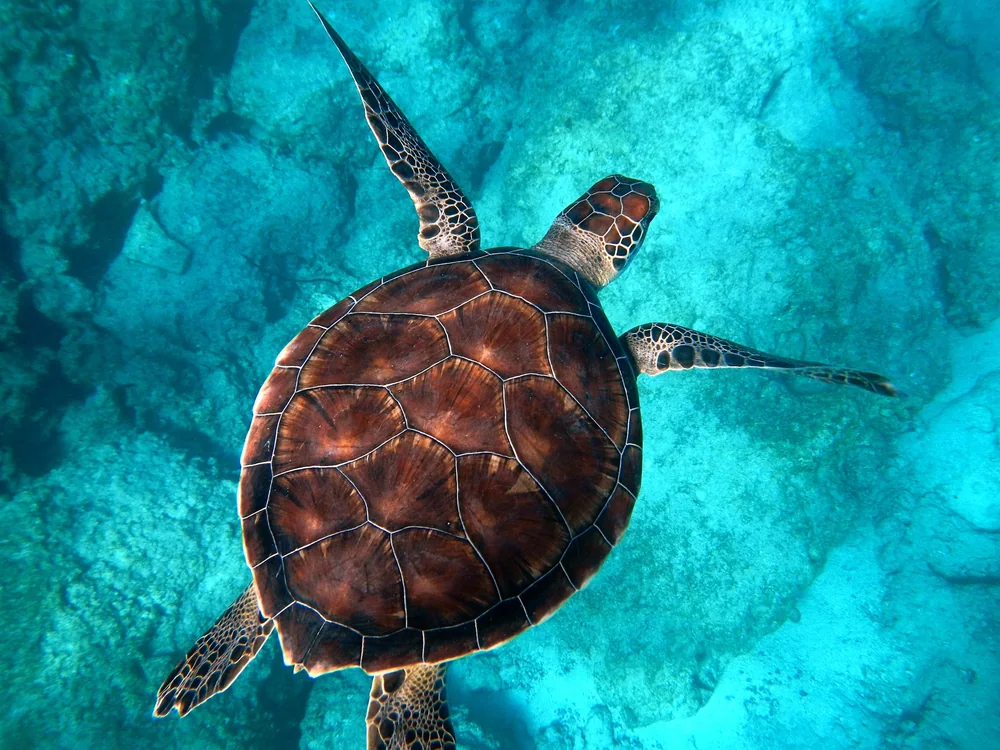
Green Sea Turtle
The great grazing turtle of the tropics, the only sea turtle that turns vegetarian as an adult. Where: Similan, Trang and Koh Libong, southern reefs and seagrass. Best: Dive season, Nov-Apr.
At its best in December
45 species
Dry season concentrations inland, calm water on the Andaman, and the full wintering shorebird cast on the Gulf coast.
Bowmouth Guitarfish Ultra rare Critically Endangered
Rhina ancylostomus
Half shark, half ray, with ridges of thorns above the eyes that look like a set of eyebrows.
Where: Sand adjacent to reef in the outer Andaman; Similans and the Burma Banks. Best: Nov-Apr. Exceptional now. Log any sighting with a local operator.
Jullien's Golden Carp Ultra rare Critically Endangered
Probarbus jullieni
A gold and black striped river carp that gathers at the same gravel bars each cold season to spawn, which is exactly why it is nearly gone.
Where: Deep runs of the Mekong in Nong Khai and Ubon Ratchathani provinces. Best: Dec-Jan spawning run. Spawning aggregations are the species' great vulnerability.
Giant Guitarfish Rare Critically Endangered
Glaucostegus typus
A strange shark-ray hybrid in shape, part flattened ray at the front and part shark behind, and one of the most threatened fish in the sea.
Where: Andaman sandy flats near reefs. Best: Dive season, Nov-Apr. A Critically Endangered species; sandy-bottom sightings are exceptional.
Spoon-billed Sandpiper Rare Critically Endangered
Calidris pygmaea
One of the world's rarest and most charismatic shorebirds, tiny and armed with an unmistakable spatula bill.
Where: Pak Thale, Laem Pak Bia (Inner Gulf). Best: Nov-Mar (winter). Pak Thale in the Inner Gulf is arguably the best place on earth to see one in winter.
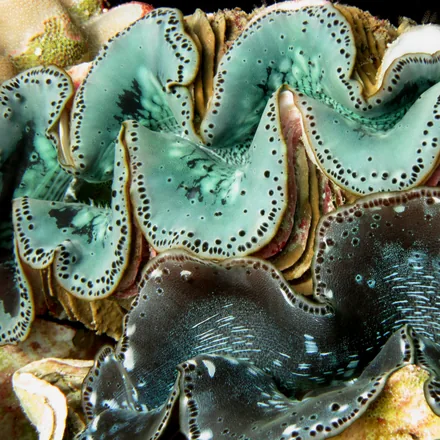
Giant Clam Occasional Critically Endangered
Tridacna gigas
The largest shellfish on Earth, a metre-wide clam that farms algae in its own rippling, jewel-coloured flesh.
Where: Similan, Hin Daeng and Hin Muang, shallow reefs. Best: Dive and snorkel season, Nov-Apr. Large individuals embedded in the reef; now Critically Endangered and treasured.
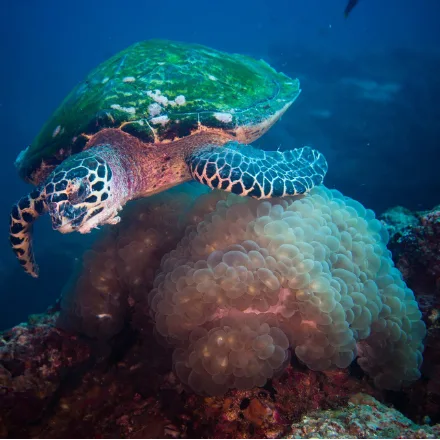
Hawksbill Turtle Occasional Critically Endangered
Eretmochelys imbricata
The reef's sponge specialist, its beautiful shell also the reason it was hunted to the edge.
Where: Similan, Hin Daeng and Hin Muang, coral reefs. Best: Dive season, Nov-Apr. Watch for it threading coral crevices for sponges on healthy reefs.
Chambered Nautilus Ultra rare Endangered
Nautilus pompilius
A living fossil that has kept the same shell design for 500 million years and steers by pumping gas between chambers.
Where: Deep Andaman drop-offs beyond recreational depth; occasionally on very deep night dives. Best: Nov-Apr. Effectively out of reach of sport diving. Empty shells wash up after storms.
Giant Freshwater Stingray Ultra rare Endangered
Urogymnus polylepis
The largest freshwater fish on earth by some measures, a two metre disc carrying a 38 cm barb.
Where: Deep channels of the Maeklong, Bang Pakong and Mekong rivers. Best: Nov-Feb, clearer low water. Handled only by research teams. The Maeklong die-off in 2016 was a major setback.
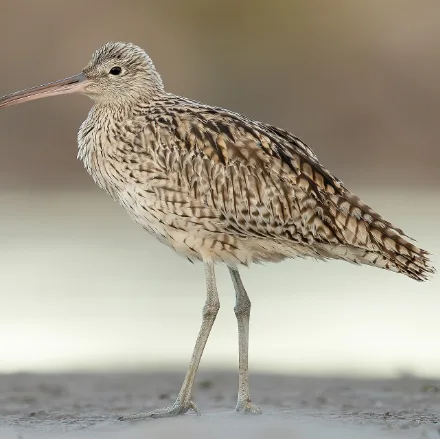
Far Eastern Curlew Rare Endangered
Numenius madagascariensis
The longest bill of any wader in the world, curved like a sickle and used to reach crabs deep in the mud.
Where: Inner Gulf and Andaman mudflats; Pak Thale and Ranong. Best: Sep-Apr. Check for the very long bill and the absence of a white rump.
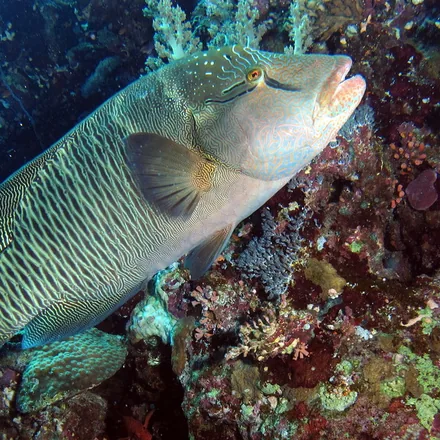
Humphead Wrasse (Napoleon Wrasse) Rare Endangered
Cheilinus undulatus
A giant, curious reef fish with thick lips and a bulging forehead, able to crunch prey that few other animals can eat.
Where: Similan, Hin Daeng and Hin Muang, outer reefs. Best: Dive season, Nov-Apr. A large curious individual approaching is a highlight; now scarce and Endangered.
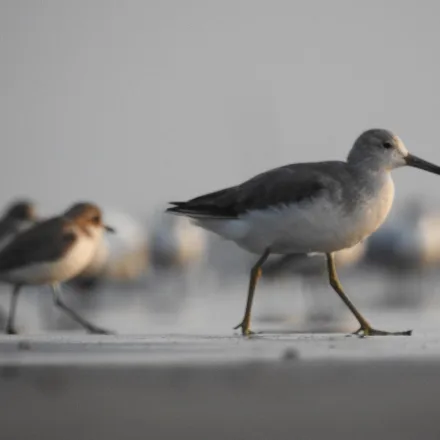
Nordmann's Greenshank Rare Endangered
Tringa guttifer
One of the world's rarest waders, a stocky greenshank that winters on Thai mudflats among thousands of commoner shorebirds.
Where: Inner Gulf mudflats and southern coasts. Best: Winter visitor, Nov-Mar. One of the world's rarest waders; winters on the Gulf flats with spoon-billed sandpiper.
Pineapple Sea Cucumber Rare Endangered
Thelenota ananas
A metre-long sea cucumber covered in star-shaped spikes, and one of the most valuable animals per kilo in Asian seafood.
Where: Reef slopes in the Andaman; Similans, Surin and Koh Lipe. Best: Nov-Apr. Once common, now scarce. A good illustration of quiet overharvest.
Shortfin Devil Ray Rare Endangered
Mobula kuhlii
A manta in miniature that leaps clear of the water and lands flat, sometimes dozens at a time.
Where: Open water off the Andaman coast; liveaboard crossings and Hin Daeng. Best: Nov-Apr. Look for breaching schools. Mouth under the head, not at the front, separates it from a manta.
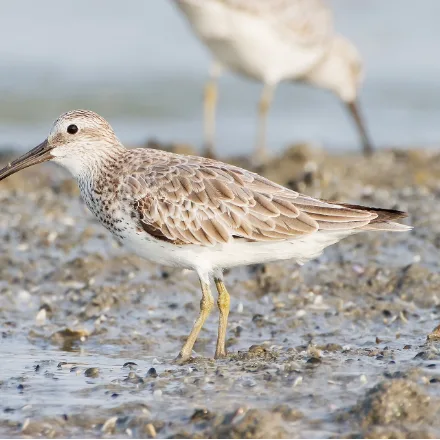
Great Knot Occasional Endangered
Calidris tenuirostris
Flies from Siberia to Australia with a single refuelling stop, and losing that one mudflat has nearly finished the species.
Where: Inner Gulf mudflats; Pak Thale, Laem Phak Bia and Bang Pu. Best: Sep-Apr, peaks on passage. Same flats as the spoon-billed sandpiper. Scan flocks carefully.
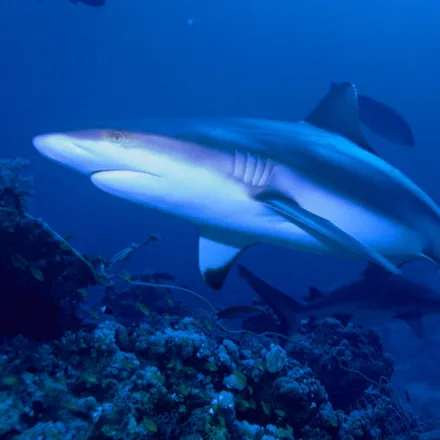
Grey Reef Shark Occasional Endangered
Carcharhinus amblyrhynchos
The classic requiem shark of the drop-off, bold and inquisitive where currents sweep the reef.
Where: Hin Daeng and Hin Muang, Similan outer reefs and channels. Best: Dive season, Nov-Apr. Best at current-swept walls and channels of the outer Andaman sites.
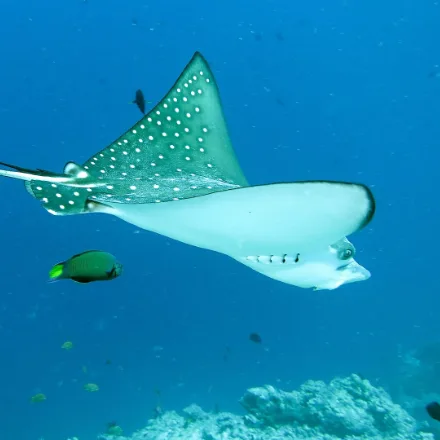
Ocellated Eagle Ray Occasional Endangered
Aetobatus ocellatus
A dramatic ray that flies through open water on wings spangled with white spots, trailing a whip-like venomous tail.
Where: Hin Daeng and Hin Muang, Similan drop-offs. Best: Dive season, Nov-Apr. Watch the blue water off walls and sand flats for its soaring flight.
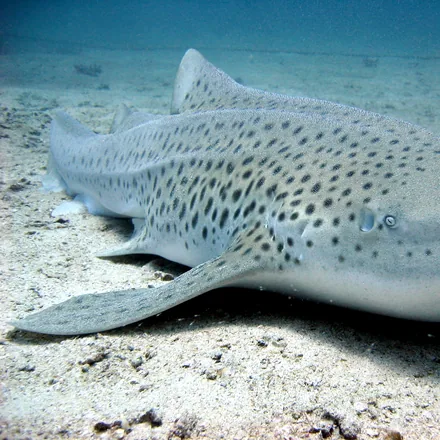
Zebra Shark (Leopard Shark) Occasional Endangered
Stegostoma tigrinum
A gentle, spotted shark that lies on the sand like a giant lazy cat, striped as a pup and spotted as an adult.
Where: Similan, Hin Daeng and Hin Muang, sandy patches. Best: Dive season, Nov-Apr. Look for it resting on sand between coral heads; harmless and photogenic.
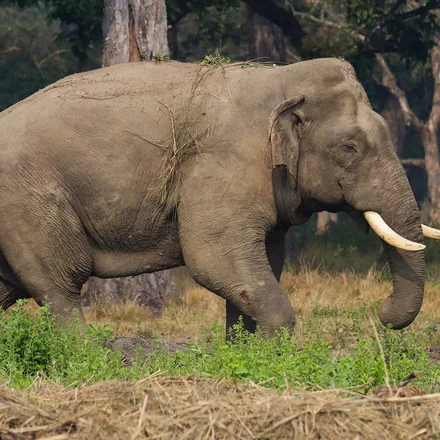
Asian Elephant Regular Endangered
Elephas maximus
The largest land animal in Asia, and a genuinely wild one is worth seeking out over the camp elephants most tourists meet.
Where: Khao Yai, Kui Buri, Kaeng Krachan. Best: Dry season (Nov-Apr), dawn and dusk. Kui Buri offers Thailand's most reliable wild herds, grazing grasslands at dusk.
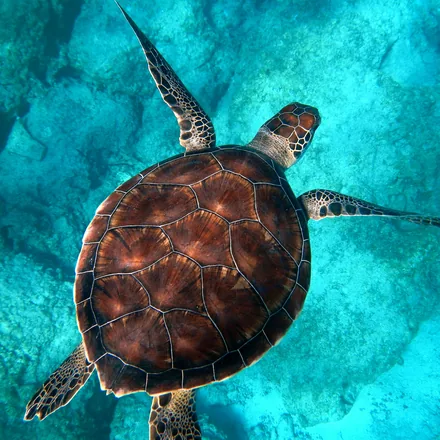
Green Sea Turtle Regular Endangered
Chelonia mydas
The great grazing turtle of the tropics, the only sea turtle that turns vegetarian as an adult.
Where: Similan, Trang and Koh Libong, southern reefs and seagrass. Best: Dive season, Nov-Apr. The turtle most often seen by divers, grazing seagrass and resting on reefs.
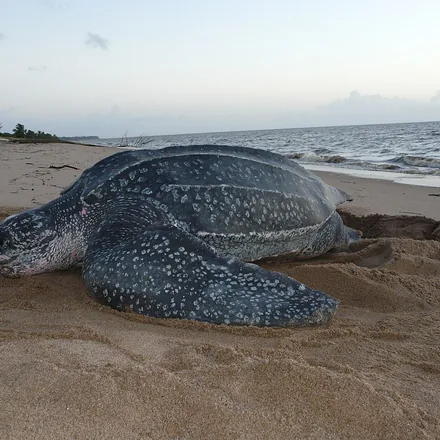
Leatherback Turtle Very rare Vulnerable
Dermochelys coriacea
The largest turtle on Earth, a jellyfish hunter that dives deeper than most whales and crosses whole oceans.
Where: Andaman waters and rare nesting beaches. Best: Nesting Nov-Feb. Wild sightings are exceptional; nesting on Thai beaches is now very rare.
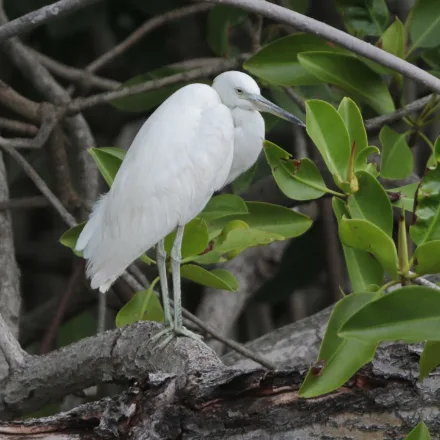
Chinese Egret Rare Vulnerable
Egretta eulophotes
Hunts by sprinting across the mudflat with wings half open, a running dash that no other egret uses.
Where: Tidal flats and shrimp ponds; Pak Thale, Laem Phak Bia and the inner Gulf. Best: Sep-Apr. Watch the feeding action. The open-winged run is the giveaway.
Porcupine Ray Rare Vulnerable
Urogymnus asperrimus
The only large stingray with no sting at all, protected instead by a hide of blunt thorns.
Where: Undisturbed seagrass and sand in the Andaman; Trang, Koh Lipe and the Surin islands. Best: Nov-Apr. Very shallow at times. No sting, but still leave it alone.
Silvertip Shark Rare Vulnerable
Carcharhinus albimarginatus
Bold, curious and dominant over every other reef shark it meets, with brilliant white trim on every fin.
Where: Outer Andaman drop-offs; Hin Daeng, Hin Muang and the Burma Banks. Best: Nov-Apr. Bold and curious, unlike most reef sharks. White fin margins are visible from a distance.
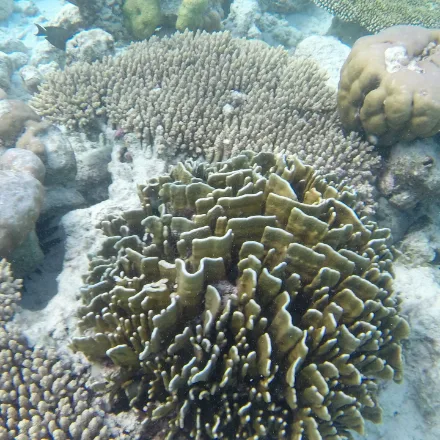
Blue Coral Occasional Vulnerable
Heliopora coerulea
The only coral on earth with a blue skeleton, hidden under brown tissue until the animal dies.
Where: Shallow high-energy reef; Surin, Similans and parts of the Gulf. Best: Nov-Apr. Unremarkable alive. The blue is in the skeleton.
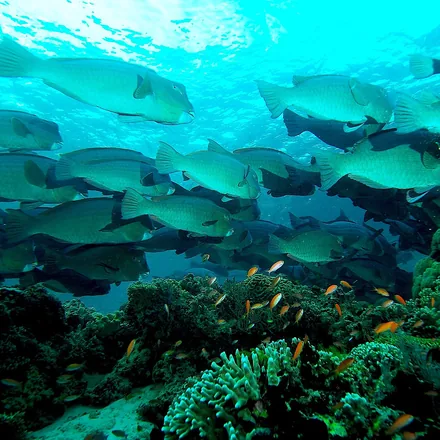
Bumphead Parrotfish Occasional Vulnerable
Bolbometopon muricatum
A hulking, bull-headed parrotfish that rams and bites living coral, turning reef rock into the white sand of tropical beaches.
Where: Similan and outer Andaman reefs. Best: Dive season, Nov-Apr. Look for roving herds grazing coral, most active in early morning.
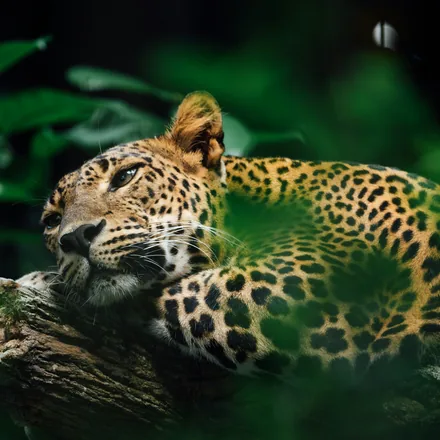
Leopard (incl. Black Panther) Occasional Vulnerable
Panthera pardus
A big cat that is unusually often born jet black, prowling as the fabled black panther.
Where: Kaeng Krachan (Ban Krang road), Khao Yai. Best: Dry season (Dec-Apr), early morning. The Ban Krang road in Kaeng Krachan is arguably the most reliable place in Asia for a wild black panther.
Pink Whipray Occasional Vulnerable
Pateobatis fai
Often travels in loose groups across the sand, several large rays moving in slow formation.
Where: Sand flats and lagoons in the Andaman; Similans and Koh Lipe. Best: Nov-Apr. Sometimes in loose groups of several large rays.
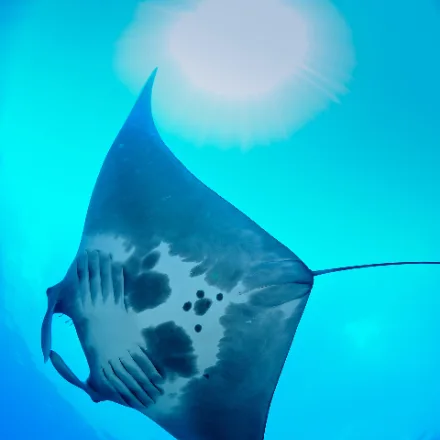
Reef Manta Ray Occasional Vulnerable
Mobula alfredi
A four metre wingspan gliding overhead in slow, hypnotic loops that leave divers grinning for days.
Where: Koh Bon, Koh Tachai, Richelieu Rock, Hin Daeng. Best: Nov-Apr, Similan and Hin Daeng pinnacles. Koh Bon in the Similans is a renowned manta cleaning station.
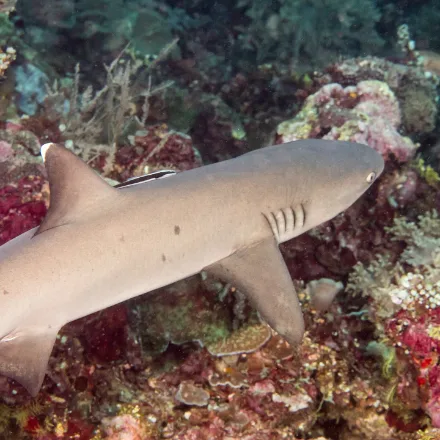
Whitetip Reef Shark Regular Vulnerable
Triaenodon obesus
A slender reef shark that rests motionless in caves by day and hunts the reef in packs by night.
Where: Similan, Hin Daeng and Hin Muang, reef caves and ledges. Best: Dive season, Nov-Apr. Look under ledges and in caves by day; more active on night dives.
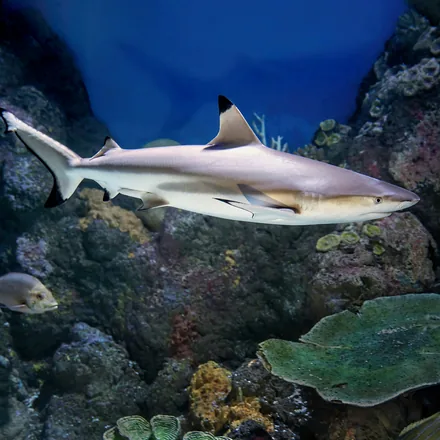
Blacktip Reef Shark Common Vulnerable
Carcharhinus melanopterus
The neat little reef shark of the shallows, its black-tipped fins often cutting the surface over sun-lit sand flats.
Where: Similar shallow reefs, Similan, Trang and Koh Libong. Best: Dive and snorkel season, Nov-Apr. The reef shark most often seen by snorkellers over shallow reef tops.
Tiger Shark Ultra rare
Galeocerdo cuvier
The only shark with teeth built to shear turtle shell, and the least fussy eater in the ocean.
Where: Outer Andaman islands and open water; Surin, Similan and the Burma Banks. Best: Nov-Apr. Most likely at dawn or in low light. Attacks in Thai waters are essentially unknown.
False Killer Whale Rare
Pseudorca crassidens
Has been recorded offering captured fish to divers and to other dolphins, apparently as a gift.
Where: Offshore Andaman waters; liveaboard crossings. Best: Nov-Apr. Inquisitive and likely to approach a boat.
Brownbanded Bamboo Shark Occasional
Chiloscyllium punctatum
A small, slender carpet shark that walks across the reef on its fins and can survive hours out of water in a tide pool.
Where: Shallow Andaman reefs and tide pools, Trang. Best: Night dives, Nov-Apr. A small nocturnal shark; look under ledges and in rubble after dark.
Leopard Coralgrouper Regular
Plectropomus leopardus
A blue-spotted red grouper that hunts in partnership with moray eels and octopus.
Where: Reefs across the Andaman. Best: Nov-Apr. Watch for it signalling to moray eels on cooperative hunts.
Indo-Pacific Sailfish Ultra rare
Istiophorus platypterus
The fastest fish in the sea, and it lights up electric blue across the sail when it is herding a bait ball.
Where: Offshore blue water; liveaboard crossings to the Similans, Surin and Hin Daeng. Best: Nov-Apr. An open-ocean animal. Surface hunting is what gives one away.
Brown Booby Rare
Sula leucogaster
Dives from twenty metres and hits the water at over sixty kilometres an hour, with air sacs in the skull absorbing the shock.
Where: Outer Andaman and Gulf islands; seen from boats and liveaboards. Best: Nov-Apr. Often following fishing boats or feeding alongside dolphins.
Clown Triggerfish Rare
Balistoides conspicillum
Perhaps the most flamboyant fish on the reef, a black triggerfish spotted with huge white polka-dots and a saddle of gold.
Where: Hin Daeng and Hin Muang, Similan deeper reefs and walls. Best: Dive season, Nov-Apr. A prized, reclusive fish of reef walls and drop-offs.
Painted Frogfish Rare
Antennarius pictus
A lumpy anglerfish that walks on hand-like fins and fishes for prey with a built-in rod and lure on its forehead.
Where: Similan and Andaman reefs, on sponges and rubble. Best: Dive season, Nov-Apr. A macro prize; hunt for a sponge-like lump that does not quite belong.
Risso's Dolphin Rare
Grampus griseus
Old males are almost white, scarred head to tail by the teeth of other Risso's and the beaks of the squid they eat.
Where: Deep water off the Andaman shelf edge; longer liveaboard crossings. Best: Nov-Apr. The paler the animal, the older it is.
Short-finned Pilot Whale Rare
Globicephala macrorhynchus
Females go through menopause and live decades beyond breeding, one of only a handful of species on earth that do.
Where: Deep water beyond the Andaman shelf edge; liveaboard crossings to the Burma Banks. Best: Nov-Apr. Tight pods that log at the surface between deep squid dives.
Black-capped Kingfisher Occasional
Halcyon pileata
A striking mangrove kingfisher in black, white and deep purple-blue, a winter visitor to Thailand's coasts.
Where: Mangroves and estuaries, Trang and Koh Libong, Khao Sam Roi Yot. Best: Winter visitor, Oct-Apr. A non-breeding visitor to coastal mangroves and tidal creeks.
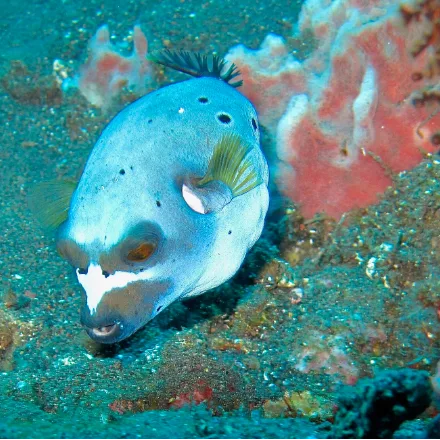
Blackspotted Puffer Occasional
Arothron nigropunctatus
A comically dog-faced puffer, its colour ranging from grey to sunny yellow, carrying a potent toxin in its flesh.
Where: Similan, Hin Daeng and Hin Muang, coral reefs. Best: Dive season, Nov-Apr. A dog-faced puffer that hovers over coral; comes in grey and yellow forms.
Dogtooth Tuna Occasional
Gymnosarda unicolor
A heavy-shouldered blue-water hunter that materialises out of the deep at reef pinnacles to smash into bait schools.
Where: Hin Daeng and Hin Muang, Similan deep pinnacles. Best: Dive season, Nov-Apr. Appears from the blue at current-swept pinnacles to hit baitfish schools.
Giant Trevally Occasional
Caranx ignobilis
A silver battering ram that hunts by simply outrunning everything, and has been filmed taking birds off the surface.
Where: Current-swept pinnacles and drop-offs; Hin Daeng, Richelieu Rock and Sail Rock. Best: Nov-Apr. Look on the current side where prey is pushed against structure.
Longnose Hawkfish Occasional
Oxycirrhites typus
A dainty fish gridded in red like graph paper, perched among the branches of a giant sea fan waiting to ambush prey.
Where: Hin Daeng and Hin Muang, Similan, in sea fans. Best: Dive season, Nov-Apr. Perches within large gorgonian sea fans on current-swept walls.
Also out in December, any month of the year
30 species
A selection of the year-round animals. See the category pages for the complete lists.
Giant Asian Pond Turtle Ultra rare Critically Endangered
Heosemys grandis
The largest hard-shelled freshwater turtle in mainland Southeast Asia, and it is being eaten out of existence.
Where: Protected swamps and slow streams; Bueng Boraphet, Thale Noi and western sanctuaries. Best: Year round. Collapsing under trade pressure. Wild encounters are now very rare.
Giant Barb Ultra rare Critically Endangered
Catlocarpio siamensis
The world's largest carp, a bronze slab of a fish with a head so big it looks borrowed from something else.
Where: Deep pools of the Mekong and Chao Phraya; Bueng Boraphet and large reservoirs. Best: Year round. Thailand's national fish and functionally extinct in the wild.
Largetooth Sawfish Ultra rare Critically Endangered
Pristis pristis
A seven metre ray with a chainsaw for a nose, and almost certainly gone from Thai waters.
Where: Historically the Gulf, the Andaman coast and the lower Chao Phraya. Best: No current season; no reliable records for decades. Very likely regionally extinct. Include it as a record of what Thailand has lost.
Masked Finfoot Ultra rare Critically Endangered
Heliopais personatus
One of the rarest birds in Asia, perhaps a hundred left, and Thailand may already have lost it.
Where: Historically quiet forested waterways and mangrove creeks; no reliable recent records. Best: No current season. Very likely lost from Thailand. Included as an honest record of what has gone.
Redtail Sharkminnow Ultra rare Critically Endangered
Epalzeorhynchos bicolor
A jet black fish with a blood-red tail, found nowhere on earth but one Thai river system, and thought extinct for twenty five years.
Where: A few remaining clear streams of the Chao Phraya basin. Best: Year round. A Thai endemic once declared extinct in the wild. Handle claims carefully.
Whitespotted Wedgefish Ultra rare Critically Endangered
Rhynchobatus australiae
Its fins are the single most valuable in the global shark fin trade, which is why it has all but disappeared.
Where: Sand beside reef on both coasts; historically the Gulf and Andaman shelf. Best: Year round. Critically endangered. Large individuals are effectively gone.
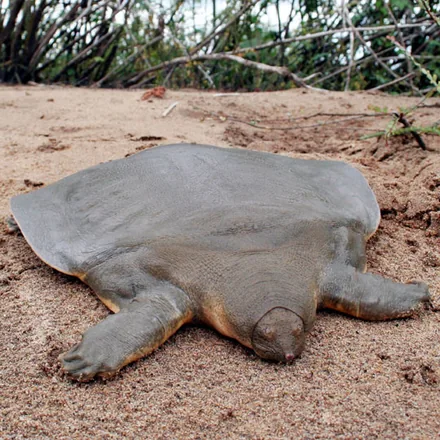
Asian Giant Softshell Turtle Very rare Critically Endangered
Pelochelys cantorii
A huge, frog faced softshell that buries itself in river mud and surfaces to breathe only twice a day.
Where: A few remote lowland rivers and protected wetlands. Best: Rare, any time. Buried on river bottoms and Critically Endangered; a truly exceptional sighting.
Chinese Pangolin Very rare Critically Endangered
Manis pentadactyla
The northern cousin of the Sunda pangolin, more of a burrower, and just as devastated by the illegal trade.
Where: Hill forest of the north. Best: Night. A northern burrower, Critically Endangered; exceptionally rarely seen.
Gurney's Pitta Very rare Critically Endangered
Hydrornis gurneyi
A gorgeous blue-crowned pitta once thought extinct, rediscovered in Thailand and now teetering on the very edge.
Where: Khao Nor Chuchi (Krabi), historically. Best: Rains, at dawn. Rediscovered in Thailand in the 1980s but now considered functionally extinct here; survives in Myanmar.
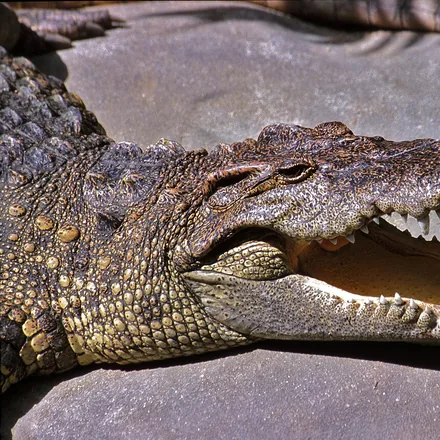
Siamese Crocodile Very rare Critically Endangered
Crocodylus siamensis
A freshwater crocodile once thought nearly extinct in the wild, now clinging on in a few remote Thai wetlands.
Where: A few remote protected wetlands, Kaeng Krachan area rivers. Best: Rare, any time. All but extinct in the wild; survives in a handful of remote protected waters.
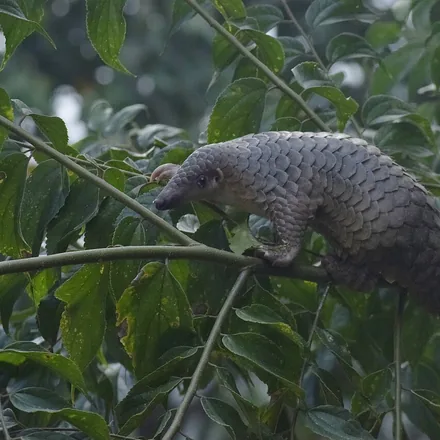
Sunda Pangolin Very rare Critically Endangered
Manis javanica
A living pine cone of a mammal, armoured in scales and, tragically, the most trafficked wild animal on the planet.
Where: Lowland and hill forest nationwide. Best: Night. Critically Endangered and heavily poached; a sighting is extraordinary.
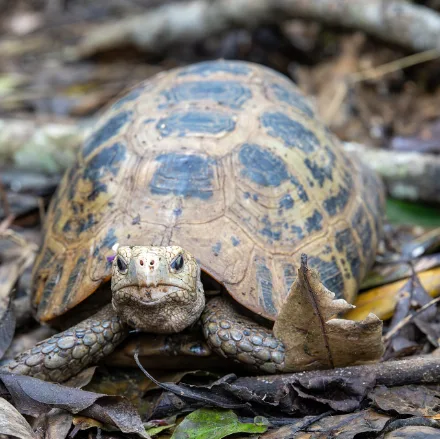
Elongated Tortoise Rare Critically Endangered
Indotestudo elongata
A forest tortoise whose pale head flushes pink around the eyes and nose in the breeding season.
Where: Deciduous and evergreen forest, Huai Kha Khaeng, Khao Yai. Best: Rainy season. Most active in the wet season; a scarce and declining forest tortoise.
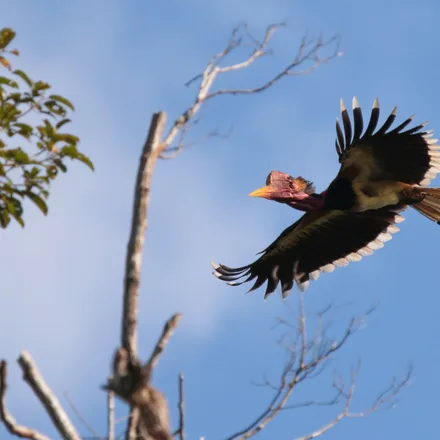
Helmeted Hornbill Rare Critically Endangered
Rhinoplax vigil
A hornbill with a solid ivory casque, hunted to the brink for carving, whose call sounds like maniacal laughter.
Where: Hala Bala, Budo-Sungai Padi (deep south). Best: Year round, tall rainforest. Confined to the far southern rainforests; critically endangered and hard to find.
Straw-headed Bulbul Rare Critically Endangered
Pycnonotus zeylanicus
A large riverside bulbul with a glorious bubbling song that has, tragically, made it one of the most trapped birds in Asia.
Where: Dense riverside thickets of the south, protected wetlands. Best: Year round. Critically Endangered from song-bird trapping; now only a few protected pockets.
Asian Arowana Ultra rare Endangered
Scleropages formosus
A living dragon that hunts at the surface and can launch clear of the water to take insects off overhanging branches.
Where: Blackwater swamps and slow rivers of the far south, notably around Toh Daeng peat swamp. Best: Year round. Wild fish are almost never seen. CITES Appendix I.
Big-headed Turtle Very rare Endangered
Platysternon megacephalum
A bizarre stream turtle with a head too big to pull in and a tail nearly as long as its shell, which climbs trees.
Where: Cool fast hill streams of the north and west. Best: Night, cooler months. A nocturnal stream specialist and rare find; look in clear rocky headwaters.
Hairy-nosed Otter Very rare Endangered
Lutra sumatrana
One of the rarest otters on Earth, so seldom seen it was once feared extinct across its range.
Where: Peat swamps and coastal wetlands of the south. Best: Day and dusk. Extremely rare; among the least-known otters in the world.
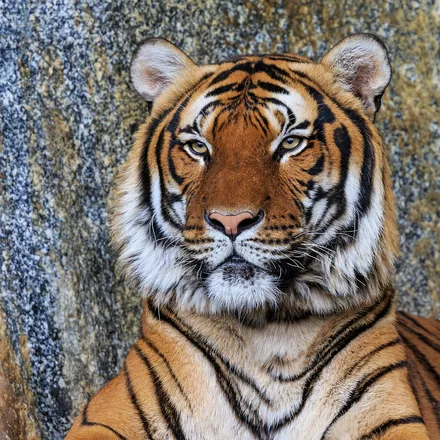
Indochinese Tiger Very rare Endangered
Panthera tigris
The largest cat in Asia and its top predator, a striped ghost most people only ever know from a paw print.
Where: Huai Kha Khaeng, Thung Yai, Kaeng Krachan. Best: Dry season, dawn and dusk. Realistically camera-trap territory; the Western Forest Complex is the last stronghold.
Otter Civet Very rare Endangered
Cynogale bennettii
A bizarre, otter-like civet built for water, with closable nostrils and a face full of whiskers.
Where: Lowland swamps and stream forest of the south. Best: Night. One of the least-seen carnivores; tied to vanishing wetland forest.
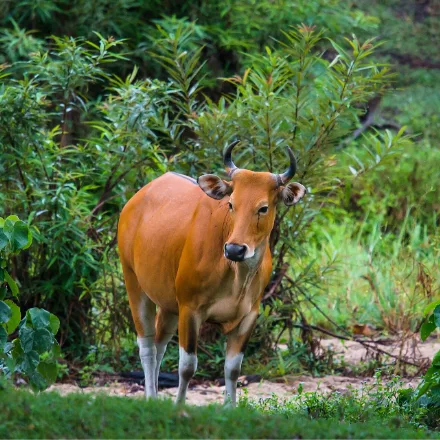
Banteng Rare Endangered
Bos javanicus
A sleek wild ox with a white rump patch and white stockings, far rarer and more elegant than the domestic cattle it resembles.
Where: Dry forest and clearings, Huai Kha Khaeng, Kui Buri. Best: Dawn and dusk. Thailand holds key populations; watch glades and salt licks at first and last light.
Black Marsh Turtle Rare Endangered
Siebenrockiella crassicollis
Two pale patches above the eyes give it a permanently startled expression, which is why Thais call it the smiling terrapin.
Where: Muddy ponds, canals and marshes of the central plain. Best: Year round, at dusk. Also seen at temple ponds, but those are released animals, not wild ones.
Eld's Deer (Brow-antlered Deer) Rare Endangered
Rucervus eldii
An elegant deer whose antlers sweep forward in a great bow, a grassland specialist now clinging on in a few reserves.
Where: Dry forest and grassland, Huai Kha Khaeng and reserves. Best: Dawn and dusk. Survives mainly through protected and reintroduced herds; note the bowed antlers.
Hog Deer Rare Endangered
Axis porcinus
A stocky grassland deer that runs head-down like a hog through tall grass rather than leaping like other deer.
Where: Floodplain grassland and wetland reserves. Best: Dawn and dusk. Now restricted to a few protected grasslands; runs low through the grass.
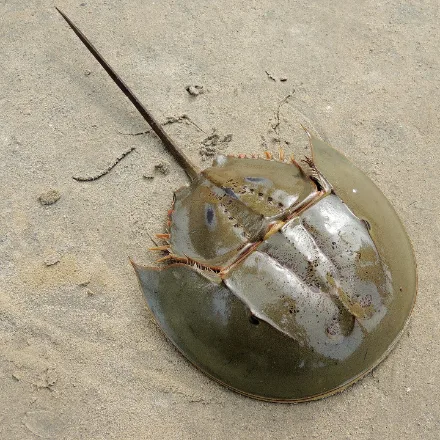
Indo-Pacific Horseshoe Crab Rare Endangered
Tachypleus gigas
Not a crab at all, closer to a spider, and its blue blood is used worldwide to test every injectable drug for contamination.
Where: Quiet sandy and muddy shores; the inner Gulf, Ranong and Trang. Best: Spawning on spring tides around the full and new moon. Completely harmless. Right an upended animal by the shell, never the tail.
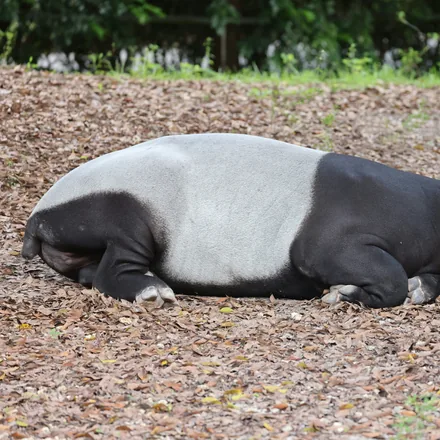
Malayan Tapir Rare Endangered
Tapirus indicus
A living oddity, half jet black and half stark white, that looks assembled from spare parts.
Where: Kaeng Krachan, Hala Bala, Khao Luang (Krung Ching). Best: Night, near forest streams. The deep south (Hala Bala) and Krung Ching hold the best chances.
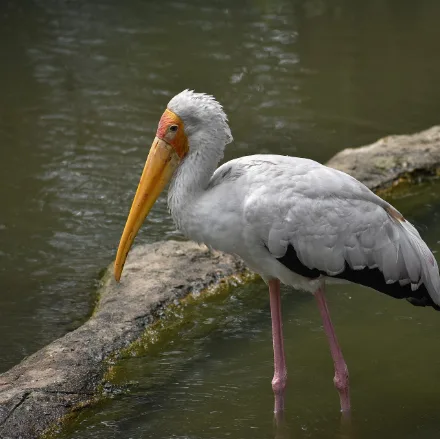
Milky Stork Rare Endangered
Mycteria cinerea
A rare, ghostly white stork of the mangroves, its bare face flushing from yellow to red in the breeding season.
Where: Coastal mangroves and estuaries of the Gulf and south. Best: Year round. A scarce mangrove stork; watch tidal flats and estuaries, distinguish from painted stork.
Phayre's Leaf Monkey Rare Endangered
Trachypithecus phayrei
A grey langur with bold white spectacles around its eyes, a leaf specialist of the northern and western forests.
Where: Hill and evergreen forest of the north and west. Best: Year round, day. A scarce langur; look for the pale spectacle markings in the canopy.
Sicklefin Lemon Shark Rare Endangered
Negaprion acutidens
A heavy, yellow-brown shark that uses mangrove shallows as a nursery and barely moves out of them for the first years of life.
Where: Mangrove-fringed shallow bays; Ao Phang Nga, Ranong and parts of Trang. Best: Year round. Very shallow water. Site-faithful, so local knowledge matters.
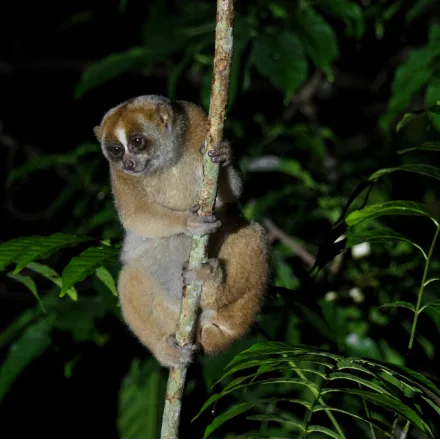
Sunda Slow Loris Rare Endangered
Nycticebus coucang
A wide-eyed nocturnal primate of the far south with a rare and startling trick: it is one of the world's few venomous mammals.
Where: Southern rainforest, Khao Sok and the peninsula. Best: Night. A night-walk prize; scan the canopy for eyeshine and slow, deliberate movement.
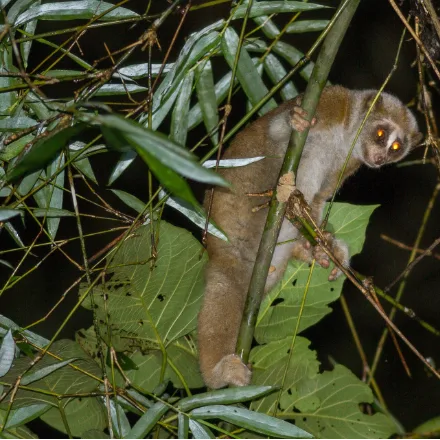
Bengal Slow Loris Occasional Endangered
Nycticebus bengalensis
The only venomous primate on Earth, huge eyed and slow motion, with a toxic bite armed from glands on its arms.
Where: Khao Yai, Kaeng Krachan, southern forests. Best: Night, spotlighting in canopy. Night safaris that spotlight the canopy give the best chance of eyeshine.
Out of season in December
20 species
The green season specialists. Come between May and October for these, particularly the amphibians and the night-walk invertebrates.
Great Hammerhead Ultra rare Critically Endangered
Sphyrna mokarran
Uses the flat of its head to pin a stingray to the seabed, then bites chunks out of the wing.
Where: Deep outer Andaman pinnacles; Hin Daeng, Hin Muang and the Burma Banks. Best: Feb-Apr. The very tall sickle dorsal fin is what people remember.
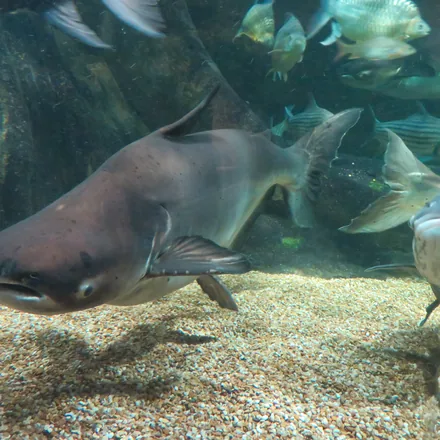
Mekong Giant Catfish Ultra rare Critically Endangered
Pangasianodon gigas
The largest scaleless freshwater fish on earth, a three metre catfish that has all but vanished from the river it is named after.
Where: The wild Mekong along the Chiang Rai and Nong Khai stretches; realistically, stocked fish at Bung Sam Ran and temple ponds. Best: Apr-Jun for the historic Mekong run. Wild fish are all but gone. Be clear that a fishing-park giant is not a wild sighting.
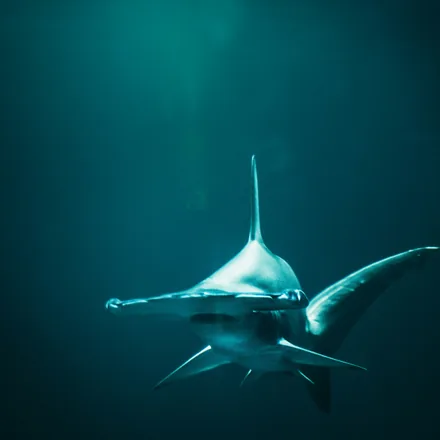
Scalloped Hammerhead Ultra rare Critically Endangered
Sphyrna lewini
The head is a sensory antenna, packed with electroreceptors that can find a ray buried under sand.
Where: Deep Andaman pinnacles and the Burma Banks; occasionally Hin Daeng and Richelieu Rock. Best: Feb-Apr. Numbers have collapsed. Report any sighting to local operators.
Pelagic Thresher Ultra rare Endangered
Alopias pelagicus
Hunts by cracking its tail like a whip over its own head, stunning several fish at once with the shockwave.
Where: Deep Andaman pinnacles at dawn; Hin Daeng and Hin Muang cleaning stations. Best: Feb-Apr, first dive of the day. Only realistic on an early morning deep dive at a cleaning station.
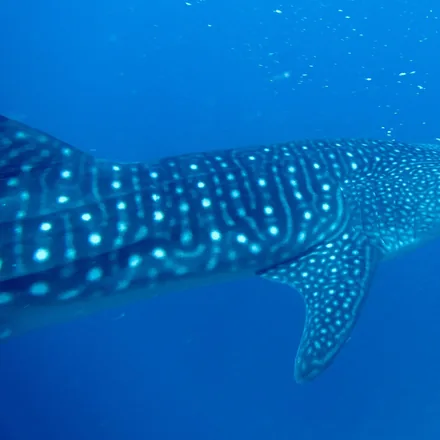
Whale Shark Rare Endangered
Rhincodon typus
The biggest fish in the ocean, a spotted, bus sized filter feeder and the undisputed holy grail of tropical diving.
Where: Richelieu Rock, Koh Tachai, Hin Daeng, Phi Phi. Best: Feb-Apr, Andaman dive sites. Richelieu Rock and Koh Tachai are the classic seasonal hotspots.
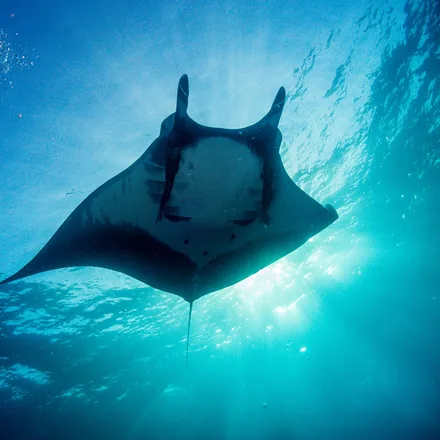
Giant Manta Ray Occasional Endangered
Mobula birostris
The largest ray on the planet, an ocean wanderer that can span seven metres and loops through plankton clouds in slow somersaults.
Where: Hin Daeng and Hin Muang, Koh Bon and Koh Tachai area. Best: Peak Feb-Apr. The Andaman's marquee dive; manta season peaks in the late dry months.
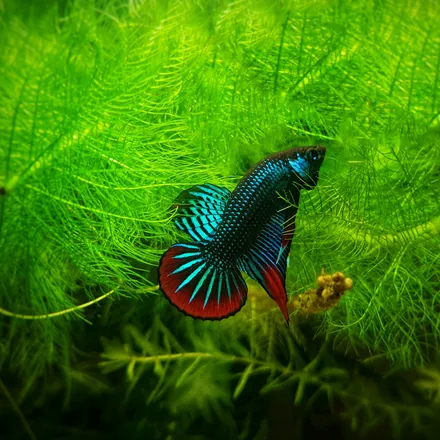
Siamese Fighting Fish Occasional Vulnerable
Betta splendens
Thailand's national aquatic animal is a wild rice-paddy fish, and the wild one looks nothing like the trailing-finned pet.
Where: Rice paddies, ditches and marshes of the central plain around Ayutthaya and Bueng Boraphet. Best: Jun-Oct wet season, when paddies flood. Look in shallow warm water with plant cover. Wild fish are drab, not the pet-shop version.
Asian Tree Toad Rare
Rentapia hosii
A toad that lives in the canopy, and the females are bright yellow and purple while the males stay plain brown.
Where: Streamside trees in southern lowland rainforest; Khao Sok and Hala-Bala. Best: May-Oct, at night. Arboreal, so search trunks and branches rather than the ground.
Thai Crocodile Newt Rare
Tylototriton uyenoi
Thailand's only newt, restricted to a handful of cool mountain pools in the north, and it looks like a small armoured dragon.
Where: Cool montane pools and ditches in the north; Doi Inthanon, Doi Suthep and Chiang Dao above 1,000 m. Best: May-Aug, during the rains. Thailand's only newt and a national endemic. CITES listed; never collect.
Bridled Tern Occasional
Onychoprion anaethetus
Spends most of the year entirely at sea, feeding on fish driven to the surface by tuna hunting below.
Where: Rocky islets and offshore waters on both coasts; Similans, Surin and Koh Tao. Best: Apr-Sep breeding season. Boat trips to outer island groups. Nests under scrub on islets.
Bryde's Whale Occasional
Balaenoptera edeni
A warm-water baleen whale that lunges up through bait balls with its mouth wide open.
Where: Upper Gulf of Thailand, off Bang Taboon and Phetchaburi. Best: Aug-Nov. A rare great whale watchable close to shore in the Gulf on dedicated trips.
Green Cascade Frog Occasional
Odorrana chloronota
Lives in the spray of waterfalls and calls in ultrasound, above the range of human hearing, to beat the noise of the water.
Where: Waterfall splash zones in northern hill forest; Doi Inthanon, Doi Suthep and Doi Chiang Dao. Best: May-Sep, at night. On wet rock in the spray. The ultrasonic call is inaudible to us.
Kuhl's Creek Frog Occasional
Limnonectes kuhlii
Males grow tusk-like projections from the lower jaw and use them to wrestle rivals in the stream.
Where: Gravel edges of shaded hill streams in the north and west; Doi Inthanon and Kaeng Krachan. Best: May-Sep, at night. Half-submerged against gravel. Check breeding males for jaw tusks.
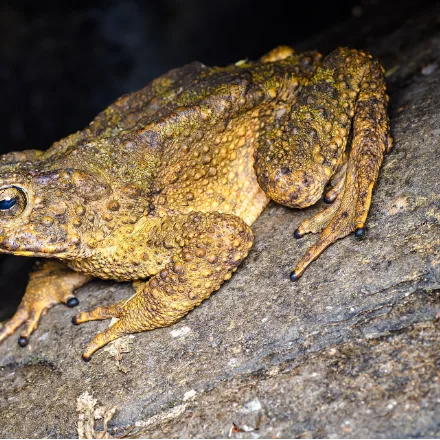
Malayan Giant Toad Occasional
Phrynoidis asper
The biggest toad in Southeast Asia, and it sits in the spray zone of waterfalls where nothing can hear it call.
Where: Splash zones of waterfalls and fast streams; Khao Sok, Kaeng Krachan and the peninsula. Best: May-Oct, at night. Look on wet rock in the spray, not on the bank.
Red-tailed Pipe Snake Occasional
Cylindrophis ruffus
When threatened it hides its head and raises its blunt tail instead, flashing bright red underneath as a decoy.
Where: Damp lowland soil, paddies and gardens countrywide. Best: May-Oct, after rain. Harmless. If it raises its tail, that is the false head display.
Sunbeam Snake Occasional
Xenopeltis unicolor
Looks plain brown until light hits it, when the scales split the light into a full oil-slick rainbow.
Where: Paddies, gardens and damp lowland ground countrywide. Best: May-Oct, on wet roads after dark. The iridescence needs direct light. Worth a torch beam from the side.
Climbing Perch Regular
Anabas testudineus
A fish that walks out of the water and hauls itself overland on its gill covers, sometimes for hours.
Where: Paddies, roadside ditches and marshes countrywide. Best: Jun-Oct, on the ground after heavy rain. The overland walk happens after dark following rain.
Giant Snakehead Regular
Channa micropeltes
A metre-long ambush predator that guards its young in a red cloud of fry, and will charge anything that comes near them.
Where: Reservoirs and large canals countrywide; Khao Laem, Srinakarin and Bueng Boraphet. Best: Mar-Jul, when fry balls are visible. Watch for a dense orange cloud of fry at the surface with two adults beneath.
Oriental Honey-buzzard Regular
Pernis ptilorhynchus
A raptor with a taste for wasps, raiding bee and hornet nests for their grubs with a specially armoured face.
Where: Forest and open country nationwide. Best: Resident, big passage Sep-Nov. Huge migrating flocks stream south through Thailand in autumn.
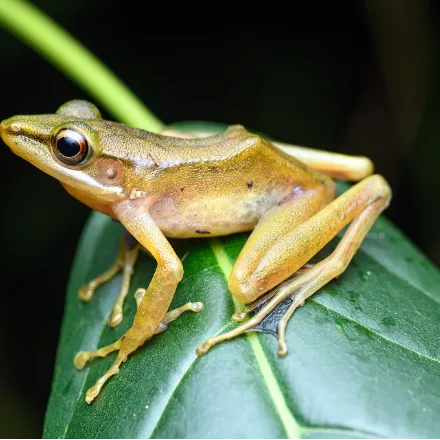
White-lipped Frog Regular
Chalcorana labialis
A clean white stripe along the upper lip, and a call like two stones being tapped together.
Where: Rocks and vegetation beside clear forest streams in the south; Khao Sok and Hala-Bala. Best: May-Oct, at night. Often the dominant sound along southern forest streams after dark.
Practical notes for December
December is peak season for both foreign and Thai visitors, so book parks, raft houses and liveaboards well ahead, and expect popular sites to be busy at weekends. Nights are genuinely cold on the northern and central plateaus, into single figures at Khao Yai, so pack a layer. The Andaman dive season is open and building towards its February peak. Park fees, opening seasons and closures are set by the Department of National Parks, and are worth checking before you travel rather than on arrival.
Find December wildlife trips and Andaman liveaboards
Some links on this page are affiliate links. If you book through them, Wildseer may earn a small commission at no extra cost to you.
Frequently asked questions
Is December a good time for wildlife in Thailand?
It is the best all-round month. Dry forest access, calm Andaman diving and the peak of the wintering shorebird season all coincide.
What can you not see in Thailand in December?
The rainy season animals: most frogs, many snakes, and the moths, beetles and mantids that appear at lights between May and October.
Where should you go in Thailand in December?
Kui Buri or Khao Yai for large mammals, Kaeng Krachan for birds and cats, the Inner Gulf for shorebirds, and the Similans or Hin Daeng for diving.
Explore Thailand wildlife by group
- Mammals of Thailand
- Birds of Thailand
- Reptiles and Amphibians of Thailand
- Fish of Thailand
- Sharks and Rays of Thailand
- Reef Invertebrates of Thailand
- Insects and Spiders of Thailand
- Wildlife in Thailand in July
Part of the Wildlife in Thailand guide.